

By Katie Myers, Contributing Writer
During the recent streak of extremely cold temperatures throughout the Blue Ridge region and Tennessee Valley, the two major utilities that serve western North Carolina experienced the highest power demand ever recorded, representatives from both utilities said.
Duke’s new power record was set Jan. 30 at 37,387 megawatt-hours of electricity across the utility’s coverage area, beating out a previous record set in 2015. The Tennessee Valley Authority set records of their own on Jan. 29 at 35,319 megawatts. Over the course of the extreme cold snap, the federally owned utility asked customers to reduce power usage as much as possible to prevent blackouts.
Duke Energy provides energy to 2.8 million customers across the Carolinas, plus 7.8 million customers across the Southeast and parts of the Midwest. Bill Norton, spokesperson for Duke, said population growth in the region is part of the picture, but not all of it.
“You also have growth in electric vehicles,” he said. “And you know, data centers. You put all those together.”
Norton said Duke has been trying to diversify its energy mix to meet that need.
3 times the power
Scott Brooks, a spokesman for the TVA, concurred, said the population in the Tennessee Valley is growing at about three times the national average.
The TVA provides energy for the Tennessee Valley and some of the Blue Ridge region, which has seen its own increase in population. Brooks says the population spike came directly after the COVID-19 pandemic as remote workers relocated to the region.
Beyond more people using energy, data centers and E.V. manufacturing have also been relocating to the area, he said.
The Southeastern “battery belt,” which includes North Carolina, has seen explosive manufacturing growth since clean-energy investments from the Biden administration incentivized more E.V. battery factories. These centers are energy-intensive, putting more strain on the grid, and nationwide have nearly tripled projections in energy use growth for the country.
The largest data centers in the United States take up as much energy as about 80,000 households.
Brooks said TVA needs to add a lot more generating capacity to keep up with these energy needs and is making investments to ensure it can scale up quickly.
“Increasing investment in natural gas in particular,” he said, “allows us to meet demand as it rises and falls. We’ve been able to show that our system is not only resilient but also flexible.”
Plans for the future
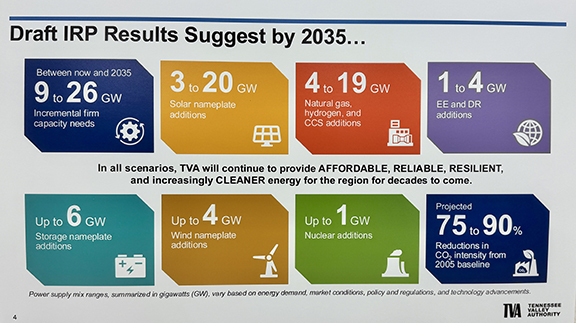
Both Duke and the TVA recently shared their future energy plans, which both developed over the course of the past year, and propose to increase their outputs through additional solar, increases in natural gas use and other plans. Environmental advocates are against an increase in fossil fuel use such as methane gas.
In early November, North Carolina regulators accepted Duke’s Consolidated Carbon & Integrated Resource Plan, which incorporates plans to shut down coal plants and increase alternative energy sources.
As it stands, Duke Energy plans to build more than 3,000 megawatts of solar, 2,400 megawatts of offshore wind and 1,100 watts of battery energy storage by 2031. That’s a fair amount, but critics say it’s still not sufficient for future growth.
Solar energy advocates in North Carolina say this investment in alternative energy is progress but wish renewable energy sources and energy efficiency could fill a larger share of the demand instead of a planned 9 gigawatts of new gas plants by 2030. The utility has said these plants could be converted to hydrogen in the future.
Meanwhile, TVA reps have said a .8% rate of growth in demand is anticipated over the next decade. Because the utility has slowly been shutting down its coal plants to comply with national climate goals, it is seeking to diversify its energy mix.
TVA hopes to offset 30% of the growth in their electric load through energy efficiency programs that will allow homeowners and businesses to reduce their energy use.
Community concerns
The utility is also doubling down on plans to convert its fleet of coal plants to gas and build new pipelines to accommodate the transition, a nearly $9 billion buildout. TVA’s plans to expand gas mean it’ll still be just as reliant on fossil fuels in 2030 as it is today, according to the company’s reports.
These plans have been controversial, raising concerns from community members in the path of the pipelines and from climate advocates who want to see the utility on a quicker path to cutting carbon emissions.
“It doesn’t make sense to me to increase our reliance on gas at this moment,” said Maggie Shober, a research director for Southern Alliance for Clean Energy, a climate advocacy group and think tank based in the Southeast. “It’s not necessarily easy to go out and weatherize a bunch of homes, but it’s what we should be doing.”