
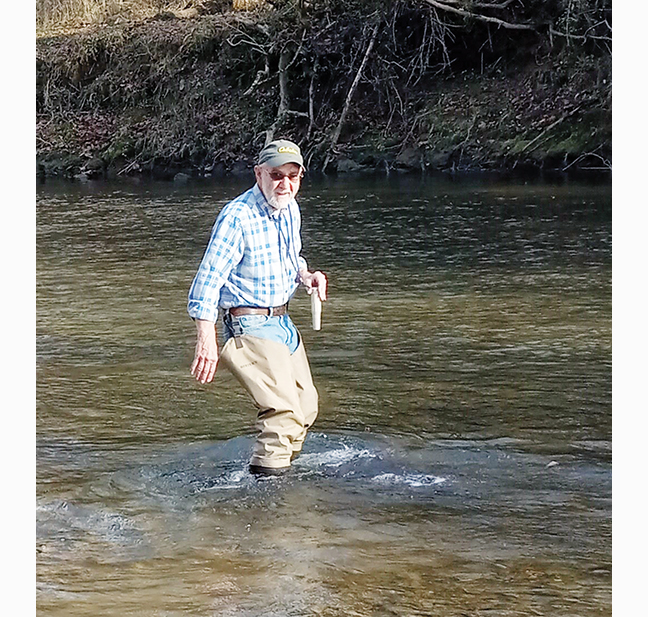
Marble Seventy-six-year-old Ken Kloeblen always knew that when he retired, he’d do much more than tie flies and fish for trout. He’s the type of man who has always stayed involved with his community and did what he could to contribute to its well being.
Four years ago, after finding a piece of real estate paradise that backs up to a stretch of the Valley River, he noticed big tires lodged in the silt. With a borrowed tractor and winch, he wrangled them out. One was a giant tractor tire and its metal rim. Ultimately, he removed another 250 pounds of debris from the river, including lots of bottles and aluminum cans, as well as several 50-gallon drums.
That experience combined with information from a trout-fishing group led him to volunteer for MountainTrue.org, a group dedicated to environmental causes including the protection and restoration of water quality in the western North Carolina and northern Georgia mountains.
On a monthly basis, Kloeblen dons hip waders to obtain water samples from behind his home. He also monitors a second Valley River site and a Britton Creek site, both in Andrews.
The outdoorsman notes weather conditions, the water level and its clarity. After testing the samples, he records his findings for the water’s temperature, conductivity, dissolved oxygen and PH levels. From May through October, when recreational use of the area rivers and lakes is in full swing, he and the other river monitors also tests for bacteria levels.
Results are entered at adoptastream.georgia.com, a state government website that tracks water testing sites from eastern Tennessee to northern Florida. The ongoing data dump from Kloeblen and his like-minded counterparts is available to anyone who wants to stay on top of water quality in their respective communities.
Even more impressive is the fact that the extensive database has proven to be an invaluable tool for scientists. Researchers, builders and town planners also make use of the data.
The good news
Kloeblen is happy to report that all three of his test sites are clean, adding that he’d drink the water in an emergency situation. In fact, a recent Hiwassee River watershed report indicates that water quality at all test sites in Cherokee County is good overall, and area lakes are mostly unbothered by pathogens.
Hiwassee Lake at Hanging Dog was this year’s best local site with an average E. coli count of 6.5 CFU/100mL – that’s 6.5 colony-forming units, or microbes, per 100 milliliters of a singular water sample. By comparison, the Environmental Protection Agency’s safe guideline for recreational waters is 235 CFUs.
Not-so-good news
Sadly, the lower end of the Valley River continues to be on North Carolina’s list of impaired and threatened waters. Furthermore, Konehete Park at the Murphy River Walk was this year’s worst testing site with an E. coli count of 914 CFUs. It failed to pass the EPA’s guideline for recreation waters 80 percent of the time it was tested this summer.
Primary causes of the pollution are leaking septic systems and poor farming practices, said Callie Moore, western regional director for MountainTrue. A burgeoning Canadian geese population is another culprit. However, upstream testing in Andrews and Marble indicate that the E. coli issue is contained to the lower third of the Valley River system.
Similarly, the Sweetwater Creek Watershed in Clay County failed to pass the EPA’s recreational use standard 40 percent of the time it was tested. Again, animal farming is believed to be a primary cause.
Another contributor to watershed quality is heavy rainfall and resulting stormwater runoff – as indicated by the worst E. coli readings of the year for the Hiwassee River watershed being recorded during the first week of September, right after Hurricane Ida dumped four inches of rain in 48 hours.
What you can do
- Stay informed. While some polluting factors might be out of your control – outdated stormwater infrastructures, for example – you can support organizations that petition state legislatures for environmental programs and funding. One such effort by MountainTrue would secure money to help farmers erect fencing that would keep livestock out of the rivers and streams. MountainTrue is also lobbying for the reinstatement of Waste Discharge Elimination or WaDE, a program to identify and repair leaky septic tanks.
- Don’t litter and don’t dump. Heavy rainwaters carry trash that ultimately lands in the watersheds. And contaminants in the water harms wildlife, fish, and life-generating estuaries.
- Contain yard debris. If you live in an area that is prone to flooding, try to remove or contain items that could be swept away in floodwaters. Old appliances and tires are a few examples.
- Volunteer. Become a certified water monitor; MountainTrue particularly needs testers west of Murphy. You can also participate in a river cleanup or help at a live staking event – that’s planting cuttings from dormant trees along stream and riverbanks to help stop erosion. For details, contact the MountainTrue office in Murphy at 837-5414.
Ultimately, Kloeblen said our rivers and streams are ever-changing, living entities. As earth’s human inhabitants, we all share the responsibility to protect them.
“When I put my hand in the water,” he said, indicating the river behind him. “I’m touching the past, and I’m touching the future. We must keep our waters clean.”