

 |
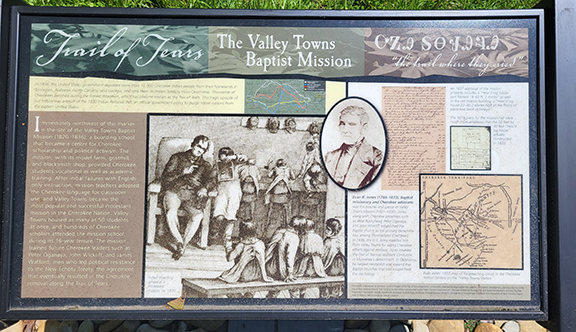
Where U.S. 64 splits the fields alongside the Hiwassee River, bridging the river that forms the border between Cherokee and Clay counties, is an expanse of land still known as Mission Farm. This location marks the most successful mission to the Cherokee, the Valleytown Mission.
The story of the mission began with the Cherokee treaty of 1819, when the Boston-based Baptist Foreign Mission Board endorsed a single mission in Peachtree, to be managed by Humphrey Posey from Georgia. He ran the mission until 1821, when a newcomer arrived, Evan Jones.
Jones was born Welsh, educated in England and worked in London dry goods. While there, he attended the Methodist Church. In 1821, Jones left England for Pennsylvania, where he joined the Rev. Thomas Roberts’ Welsh Baptist Church.
When Posey left his mission job to pastor a church in Franklin, Roberts was called to replace him. Roberts asked for help from his Pennsylvania church congregation to join him at the mission. Four families chose to go. One of those was Evan Jones’.
The Valleytown Mission was established to teach Cherokee boys to become farmers, and as one source said, “to teach Cherokee girls to become farmer’s wives.” The Rev. Evan Jones started as a teacher there until 1824, when he was ordained a Baptist minister and appointed superintendent of the Valleytown Mission. He would minister to the Cherokee for 47 years.
The Valleytown Mission boasted a model farm, gristmill and blacksmith shop, housing as many as 50 Cherokee students at a time.
At first, Jones preached with Cherokee Jesse Bushyhead translating, but to be more effective Jones learned to speak the language and would eventually translate the Bible into Cherokee. Along the way, he converted more Cherokee to Christianity than any other 19th-century missionary, and trained Cherokee ministers – including Jesse Bushyhead, who was the first ordained Cherokee Baptist minister. Jones also established a 200-mile circuit of churches.
When Jones’ wife died in 1831, he remarried Pauline Cunningham, an assistant at the mission.
The Indian Removal Act of 1830 had already passed and been signed into law, and the clock was ticking for the Cherokee. Some white men were biding their time to take advantage of the circumstances and to plot to obtain the Mission Farm after the Cherokee were forced to Oklahoma. The Rev. Evan Jones stood in their way.
His sister-in-law, Cynthia Cunningham, came to the mission in January 1832 to visit, successfully concealing she was also in the final weeks of pregnancy. Cynthia died at the mission, but it was not until the women removed the bedcovers that they discovered she had delivered a baby, now dead, and probably bled to death during childbirth.
There was a further complication. Cynthia was not married – a serious scandal in the 1830s, especially within the confines of a Baptist mission.
Jones made the mistake of directing them to bury his sister-in-law with the baby in the same coffin and keep the baby’s birth a secret. Thus he unwittingly fell into the trap of two men who were waiting for just such an opportunity to weaken the good standing of the head of the Mission.
Their plan was simple as it was devious. The U.S. government had been encouraging Cherokee to relocate to Oklahoma voluntarily since 1830 and stated that Cherokee who would go to Oklahoma would be paid for any improvements for which they had added to the value of the property.
One of the men contrived to file for the improvement payment, and upon receiving payment would sell it to David England, who was married to a Cherokee woman, who could then in turn be paid again by the government for the same improvements when he vacated the property for Oklahoma.
When England learned of the disposition of Cunningham’s child, he rode 40 miles to Franklin (the closest white town) and swore a complaint of foul play on Evan Jones. He and his wife were charged with murder, the first clergyman in America to face the charge. For a time, it appeared the plot might pay off – until a court inquiry and a church investigation cleared both. Jones remained ministering to the Cherokee.
Jones urged resistance to the removal, so much that the U.S. military expelled the vocal Jones from the Cherokee nation. Undeterred Jones still ministered to the Cherokee outside the nation at Fort Cass (Charleston, Tenn., today).
After the Cherokee received permission to transport themselves to Oklahoma, Jones was chosen by Chief John Ross to be assistant conductor of the Situwakee detachment, since the detachment leader could not read or write. This group, comprised of those removed from here, embarked on what the Cherokee called “The Trail Where We Cried.” Of about 1,033 people under Jones’ care, only 71 died, far fewer than that cited by some for the death rate on the trip.
Bushyhead conducted a second group from here, also with minimal deaths.
Jones remained in Oklahoma, establishing the Oklahoma Cherokee Mission in 1839, and starting the first Cherokee publication there.
When Jones formed an anti-slavery society in 1859, he was forced to flee his mission during the Civil War. In 1865 when he was 76 years old, Jones was honored for his missionary work with a $3,000 gift – and Cherokee citizenship.
Jones is buried in Tahlequah, Okla., among the graves of the people to whom he dedicated his life.
Bruce Voyles’ local history column runs every other week in the Cherokee Scout. Email him at RoadsLessTraveled@cherokeescout.com.