
By Glenn Harbison
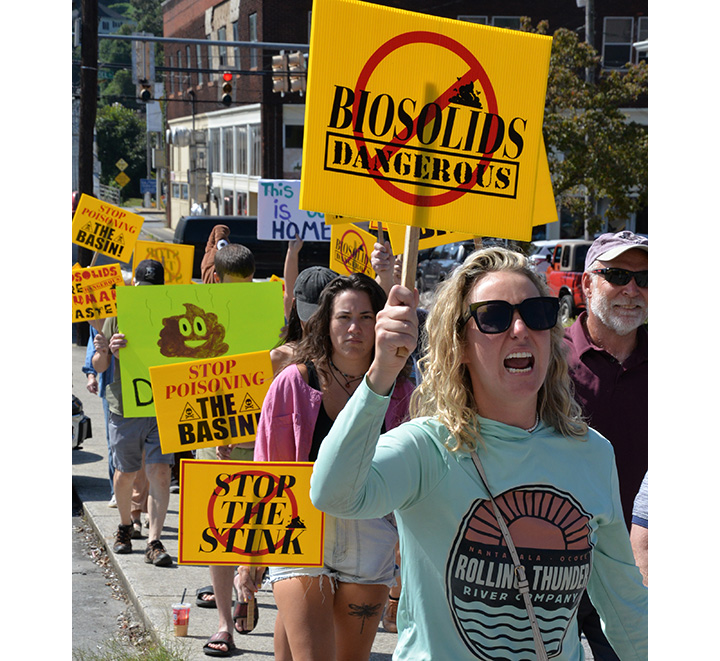
Copperhill, Tenn. – Cries of “protect our children” and “stop the crap” echoed through the streets of Copperhill and McCaysville, Ga., on Oct. 4 as biosolid protesters marched to the Copperhill City Hall.
Worries over the smell dominated the concerns heard, but voices also warned of dangers to area water. The group of citizens gathered for the noon event was small but vocal, as they continued what has become a far reaching effort to stop the spread of biosolids at Copperhill Industries.
Sludge – human waste – from three wastewater treatment plants in Cobb County, Ga., arrives at Copperhill Industries in the form of Class B biosolids. It is then treated with lime and spread on the ground as Class A-EQ biosolids, the same grade that is sold as fertilizer.
Biosolids are known to contain PFAS (forever) chemicals, but the U.S. Environmental Protection Agency has not ruled what amount, if any, of these chemicals are safe.
Joining the citizens fight to stop the spread of biosolids, the Polk County Board of Commissioners is aligning with commissions in Bledsoe and Grundy counties in hopes of establishing private acts, law enforcement in Georgia has effectively stopped trucks carrying biosolids from coming through the town and a Cherokee County, N.C., commissioner has joined the fight.
At the heart of the Oct. 4 protest were renewed complaints of the odor from biosolids forcing students inside at Copper Basin schools.
Crystal Taylor, the parent of a Basin student, said, “He was so disappointed. He said, ‘We were going to go outside for STEM and do a project, but we didn’t get to’.”
When Taylor asked why, her son’s reply was, “Because the teacher said it was too stinky.”
“That just takes away from my son’s learning,” she said.
Dr. James Jones, director of Polk County Schools, confirmed the problem in a statement to Channel 9 News of Chattanooga.
“I can say that at times, the smell from the biosolids is so bad teachers have told me they have to come in because the students are complaining so much,” he said.
However, a spokeswoman for the Tennessee Department of Environment & Conservation said in an email, “The agency has not received any recent odor complaints regarding the site.”
She said TDEC maintains a website at tn.gov/content/tn/environment/program-areas/rem-remediation/ongoing-projects/copper-basin.html that lists two email addresses where complaints or questions can be sent.
In an email June 5, Buddy Haynes, owner of Copperhill Industries, wrote that he was “very, very confident the odor issue will soon be over.” He also referred to conversion of biosolids from Class B to Class A-EQ at the facility before spreading in order to finish up reclamation “hopefully without any odor.”
The Polk County Commission is waiting on word from the Bledsoe County Commission as to progress with a private act to be introduced in the Georgia Legislature. That act would allow citizens to vote for or against the spread of biosolids in their counties.
Polk County Executive Robby Hatcher said Monday he has not received an update, but was going to contact Bledsoe County Mayor Gregg Ridley the next day. A biosolids item is on the Polk commission meeting agenda for Oct. 19.
Transportation of the sludge has been a major concern among residents. Efforts by McCaysville and Georgia authorities have worked to keep trucks from coming through the small town. Early on, Haynes said he requested trucks not to come through downtown Copperhill/McCaysville.
A Polk County sheriff’s deputy issued a citation to one truck after he witnessed it leaking sludge onto U.S. 64 after coming up the Ocoee River gorge. However, the citation was nolle prossed (dismissed) by the 10th Judicial Circuit District Attorney’s Office, saying it did not meet the statute.
The trucks have been seen on various local roadways, including coming through North Carolina. Cherokee County Commissioner Jan Griggs wrote on Facebook, “I am working with officials from Polk County, Tenn., on this issue. We are having our well tested as a precaution since we live only a few miles from the Tennessee border.
“Our drinking water is a major concern for everyone. I will continue to provide updates as I get them.”
Two speakers at the Oct. 4 protest concentrated their remarks on the affects biosolids could have on water. Mary-Katherine Horne, a rafting guide on the Ocoee River, warned of the effect runoff could have on the quality of water.