
 |
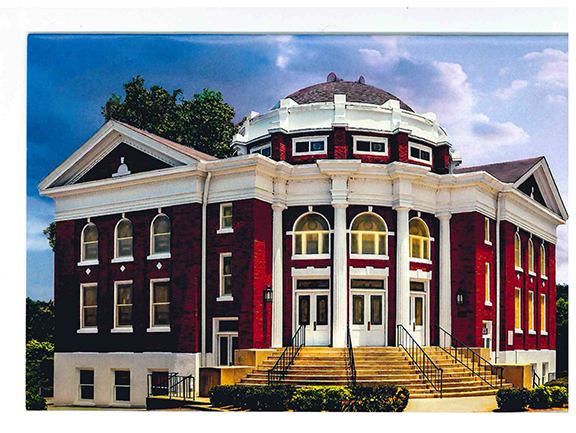
I am often amused in warm weather to see curious tourists standing out in the middle of Valley River Avenue taking photos of our beautiful old church building in Murphy.
“Is that your courthouse?” they’ll ask. “Is it a library?”
I tell them no, it’s the Methodist church that my family and I have attended for years.
“Can we see inside it?” is usually the next question.
It’s kept locked for security reasons these crazy days, but sometimes I’ll go get a key and take them in.
The beautiful stained-glass windows, lit up inside by the sun, draw the most compliments. But the polished wood and pipe organ get their share, too.
First United Methodist is officially a century old this year, the cornerstone being laid in 1922. A big celebration is being planned for May, with Bishop Carter from church headquarters in Charlotte scheduled to be the main speaker.
Local history
Murphy’s history is all around when you stand in the sanctuary and look carefully.
The big windows dominate the space, brightly colored slivers of colored glass pieced together to create Bible scenes. We knew the centennial celebration was coming, so a few years ago our budget allowed some $70,000 to be spent in cleaning and refreshing our windows by a specialty company that performs this service nationwide.
Donors in the 1920s who financed individual windows got their names painted on each one.
Here is a large window and the donor’s name is familiar, that of Joshua Harshaw. This, of course, was a relative of the original Joshua Harshaw, a Brasstown plantation owner who gave both Harshaw Chapel and the cemetery land that surrounds it.
Smaller windows recognize veterans of the recent world war but give it no number, for it was the only world conflict they had seen in 1922. Hitler, Pearl Harbor and the atomic bomb were way off in the future somewhere, along with the deaths of millions.
Methodism and Murphy
Our church’s history committee is deeply involved in the centennial and has published a brief summary, from which some of this column is taken.
Methodism was started by brothers John and Charles Wesley, who both lived briefly as young men in coastal Georgia before returning to their native England, where they both died as old men about the time of our revolution.
Although recognized as the “father of Methodism,” John Wesley remained a minister of the official Church of England all his life and disapproved of the American revolution, saying we should all strive to be proper Englishmen under the king.
The Wesleys’ choice to lead the new denomination in America was a sturdy young blacksmith named Francis Asbury, who put a small army of horseback preachers called “circuit riders” into action up and down the states along the East Coast in the early 1800s. Methodism spread like wildfire.
Growing church
Harshaw Chapel downtown was officially dedicated in 1868, and it is thought to have been in use for several years prior. The congregation grew and by 1919 had purchased the present site from a Dr. Meroney for the planned new larger church.
It was built in the mid-1920s, and construction lagged due to finances. The Cherokee Scout in an editorial urged its completion – as did downtown business owners, who finally set aside a certain day to contribute a percentage of their sales to the church project.
A 1926 photo shows a handsome building completed, about the time Murphy’s main street of mud and dirt was being sealed under a layer of concrete, the long-awaited Atlanta-to-Asheville highway.
Wally Avett first wrote for the Cherokee Scout as editor in 1969. His books are available as signed copies at the Scout office in Murphy. Call him at 837-5531 or email wallyavett@gmail.com.