
 |
This is the first of a series about Elvis Presley.
Sam Phillips, owner and record producer for Sun Studio in Memphis, Tenn., was looking for a “ground-breaking” sound, when a shy, 18-year-old teenager named Elvis Presley walked into his recording studio with his guitar. The secretary asked him who he sang like, and he replied, “I don’t sound like nobody.”
His first record was “That’s All Right” and was released in 1954 on the Sun label, setting off a firestorm of “rock and roll” music, and the rest was history.
I had loved Elvis Presley since I was 4 years old, and I remember my teenage sister playing “Jail House Rock” on her red and white record player over and over, when the recording was released on the RCA label in 1957. The song was an anthem for youthful rebellion, inspiring teenagers to break away to a new freedom of expression, and they did.
My father worked in Florida for the Bartow Airbase in the 1950s for many years until it closed and all operations were moved to Mac Dill Air Force Base in Tampa, Fla. He later worked as the payroll clerk for his nephew, Jerry Birchfield, who had moved from Andrews to operate a citrus business. But my mother hated Florida and she missed her family here in the mountains, so I would start school in Andrews and during Christmas break Mother and I would go back to Florida, and I would finish the school year there.
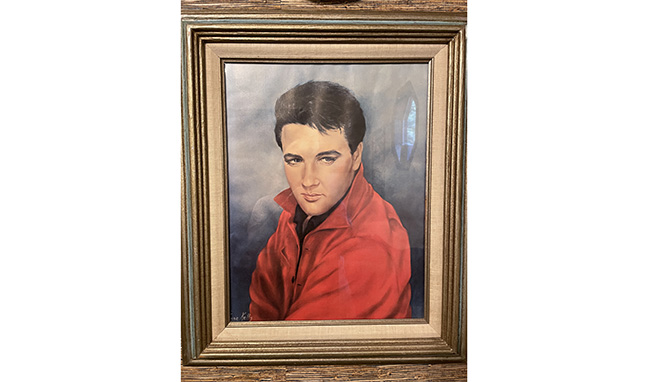
My mom worked at McCrory Dime Store and while my Dad and I waited for her to get off work, I would visit the record store next door. There was a 16x20 picture of Elvis Presley on the wall along with other singers, and every time I went in that music store, I asked the owner if he would sell me that picture, but the answer was always “no, I can’t.”
Months went by, and one day when I walked in the store, the man said, “Hey, do you still want to buy that picture? The company is changing out the look of the store and is getting rid of all this.” I said, “Yes, I do,” and he told me it was $25, which back then that was about all my Dad made in a week. So, I ran back to the car and told my Dad that he was going to sell me the picture, and he said, “Twenty-five dollars is a lot of money,” but he knew how much I wanted it and gave me the money to buy it.
My parents made the decision to move back to Andrews permanently in 1967 because I would be in high school. My Dad returned to Florida to pack up our personal belonging and what did not go with the sale of the house.
I told him the only thing I want is my Elvis picture which hung above my bed. But when he returned to Andrews, he had forgotten to pack it. I was devastated, it was my prize possession at 15 years old, and I cried for weeks on end.
But as fate would have it, I was working for Dr. Don Ambler in the 1970s. He and his wife, Gayla, went to visit some relatives one weekend and a miracle happened.
The aunt was reframing her children’s baby pictures and a picture of Elvis was behind one of them. Gayla asked her what she was going to do with the picture and told her she knew a girl that would love to have that.
I went to work that Monday and Gayla came in with a large wrapped gift and told me to come into Dr. Ambler’s office. Patricia Postell, the other assistant, and the secretary, Martha Postell, was there and then Gayla gave me the present and told me to unwrap it.
I could tell it was a picture, and when I tore the paper off, it was the same picture that I had bought at the record store when I was 13. I could not believe it, and I cried uncontrollably.
Artist June Kelly painted the picture in 1964 and the copies were printed on canvas. The owner of the record store told me when I bought it, they were hung in record stores throughout the country.
I never knew how Gayla’s aunt ended up with a copy, but I am forever grateful. It hangs in my “Elvis Room” today.
Kandy Barnard is a columnist for the Cherokee Scout. To talk about the Andrews Valley, call her at 361-3268 or email kandybarnard@gmail.com.