
Murphy – State Treasurer Dale Folwell, by all outward appearances, is a thrifty man.
Though he presides over the 26th largest pool of public money in the world – yes, the world – he uses coupons at Supercuts, drives a state-owned economy car and travels with an entourage of one – his wife, Synthia.
Compare that to the state transportation secretary, who with a somewhat larger entourage flew from Raleigh to Knoxville, Tenn. – the airport in Andrews was fogged in – in a state-owned airplane to attend a highway ribbon-cutting ceremony in Robbinsville last year.
Folwell said he has never even been in a state-owned aircraft.
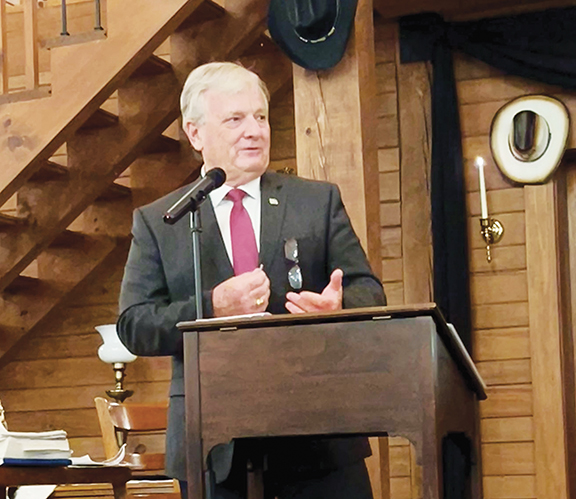
Folwell was invited to be the keynote speaker at the Cherokee County Chamber of Commerce annual dinner meeting Thursday, and since he was going to be in western North Carolina – the real western North Carolina, not Asheville – he looked for other things to do to maximize trip efficiency.
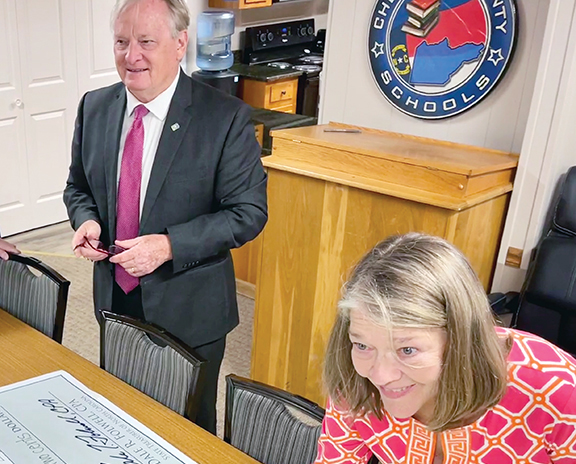
Folwell added stops in Hayesville and Murphy, where he visited Cherokee County Schools Central Office to present a check for $2,249.62 due to the district from unclaimed funds.
Folwell also presides over nccash.com, the state’s $1.09 billion unclaimed property fund. He carries stacks of cards around promoting nccash.com and hands them out like pieces of candy.
Check it out, put in your name and see if you are owed money from the fund. The author of this article tried and found that there are a lot of people in the state with the same name. Most of the others by that name were eligible for small refunds in the $10-$15 range, but the author was not among them.
The $2,249.62 check for Cherokee County Schools was no insubstantial amount. Superintendent Keevin Woody said it would go to benefit students.
Though Folwell has been to Cherokee County before, this was his first visit since declaring his candidacy for the Republican nomination for governor in a crowded field dominated by Lt. Gov. Mark Robinson. During appearances at the schools office and chamber dinner, Folwell kept his comments fairly apolitical – but not without criticisms.
“I have all the right enemies in Raleigh,” he said at the schools offices. “I’m glad to be here in Murphy.”
The state’s retirement fund, over which he presides, is 89 percent funded with premiums and co-pays flat over previous years, he said, proudly adding that the pension plan is the most efficient in North America. He takes that part of his job seriously.
“People only call us because of life-changing events. Most are blessings, some are not,” he said about the state’s benefits program for retired and disabled state employees, which includes teachers.
With competition just over the Georgia and Tennessee lines, Murphy can’t be a high-cost place to work or do business, Folwell added.
North Carolina has received back-to-back recognition for being the top state for business in the nation, due in part to the state’s balanced budget and AAA bond rating ensuring that the state can borrow money at the lowest interest rates.
In August, the United States’ credit rating was lowered to AA+ by Fitch Ratings, one of the nation’s three major credit rating agencies. Interest rates and inflation are consequences.
“This is not Democrat, not Republican – both are equally to blame,” he said.
People are exhausted with politicians attacking people and not policies, Folwell said. He’d rather see people of different parties uniting to do the right thing.
His sharpest words were directed at health systems that he refers to as the Health Care Cartel – a group that seeks to restrict competition and raise prices.
Folwell referred specifically to HCA Mission Health, a medical center in Asheville owned by Hospital Corporation of America, a Nashville-based company that owns 186 hospitals and about 2,000 surgery centers, freestanding emergency rooms, urgent care clinics and physician clinics in 21 states and the United Kingdom.
He said these health-care organizations conceal their prices, weaponize credit reports and place liens on debtors’ properties.
“The cartel doesn’t want you to know how much you’re paying for health care,” Folwell said.
He said many of these organizations are “disguised as nonprofits,” whose chief executives earn multimillion-dollar salaries but who don’t provide the level of charity care expected of them.
“CEOs are putting profits over patients,” Folwell said.
He has been state treasurer of North Carolina since January 2017 and was re-elected in 2020. In 2013, when Folwell was named assistant secretary of commerce, he led a successful effort to pay off $2.7 billion in federal unemployment debt and build a $1 billion surplus in just 30 months.
Folwell earned bachelor’s and master’s degrees in accounting from the University of North Carolina in Greensboro.