
By Victor Skinner, The Center Square
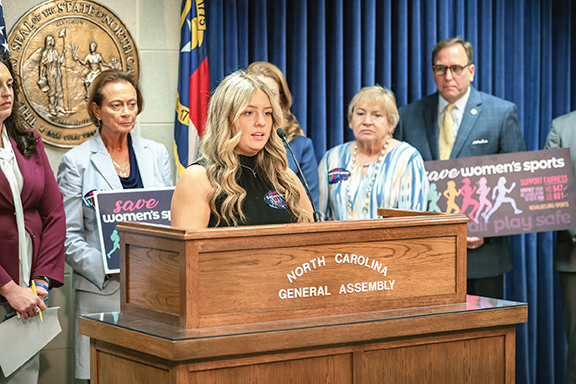
Raleigh – North Carolina legislation to protect the integrity of women’s sports will likely include college athletics and could clear the General Assembly as soon as this week, according to a bill sponsor.
Sen. Vickie Sawyer (R-Iredell) recently said Republicans have agreed on a final version of the Fairness in Women’s Sports Act lawmakers approved last month. Both versions of the bill – House Bill 574 and Senate Bill 631 – cleared their respective chambers by wide margins, with three House Democrats joining with the majority to ban transgender females from competing in girls sports.
HB574 targeted sports competitions at the middle, high school and college levels, while SB631 would apply only to K-12 schools. Sawyer told the media on Friday she expects the final version to reflect the House legislation, though she did not elaborate on the route lawmakers will take.
Sawyer noted that she was initially concerned that including colleges would impede passage, but is backing the broader bill after consultation with colleagues.
The state legislation follows more than 20 states that have approved similar laws.
The N.C. High School Athletics Association allows student-athletes to petition to play on teams that do not align with their biological sex at birth with documentation from a medical provider, and has approved the vast majority of petitions since 2019. Most were biological girls playing on boys teams.
Last fall, girls volleyball player Payton McNabb suffered serious injuries when a transgender player spiked the ball in her face during her final season at Hiwassee Dam High School. She told lawmakers last month she continues to suffer partial paralysis on her right side, chronic headaches, learning challenges and impaired vision from the incident.
“I might be the first to come before you with an injury, but if this doesn’t pass, I won’t be the last,” McNabb said.
She was joined in promoting the legislation by Riley Gaines, the University of Kentucky’s most decorated swimmer. Gaines lost a race in the 2022 NCAA Championships to Lia Thomas, a Penn swimmer who competed the previous three years for the Quakers on the men’s team and was allowed to use the locker room with Gaines and other women.
Republicans in the U.S. House of Representatives have also voted to ban transgender athletes from competition in girls sports for K-12 schools and universities that receive federal funding, but passage in the Democrat-majority Senate remains unlikely.
Earlier this month, North Carolina Superintendent Catherine Truitt formally opposed Title IX regulations proposed
by the Biden administration for transgender athletes, arguing they undermine the intent of the law.
A fact sheet produced by the U.S. Department of Education contends the proposed rule “would establish that policies violate Title IX when they categorically ban transgender students from participating on sports teams consistent with the gender identity just because of who they are.”
Truitt argued it’s possible to “respect individual gender preferences without reconstructing Title IX to inherently disadvantage women,” but “biological sex must be the basis for sporting events,” citing research on performance advantages for male athletes from Duke University. At its core, Title IX was created and signed into law in 1972 to increase opportunities for female athletes.
Twenty-five of the nation’s 26 Republican governors also sent a letter to urge the Biden administration to shelve the proposal, pointing to pending litigation before the U.S. Supreme Court.