
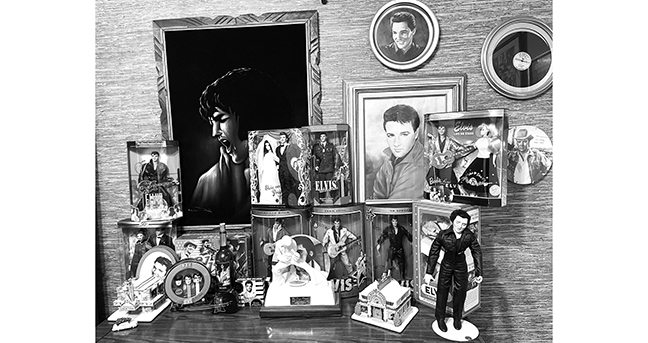

 |
This is the second of a series about Elvis Presley.
Just as Elvis Presley impacted my life as a child, he made an impact on millions of people throughout the country, even in Andrews.
Doris White, sister to Iris Plemmons, worked at Maw Wood’s Cafe on the corner of Locust and Main streets when she was a young teenager. Doris told me she was in the back doing dishes when the other young girl came running to the kitchen and told her she thought Elvis Presley had just walked into the restaurant with his band.
Doris said, “I threw that dish rag down, smoothed out my apron and we walked to the dining room door. And there he was, in the flesh, sitting on a barstool with his back to the wall. We knew that Maw Wood did not put up with any foolishness, so we did not approach him. He was so beautiful in a black shirt and two-toned jacket, and when he smiled, we just about fainted. I remember he ordered a cheeseburger and French fries.”
From the front door of the cafe, the bar started on the left against the wall and curved around down toward the kitchen, then the booths were all along the windows on the right. According to Doris, Elvis took the first barstool and turned to lean up against the wall. His band members left a couple of spaces, then sat in a row down the bar.
Doris said they heard him tell Maw Wood that they had been singing in several places and were on their way to the Louisiana Hayride in Shreveport, La. They drove up and parked the car right in front of the cafe on Main Street.
Doris said, “They had their instruments tied on the top of the car, and after they finished eating, Elvis thanked everyone for the good food. He was so mannerly and humble, and nobody had a camera back then.”
If you have not seen the new “Elvis” movie, you should go. It depicts his life growing up in the poverty of the South and rising from the dusty fields of Tupelo, Miss., to the rhythm and blues of Beale Street in Memphis, Tenn. Austin Butler, who starred as Elvis, and Tom Hanks, who portrayed Col. Tom Parker, should be up for an Oscar, as their performances were amazing.
Elvis’s daughter, Lisa Marie, praised Austin Butler, and said, “He channeled my Dad, and honored him.” She said it was an emotional experience and this was the movie that her Dad would have loved. She was so glad the director, Baz Luhrmann, had finally shown where the heart of his music grew from, which was the black community churches and Club Handy on Beale Street in Memphis, where the “blues” began, a fact that white promoters continually washed over.
Elvis said, “Truth is like the sun. You can shut it out for a time, but it ain’t goin’ away.”
Elvis brought the soul of rhythm and blues that he had learned at Club Handy to the white stages of America, because “he
was a white boy that sang like he was black.” He was friends with B.B. King, Big Mama Thornton, Little Richard and Chuck Berry, who were musical icons to whom he humbly gave credit as the birth of “rock and roll.”
Elvis understood the tension of racism and the absence of equality in the 1960s, because he had lived it, he had seen it, and he recognized the value of other cultures. He blended the differences of the black culture into his music and he became the “King of Rock and Roll.”
From the haunting lyrics of “In the Ghetto” to the healing words of “If I Can Dream” that he sang at the end of the live NBC-TV performance during the “1968 Comeback,” it was a plea for peace at Christmas, in the aftermath of the assassination of Dr. Martin Luther King and then Bobby Kennedy.
Elvis said a reverend once told me, “When things are too dangerous to say, sing.” And he did.
Kandy Barnard is a columnist for the Cherokee Scout. To talk about the Andrews Valley, call her at 361-3268 or email kandybarnard@gmail.com.