
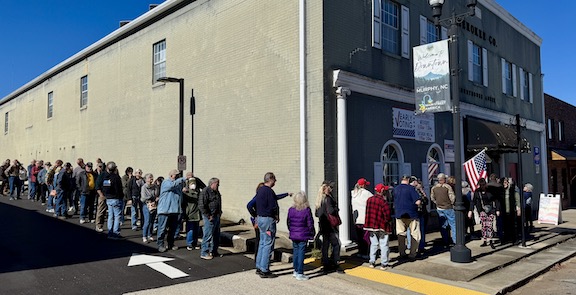
Murphy – Early voting for the 2024 general election began today, with long lines outside the Cherokee County Board of Elections in Murphy from the very start.
Around lunchtime, about 80 people stood in line to vote in this important election, which will determine the next president, vice president, governor, lieutenant governor, congressional representative along with a long line of other key state and county offices.
Among local races, only one is contested – Cherokee County Board of Education District II, with incumbent Republican Arnold Mathews running against unaffiliated candidate Paul Wade Wilson.
What to expect
If you vote early in Cherokee County, here’s what you can expect:
If early voting continues as it was on Thursday, the end of the line will be along the county annex building at 40 Peachtree St. The line continues left around the corner to the building’s front door.
People are ushered inside in small groups, where another line forms in the hallway. Past that is the elections office, where workers check your ID – don’t forget to bring your ID – print out documentation and give you a blank ballot hand-marked with your voter precinct.
You will be asked to verify your information on the documentation before continuing to yet another line down a hallway that stops at the actual room with the ballot boxes.
Voters are allowed in one at a time as ballot machines become available.
Once ushered into the ballot room, the blank ballot is fed into the voting machine and voters are shown how the machine works and how to pick candidates. Candidates’ parties are included with their names.
Once done picking candidates on the touch screen, the ballot is returned to the voter, who then inserts the completed ballot into a collection machine that verifies the votes.
Voters then leave the room and, if they wish, can grab a sticker showing that they voted. They then exit the building out a different door than the one they entered.
The whole process can take an hour so come prepared for the temperature (Thursday was chilly and breezy) and bring something to drink and snack on. Bring a portable chair if you need to, because there are few opportunities to sit down.
Handicapped voters can drive up to one of two parking spots reserved for them along Peachtree Street in front of the building. A wire along the ground detects when a car arrives, so make sure you drive over the wire.
In-person early voting for the 2024 general election ends at 3 p.m. Nov. 2 in all 100 counties. Election Day is Tuesday, Nov. 5.
Ten tips
Statewide, 419 early voting sites opened on Thursday across North Carolina.
“In-person early voting has been the most popular method of voting in recent general elections, and we expect that will continue in 2024,” said Karen Brinson Bell, executive director of the State Board of Elections.
In 2020, 65 percent of North Carolina voters chose in-person early voting as their voting method. And in the presidential election of 2016, 62 percent of N.C. voters cast their ballot early.
The following are 10 tips for voters as early voting begins from the State Board of Elections:
1. Early voting locations. Eligible voters may cast a ballot at any early voting site in their county. For sites and hours in all 100 counties, use the Early Voting Sites Search tool. Also see Early Voting Sites for the Nov. 5, 2024 General Election (PDF). The busiest days for early voting are often the first day and the last couple of days.
2. Candidate info. Sample ballots are available through the Voter Search tool. For information on candidates for the state Supreme Court and Court of Appeals, see the State Board’s Judicial Voter Guide: 2024 General Election. The Guide is also being mailed to all N.C. households. Election officials do not provide information about candidates for other contests, but some media outlets and advocacy groups do. Many candidates also have websites and social media accounts. Being familiar with your ballot choices will help your voting experience go more smoothly.
3. Bring your photo ID. Voters will be asked to show photo ID when they check in to vote. Most voters will show their driver’s license, but many other forms of photo ID will be accepted. Voters who do not have photo ID can meet the photo ID requirement by either (1) filling out a form explaining why they are unable to show ID, or (2) showing their ID at the county board of elections office by 5 p.m. Nov. 14. More information about the photo ID requirement is available at BringItNC.gov.
4. Free photo IDs. Any registered voter who needs a photo ID can get one for free from their county board of elections office during the early voting period, which ends on Nov. 2. For details, go to Get a Free Voter Photo ID.
5. Register to vote. The regular voter registration deadline was Oct. 11. But any North Carolinian who is eligible to vote may still register and vote during the early voting period. Registrants must provide proof of their residence address, which can be a driver’s license or other government document, paycheck, utility bill, or bank statement. For more information, visit Register in Person During Early Voting.
6. Updating registration. During early voting, registered voters may update their name or address within the same county, if necessary.
7. Absentee ballot drop-off. Voters who vote by absentee ballot can return it by mail or hand it to an election official at an early voting site in their county. They can also drop it off in person to their county board of elections office. Voters registered in the 25 counties in the Helene disaster area in Western North Carolina may return their absentee ballot to any early voting site in the state during early voting hours. Ballots will be kept secure and delivered to the voter’s county board of elections for processing. For more information on returning absentee-by-mail ballots, see Detailed Instructions to Vote By Mail.
8. Voting in person instead of absentee. Voters who requested an absentee ballot but have not yet returned it may choose instead to vote in person during the early voting period or on Election Day, Nov. 5. Voters may discard the absentee ballot and do not need to bring it to a voting site.
9. Peace at the polls. All voters should respect the rights of others to participate in the election. Election officials are trained to quickly address incidents that might interfere with a voter’s ability to cast their ballot. Intimidating any voter is a crime. Voters who feel harassed or intimidated should notify an election official immediately.
10. Voters in need of assistance. Voters in need of assistance may bring an eligible person to help them enter and exit the polling place or to help them complete their ballot according to the voter’s instructions. Election officials are also available to help voters. Curbside voting is also available for voters unable to enter the voting site. For more information, visit Curbside Voting.
For more information about early voting, visit Vote Early in Person.