
- Part one of a three-part series.
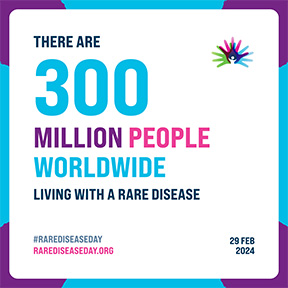
Rare Disease Day falls on the last day of this month. Feb. 29 is the rarest of days, putting an even finer point on the unusual, which for people with rare diseases is usual. The observation has been extended to include the entirety of February.
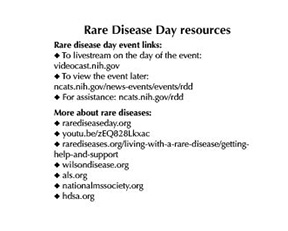
During Rare Disease Month and Rare Disease Day, the National Institutes of Health and its research ally, the National Center for Advancing Translational Science, will live-stream a free, day-long event to be held at its Maryland headquarters.
Exhibitions, panel discussions and other presentations will disseminate the latest rare disease information among patient families, health care providers, researchers and online attendees. NIH will draw attention to collaborations in any stage that are relevant to the development of diagnostics and treatments.
Rare but not rare
The NIH website provides this data about rare diseases in the United States:
- Rare diseases affect fewer than 200,000 people.
- Most people with rare diseases are children.
- Certain rare diseases, like pediatric cancers, can be fatal in early childhood.
- More than 7,000 rare diseases have been identified, including over 500 types of rare cancers.
Do the math
Individually, rare diseases remain uncommon. They are collectively common, however, comprising more than 30 million people in the United States (nearly 10 percent of the nation’s population). Therefore, the rare disease community itself qualifies as a national health crisis, according to NCATS’s own criteria.
Medical costs for the rare disease community are comparable to costs incurred by people with “ordinary” diseases.
In fact, the EveryLife Foundation for Rare Diseases found that the economic impact from a sample of only 379 rare diseases exceeded the economic impact that was estimated for the costliest chronic diseases, such as diabetes and heart disease.
Ongoing struggle
For families with rare diseases, the ongoing struggle to find better diagnostic tools and treatments can be a race against time.
The typical diagnostic method can be illustrated by the expression, “When you hear hoofbeats think horses, not zebras.” But a protracted diagnostic period that rules out more common conditions first, fails to promote quick diagnoses of rare diseases.
Because some rare diseases defy the most common explanations, the rare disease community has adopted the zebra as its symbol.
The research journal Genome found that correct diagnosis for rare diseases usually took four to five years – sometimes even a decade. The prolonged delay between the onset of symptoms and the discovery of an accurate diagnosis leads to complications, including death.
Diagnosis complete.
Now what?
While patients’ diagnoses help them face their symptoms, often that’s the only benefit.
Despite the fact that 80 percent of rare diseases are genetic and may have underlying commonalities, 90-95 percent of all rare diseases don’t have FDA-approved treatments.
Is it rare?
When a disease affects fewer than 200,000 people, it is a rare disease, and it can be found in the NIH rare disease registry.
According to the Parkinson’s Foundation, nearly 1 million people have Parkinson’s disease in the United States, so it wouldn’t be considered a rare disease.
A study funded by the National Multiple Sclerosis Society confirmed that nearly 1 million people are living with the disease in the country, so MS is not rare.
Wilson disease is a progressive genetic disorder where the body stores excess copper in tissues in areas such as the liver, brain and corneas.
Early diagnosis is key for patients with Wilson disease, most of whom are asymptomatic until their 20s or 30s. Their first symptoms are liver related, (hepatic,) neurological or psychiatric.
Treatment to reduce levels of copper can prevent complications in the liver and nervous system and death.
Wilson disease is inherited in an autosomal recessive manner, which means that each patient has received one copy of the mutated ATP7B gene from each parent.
Wilson disease is a rare disease because it affects about 30,000 people in the United States.
Amyotrophic lateral sclerosis is a progressive, neurodegenerative disease affecting nerve cells in the brain and spinal cord. The average age of onset is 55.
Muscle weakness and stiffness are the first symptoms of the disease.
The order that symptoms present and the rate of progression vary, and survival times range from 3-20 years. If functioning does improve, that improvement is always transient.
Most ALS cases lack any genetic or familial cause.
People with ALS gradually lose the ability to initiate and control voluntary movement in the arms, legs, neck and trunk. As a result, the ability to walk, dress, write, speak and swallow is lost.
Because of an inability to control muscles, a person with ALS becomes unable to support their neck and trunk. When it descends to the chest and diaphragm, it disrupts respiration.
ALS is a rare disorder in the United States, with 30,000 people affected.
Huntington’s disease is a genetic, progressive and fatal disease, according to the National Organization for Rare Diseases. It is caused by degenerating nerve cells (neurons) within certain regions of the brain, including the basal ganglia and cerebral cortex.
The basal ganglia helps coordinate body movements and the cerebral cortex is responsible for conscious thought and movement. People with Huntington’s develop involuntary muscle movements affecting the hands, feet, face and trunk.
Movement abnormalities may include uncontrolled, irregular, rapid, jerky movements called chorea, and slow, writhing involuntary movements called athetosis.
People with Huntington’s often have no symptoms earlier in life. Usually between ages 30-50, they begin to lose the ability to coordinate thoughts and emotions, and family members notice personality changes.
Over the next 15-20 years, the person with Huntington’s becomes unable to talk or swallow food.
According to the Huntington’s Disease Society of America, confusion, impairment of memory control, restlessness and agitation ensue. A myriad of psychiatric problems, such as obsessive-compulsive disorder and depression, emerge.
The final stage of the disease leaves the person trapped by their body, unable to move, talk or swallow, completely reliant on others for care.
Unable to convey needs, desires or feelings, the person appears to be a “shell.” However, intelligence, including sense of self, remains intact.
Certain medications help calm the movements, but it is impossible to slow down or stop the progression of Huntington’s.
Death is caused by complications of the disease, like falling, choking and pneumonia. Depression, impulsivity and perceived stigma due to the genetic nature of the disease creates a higher than average suicide rate.
Huntington’s is a rare disease because about 30,000 people in the United States have it.
One of those people is me. I inherited it from my mother, who inherited it from hers.
Watch this space next week to read about my experience of being diagnosed with Huntington’s. The week after next, read about the impact the disease has on my family, and how we look for silver linings.
The Rare Disease Day event will take place at the NIH main campus in the Natcher Conference Center from 9 a.m. to 5 p.m. Thursday, Feb. 29. The live-stream of the event will be available afterward.
Both options are free, open to the public and require online registration.
The writer is a resident of Andrews. Part two will be published next week.