
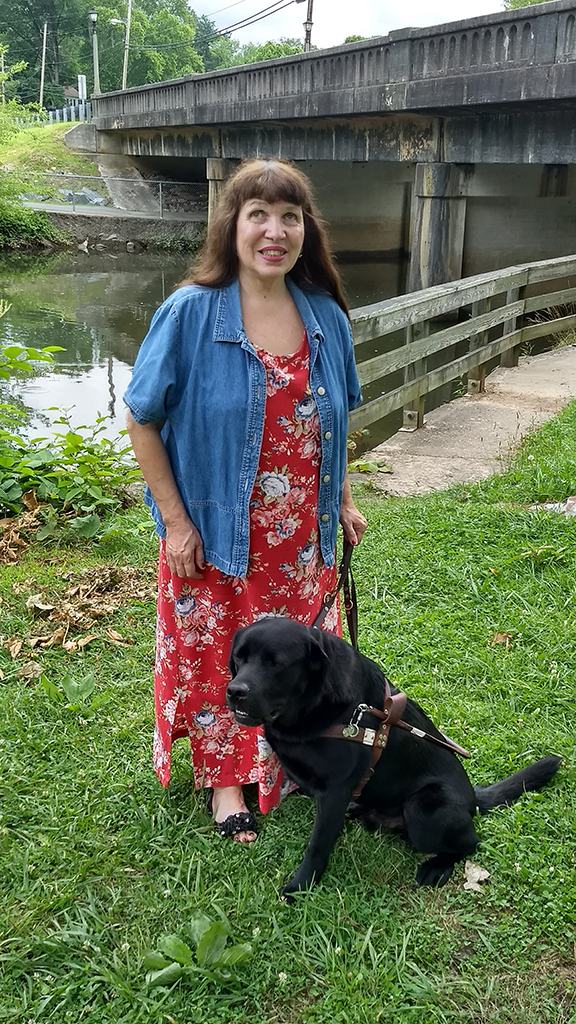
It happens at the bank, at a restaurant,” Maria McLeod said, frustrated. “I have been visually impaired since I was 18, when I lost all my sight.”
While discussing how she is treated in Cherokee County, she added, “When I go to the bank, the teller will ask the person next to me, ‘What does she want to do today?’ Or at a restaurant, the waitress will ask the person sitting with me, ‘What does she want to eat?’ ”
This makes McLeod “crazy.” “I’m a person!” she exclaimed.
McLeod is, in fact a special person. She is the first applicant to receive services from a newly developed nonprofit agency, Destination Help. Special needs advocate Cindy Brockway and her longtime professional friend, Karen Moree, who sits on the board of directors, met McLeod when she approached their organization needing heart-wrenching help.
Her guide dog, Grady, was sick with cancer, requiring expensive surgery. She hoped Destination Help could help Grady.
Helping the county
Sadly, Grady died before Moree could raise the funds, but McLeod was hooked into their inclusive mission. The organization was created to assist those who are impacted by disabilities, including the disabled themselves, caregivers, churches and businesses.
“Any disability,” Moree said. “Maybe your business or church is affected by someone with disabilities, and you need help with resources, education or tools to solve the problem.”
Moree created Destination Help to make Cherokee County an easier place to belong for those residents who have a disability or know of someone who does. “We want to serve anyone impacted by a disability,” she said.
Their ability to assist falls under a large umbrella of services, tools or products. “We wrote the bylaws as broadly as possible.” Moree added.
One area of focus is how to educate the public concerning their neighbors who present with a disability. McLeod has a good deal of experience to share on this topic.
“I am very independent,” she said. “I have two degrees, raised my family, and traveled overseas for missionary work. But I need tools, like a guide dog.”
Feeling invisible
McLeod said she often hears people talking to her son, when he accompanies her on an errand. “They’ll say, ‘Oh, isn’t it nice of you to take care of your mom?’ ” This outrages her.
“They think he feeds me and dresses me, but I’m totally independent,” she said. “I just need tools. What? They think my son was raised by elves or that he raised himself somehow?”
McLeod often feels diminished and invisible. “They give me absolutely no credit,” she said.
Brockway agrees. “I have 30 years of experience working with children and adults with special needs,” she said. “We need to teach acceptance and awareness” of what it means to navigate a neighborhood or a main street as a person impacted by disability. “This is a global issue.”
However, for founder Moree, it’s also a very personal issue. More than 19 years ago, her son was born with severe autism, and she learned firsthand how difficult it is to smoothly enter the community.
“My son, Noah, doesn’t go out in the community often because it overwhelms him,” she said. “But when he does go out, he overwhelms the community.”
Because Noah is non-verbal, he often makes noises in response to public stimulation. Moree found that her neighbors didn’t have any skills when it came to understanding how to integrate a disabled person into shared spaces.
“One lady splashed him in the face at a public pool because she felt he was being too rowdy,” she said. “Now, Noah didn’t know what was happening, but I did and it hurt.”
Feeling uncomfortable
She believes this event serves as a microcosm for a macro problem.
“Check the research,” Brockway added, “67 percent of people say they feel uncomfortable around disabled people.”
They either patronize or are afraid to say the wrong thing. “They don’t know what to say or how to react, so it’s best they pretend that the disabled person is not there,” she said.
McLeod enthusiastically agreed. She has been trying to get the N.C. Department of Transportation to put up a red light at a busy intersection so she can safely cross the road to a park.
“I’ve been trying for the past year to get them to put it up or to fix the broken sidewalks,” which are a hazard to anyone using them. She believes no one has responded to her request because “people don’t like blindness.”
McLeod said because
people have such a fear around the possibility of blindness affecting them or someone they love, “They need me to be invisible.” Brockway added that there is a societal myth “that she is helpless.”
What she really needs is a way to access tools like a guide dog and actions, or getting a stop sign installed to help her live with autonomy.
Support & services
That’s just what Destination Help intends to do by building support and services from local businesses.
“They don’t have donate money; they can provide a service-it’s all deductible,” Moree said.
Because each applicant presents with a disparity of needs, the opportunities to help are limitless. They do accept donations, but also seek trained individuals to offer pragmatic solutions.
For example, an applicant might need a wheelchair ramp built at their home or place of business. Donations can fund the materials, but local builders may donate their time and craft to meet that need.
Destination Help wants the communities in North Carolina in general, and Cherokee County in particular, to know that they are here to help make the world more accessible and accepting of those impacted by disability. For details or to donate, email Moree at destinationhelp2020@gmail.com.