
Hayesville One Dozen Who Care Inc. hosted the recent rendition of its Multicultural Women’s Development Conference on April 19-20 at the Hinton Life Center. With the 23rd conference in more than 25 years, the nonprofit has sought to bring together women across differing racial, socio-economic and age lines in western North Carolina for a gathering dedicated to empowering them and creating community.
With more than 70 attendees for the two-day event, ODWC spotlighted speakers from around the region to entertain and engage the feminine power, within and without, to foster greater involvement in both civic arenas and to shine
and recognize those arenas where they also already excel, such as caregiving, creating, mothering and teaching.
Titled “Still We Rise” – the main portion alludes to the poem by Maya Angelou, “Still I Rise” – the conference led off with a welcome from ODWC President Patricia Hall and then heard a rousing poetry reading by Michelle Lloyd, who read the poem included on the program so all could read along titled “Feed My Soul (Slow baked, over easy)” by former member Raven Chiong, who passed away in December.
Lloyd emphasized what it is to be entwined and build relationships, echoing lines of the poem that encourage women to, “Combine clarity, courage and creative juices. Simmer in strength and surrender,” as a recipe for creating unity and bonds that will sustain the tests of time.
Right before the Plenary Session, which was delayed due to the speaker being delayed by inclement weather, the crowd was asked to rejoin in the mantra of, “I’m amazing. You’re amazing. We’re amazing,” while gesturing to the individual self, the other and the group at large, which was reminiscent of the 4-H pledge.
Three audience members offered testimonies of how to combine and cope with creating relationships and resilience.
First, Phyllis Utley, also known as “Lady Sunshine” of the Land & Sky Council, related her story of being a first-time home buyer while caring for her mother. Although her mother didn’t make it to her home to see what she had been able to purchase, her mother “gifted” her with many volunteer plants to get her through the gardening phase of her new home life.
To stretch the lull of waiting for the speaker, Toni Pasquariello of Franklin, who also works as the western regional director and a federally certified navigator with Legal Aid, told the audience of her journey from Caracas, Venezuela, to the mountains of North Carolina about 20 years ago.
On the heels of that story, Murphy poet Mary Ricketson read the very poem of Angelou’s from which the conference title drew inspiration, “Still I Rise,” which drew great applause from the crowd. It details both Angelou’s travails personally and generationally, as well as many of the fairer sex’s societal denigrations from the patriarchy along with other social constructs and institutions.
Only 10 minutes late, the speaker arrived from Asheville in the form of vice mayor Sandra Kilgore, who came to the podium with all her power and tact intact through the driving rain she encountered on her way to the westernmost part of the state. Her list of accomplishments preceded her in the introduction and fit with her talk about “Overcoming the Impostor Theory.”
This theory is that high-achieving or well-accomplished people suffer from the psychological complex or idea that they will be found out to be “a fraud,” incapable of the tasks they easily complete and goals they accomplish due to their own self-doubt.
Kilgore gave facts and statistics that “more women suffer from this than men.” Given that mention she went on to discuss various ways she’d transformed herself throughout many different careers and relationships, including becoming an airline attendant, wife, mother, real estate agent, council representative, caregiver to aging parents and vice mayor – along with the different skill-sets she worked to develop to garner success in each one – while also believing she would never fully live up to expectations for each role.
In discussing the ways in which woman are spread thin, Kilgore said women have a seemingly “innate” ability to “make do with limited resources” and how many women receive “criticism disguised as love” whether it be about our appearances or abilities, so that we must move toward using those critiques by taking courses or self-teaching skills we need to hone or practice in order to better ourselves not out of spite, but rather a place of understanding criticism as a means for “making it a vehicle of self-improvement” thereby finding empowerment through personal betterment.
In terms of betterment, Kilgore pointed out that women tend to neglect themselves, as mothers and workers, no matter the purview of career and that in doing so we neglect others because “this is a reflection to others of our own perceptions of ourselves” and that women must “decide they deserve to make a change” in order to also properly care for themselves, even for a few moments a day to recalibrate our lives in every situation, from home to work.
Kilgore ended with the idea that we each must utilize our God-given attributes such as our personalities, our natural gifts and talents, even though we “may fail at first, you can only get better from there.”
After Kilgore’s endearing speech, Louise Runyon read two poems from her new work “Where is Our Prague Spring?” The poems included familial history as the descendant of founders of the Penland School of Craft near Black Mountain, and her “progressive” upbringing in terms of fighting both prejudice and racism during the turbulent 1960s.
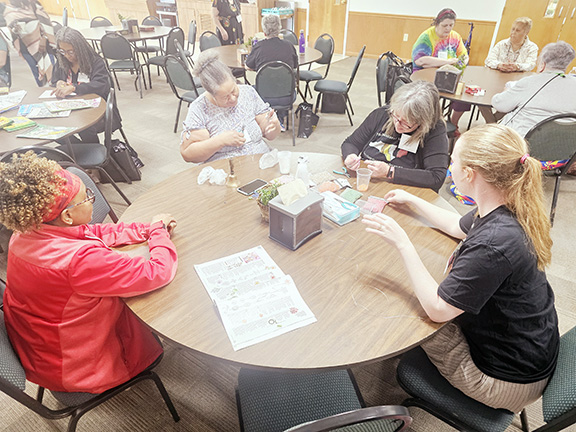
Following this reading, the ladies were feted in the dining hall with a different kind of treat called Learning Leisure Skills, a session full of games and crafts including Jenga, card-playing with both Uno and Trash, jewelry beading, a puzzle table and learning to crochet.
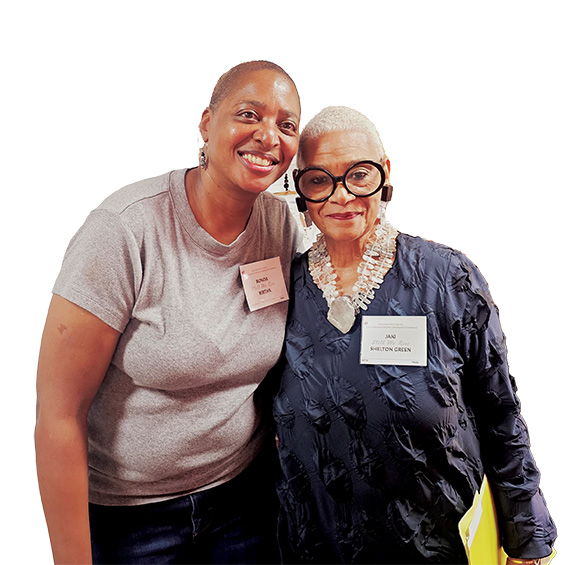
After a delicious taco and salad bar lunch replete with five kinds of homemade cookies and catered by the Hinton Center, the ladies gathered again for the keynote address from North Carolina’s first African-American woman and ninth poet laureate, Jaki Shelton Green.
Green reiterated the idea of woman as the caregiver, the center of the home and then told the tale of her “grandmother’s grandmother’s grandmother,” a slave, born on a plantation as a half-sibling to the owner’s white children and raised alongside them, secretly taught to read and write and banished and sold after answering a question asked of the owner’s children during a tutelage session.
The crux of her story ends with her grandmother’s grandmother’s grandmother’s mother snatching a rusty nail on a dusty road as the buck-board wagon rode along with her daughter in tow to be sold at auction and how that nail has been handed down as her matrilineal inheritance to remember, always.
In re-telling this tale, Shelton Green emphasized how women are the “keeper of stories, the keepers of both history and HERstory to maintain the narrative of existence when there are so many things in this world today to threaten both our stories and our bodies. And to remember that “what we keep, keeps us.”
Shelton Green also used the metaphor of us each as “The Human Museum” and how we ought to “be careful what we curate in our environs” along with the prevailing idea that “we all have currency,” meaning we are worthy and valuable and must acknowledge those attributes in order to find a way to make them useful to ourselves, others and our world.
During the Q&A portion, someone requested she read her poem “Prayer for Jesse,” an ode of sorts to North Carolina’s conservative former U.S. senator, whom Shelton Green had met many times as a lobbyist for the arts in Washington.
The poem works as a litany against all of the senator’s prejudices against both racial and gender issues and was met with a standing ovation. Immediately after the poet laureate, five local women participated in a panel discussion relating their “Many Paths to Leadership.”
Moderated by local nurse Karah Thompson, the panel included Ronda Birtha, executive director of ODWC; Scarlett Guy, the 2023-2024 Miss Cherokee of the Eastern Band of Cherokee Indians; Pasquariello of Legal Aid WNC; Jackie Simms, an educator of those with hearing loss for 44 years in western North Carolina; and Arlissa Vaughn of Aegis Power Systems in Murphy.
These five women told their incredible stories ranging from Vaughn’s inheriting a company after the sudden passing of her father to Simms’ driving throughout the 18-county region for 17 years while trying to raise her own family to Birtha’s relocation to Murphy after a management job in corporate America to Pasquariello’s passion for helping those newly migrated to the area with identification and insurance issues to Guy’s fulfilling immersion in the Cherokee language program to help sustain her ancestors’ native language before it faces imminent extinction.
The afternoon continued with “breakout sessions” where each attendee could participate in varying classes, including Zumba with member Kristen George, learning about insurance from local agent Mary Jo Dyre, self-defense and post-COVID best health practices.
After dinner, the group was entertained again by Ricketson reading from her new works. Lastly, the group attended a group MENAT dance, or bellydance experience, with Ophelia Williams & Co.
Saturday’s agenda included screenings for diabetes and blood pressure along with other speakers and sessions geared toward keeping our health attuned to the needs of our bodies and selves so as to better be proactive in our families, communities and careers as well as celebrating both the difficulties and advancements alongside the diversities and commonalities of the female experience in both our region and our world at large.
One Dozen Who Care offers scholarships to attend their annual conference. The 2025 conference dates will be announced soon.
Details: Visit onedozenwhocare.org.