
 |
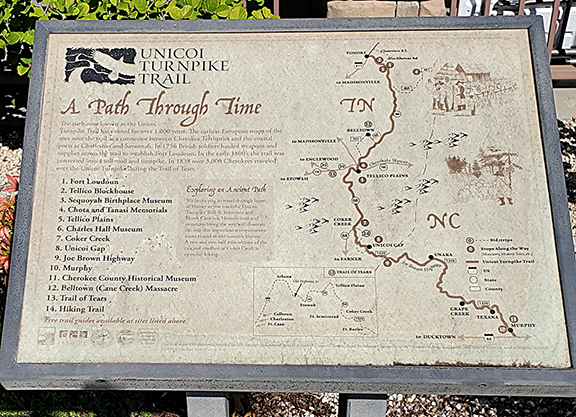
It is a thousand-year-old mountain path, for years the best way to navigate these mountain peaks, gaps and valleys. It has had many names – The Indian Path, The Unicoi Trail, The Trader’s Path, later the Unicoi Turnpike and, sadly, The Trail of Tears. This trail ran through Cherokee County and on through the Unicoi Gap to Tellico.
Tradition holds the trail existed for over 1,000 years, most of that time a narrow walking path rarely more than 3 feet wide, requiring pack animals rather than wagons and teams.
The first incursion by colonists over the Unicoi Trail was four men on foot with pack animals in 1690. They left Charleston, S.C., and took the trail to the Cherokee Overhill towns at Tellico along the Little Tennessee and Hiwassee Rivers. Their packs contained ribbons, buttons, mirrors, scissors, knives, rum, guns and gunpowder to exchange for deerskins, the currency of the frontier. Before the Industrial Revolution buckskin was used for everyone’s clothing, from the workingman to the upper classes.
A gun could be exchanged for 35 deerskins, a blanket 16, and 30 lead balls would cost one deerskin. Between 1755 and 1773, more than 2.6 million pounds of deerskins were exported through Savannah alone.
In 1730, Alexander Cumming made the journey from Charleston through Cherokee County to Tellico, traveling the Unicoi Trail. On his return seven Cherokee came with him – and visited England.
When the British recruited Cherokee to fight in the French & Indian War, a condition demanded by the Cherokee was a fort to protect their wives and families while they were away. The resulting Fort Louden was constructed in 1760. All the tools, soldiers and the fort’s 12 cannon came through here, over the trail, so narrow that the cannon, lashed crossways, would bump into trees on the narrow path.
With the coming of the American Revolution, John Sevier led his East Tennessee troops in several raids on the Overhill settlements and used the Unicoi Trail once for an invasion of the Valley towns between Murphy and Andrews. With 140 Overmountain men, Sevier burned three villages and killed 15 Cherokee.
Sevier soon retreated in the face of 1,000 assembled Cherokee warriors, exiting back down the Unicoi Trail.
A settlement was made with the Cherokee in 1795 to allow the making of a road along much of the Unicoi Trail, linking Augusta, Ga., where there were water links to the coast, to Maryville, Tenn. They had their work cut out for them.
In 1799 Benjamin Hawkins, U. S. Indian Agent to the Cherokee and Creek tribes, described the Unicoi Trail as 3 feet wide with a 300-foot descent on one side.
The road was to be 20 feet wide down to 12 feet wide at bridges and stream crossings. Accommodations were established every 10-12 miles for those traversing the turnpike. Work began on the road in 1813, and the road bypassed much of the old Unicoi Trail and rerouted a new road, along the Hiwassee River through what is now Murphy. The Cherokee were to be paid $160 per year for 20 years.
In 1815, the renamed Unicoi Turnpike opened as a toll road for freight wagons, allowing Tennessee farmers to traverse Cherokee lands and market their goods to coastal cities. The trail saw massive hog drives and became the major road of commerce. Rates were 12 ½ cents per mounted traveler, 6½ cents for every wagon, and a dollar for every carriage. Livestock charges ran 1 or 2 cents per head. A.R.S. Hunter used the opportunity to establish a ferry over the river here.
When Andrew Jackson instituted the Cherokee Removal, Gen. John E. Wool and Gen. Winfield Scott made ample use of the new Unicoi Turnpike, including utilizing the road to send over 3,000 Cherokee on their first steps of the Trail of Tears.
It was by the Unicoi Turnpike that both Confederates and Union troops raided Cherokee County. More than a few bodies from that conflict found their final resting places along the trail, including one Unicoi Turnpike gatekeeper.
The route of the turnpike remains today, Murphy to Coker Creek, some of it a 10-mile gravel road through the Unicoi Gap. The road varies some from the original path due to construction requirements.
Thanks to the Tennessee Overhill Heritage Association and others one can walk segments of the original Unicoi Trail, as many have done before you over the past 1,000 years.
In 2000, the Unicoi Turnpike was designated one of 16 National Millennium Flagship trails. If you venture to the Unicoi Gap today, stop, turn off your motor and listen. Open your heart to the historical vibe of those who traveled here. You may be surprised at what you hear.
Bruce Voyles’ local history column runs every other week in the Cherokee Scout. Email him at RoadsLessTraveled@cherokeescout.com.