
 |
During the Great Depression, a time with little hope to the future, President Franklin D. Roosevelt’s New Deal improvised a new agency that would impact our mountain communities in benefits previously undreamed, benefits we mountain dwellers and visitors enjoy still today.
It was called the Civilian Conservation Corps, created during Roosevelt’s first 100 days in office and initiated in April 1933. Some would later call it Roosevelt’s Tree Army.
The concept was simple and brilliant. Unskilled, unemployed and unmarried young men ages 18-25 were eligible to enroll. They would live in barracks and camps, do outdoor public works and conservation jobs and be paid $30 a month.
Twenty-five dollars of those wages would be sent home to their families, often in desperate need of dollars. Their spending would, in turn, help stimulate the depressed economy.
A CCC enlistment was six months, but many stayed up to the 18 month maximum. The enlistment included clothing, shoes, three meals a day, and classes and vocational training at night. All enlistees were taught to read and write. When they left the CCC, they were given discharge papers.
The CCC was supervised by the U.S. Army and regimented in a similar form. Most camps were 200 men, housed in military tents and required uniforms, ranks, orders and rules, reveille, roll call and inspections.
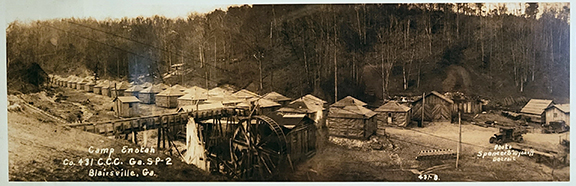
A typical camp would also include a shower house, outhouse, mess hall, hospital and infirmary, garage and shops for producing items ranging from sawmilled boards to door hinges used in the buildings they constructed.
Some historians theorize when World War II erupted that one of the factors allowing the U.S. to mobilize an army faster was the basic indoctrination of military life to those three million men who had enrolled in the CCC.
Once formed into camps these groups of men would work on roads, trails, parks, erosion control. They fought forest fires, built fire roads, fire towers and planted trees.
A breakfast would include eggs, bacon and juices, and lunch was sent with them into the field. While many families were short on food on those lean times, the average CCC worker gained 12 pounds.
The undertaking was massive, as were the results. The Appalachian Trail was a CCC project, as was parts of the Great Smoky Mountain National Park. The Skyline Drive and Blue Ridge Parkway are here because of the CCC. More than 800 state parks were constructed, as well as building Camp David, creating a park out of Carlsbad Caverns and planting 2.3 billion trees.
There would be 1,433 camps nationwide. Western North Carolina was part of District 4, and would eventually be home to 66 camps in 47 counties, housing 14,000 men in 14 different national forests over the nine years of the CCC’s existence.
One of the first CCC camps was organized at Fort Bragg. Enrollees were sent by rail to the mountains, disembarking at the closest railroad terminus to their destination, Murphy.
The tri-state area benefited with several CCC camps nearby. Camp Hiwassee was near Murphy. Camp Winfield Scott was close to Andrews. Another CCC camp was in Turtletown, Tenn. Camp Andrew Jackson was near Copperhill, Tenn.
There were several camps near Tellico Plains, Tenn., and Camp Rolling Stone was on the Unicoi Turnpike between Murphy and Coker Creek. One of their projects was improving the old turnpike into what we know today as Joe Brown Highway. A quick tally of these camps indicates over 1,600 tri-state area men were earning money in the CCC during a time when jobs elsewhere were almost non-existent.
The age limit was extended in some circumstances for World War I veterans, among them my grandfather, Samuel Voyles, a World War I vet who worked as a cook in the CCC camp.
The cooking did not excuse him from manual labor, as it was while working in a CCC camp an accident injured his leg. He walked with a limp for the rest of his life.
Despite the infirmity, my grandfather would later take what he had learned in the CCC camps and open a restaurant in downtown Murphy.
Today, there are more than 40 CCC camp museums, usually maintained by the state in which it is located. One of these is at Vogel State Park in Blairsville, Ga., where CCC Camp Enota was located.
Vogel is one of the state parks constructed by the CCC, and some CCC constructed buildings remain.
The Blood Mountain shelter on the Appalachian Trail is one of the few remaining CCC built shelters, and the stone buildings at Neel Gap on U.S. 129 between Blairsville and Cleveland, Ga., stand as monuments of the handiwork of the Civilian Conservation Corps.
The good works of the CCC ended when the men were called to an even bigger job – to win World War II.
Bruce Voyles’ local history column runs every other week in the Cherokee Scout. Email him at RoadsLessTraveled@cherokeescout.com.