
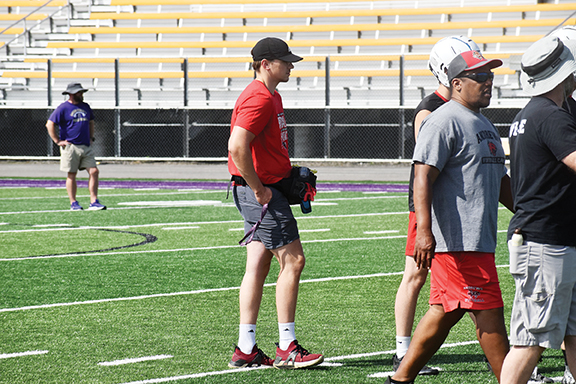
Andrews – Despite the Cherokee County Board of Commissioners approving funding for athletic trainer positions at both Andrews and Murphy high schools, the Wildcats will not have an athletic trainer to start the school year.
Coulter Clement, who worked at Andrews High last year, started a new job as an associate athletic trainer for the Western Carolina University football team on Aug. 1. Last year, Clement and Murphy athletic trainer Bob Grimes were employed by PT Solutions Physical Therapy, which partnered with Harris Regional Hospital in Sylva. After Harris decided not to renew the contract with Cherokee County Schools, the county is funding the positions for the 2023-24 school year.
That agreement made Clement uneasy when it comes to operating protocols. For an athletic trainer, operating protocols cover what an athletic trainer is supposed to do in specific situations.
The protocol is signed off on by a physician, which in previous years wasn’t an issue because trainers were employed through the hospital partnership. But as of press time this week, Cherokee County Schools still had not gotten a physician to sign off on that protocol.
This means that Grimes, who is still at Murphy, is not able to do perform the job to his full capabilities, as there are no guidelines to follow. According to school board member Jeff Tatham, the issue will “hopefully” be resolved at the Cherokee County Board of Education meeting Thursday.
“I probably would’ve stayed another year if the contract had been renewed,” Clement said. “But with all this issue of not having an operation protocol, it was just too much I didn’t feel comfortable with legally.”
The N.C. High School Athletic Association requires that a licensed athletic trainer or first responder attend all home and away football games or be in attendance at practice when protective equipment like helmets and shoulder pads are worn. First responders are required to have CPR and AED certification by an organization like the American Red Cross, take the National Federation of High Schools “Concussion in Sports” class and take 10 hours of instruction related to first aid, injury detection and prevention.
Sarah Tatham and Tim Wood are both serving as first responders after completing the necessary coursework. Wood, who serves as the Andrews girls basketball coach, had already been CPR and AED certified as it is a athletic association requirement for coaches.
That training is much less than that of a licensed athletic trainer. Before working at Andrews, Clement completed rotations at two high school and three college athletic programs while earning his bachelor’s degree in athletic training from Western Carolina.
Wood said he and Tatham are there to provide emergency care and call emergency services personnel if needed. They’re not qualified to treat specific injuries, which becomes a problem during football season, as injuries are inevitable.
With no one at Andrews qualified to diagnose and treat certain injuries, Wood said he and the coaches are taking as many precautions as possible since a misdiagnosis could mean liability issues for the county. If enough injuries pile up, the worst-case scenario is a team won’t be able to play.
It’s a precarious situation for all involved. Even if the county gets a physician to sign off on an operating protocol, there’s no timeline on how long it will take to hire an athletic trainer for Andrews High.
“If nothing else, I get to watch my boy practice and help the team and help out the school at the same time,” Wood said. “But this can’t be long term, I can’t stress that enough.”