
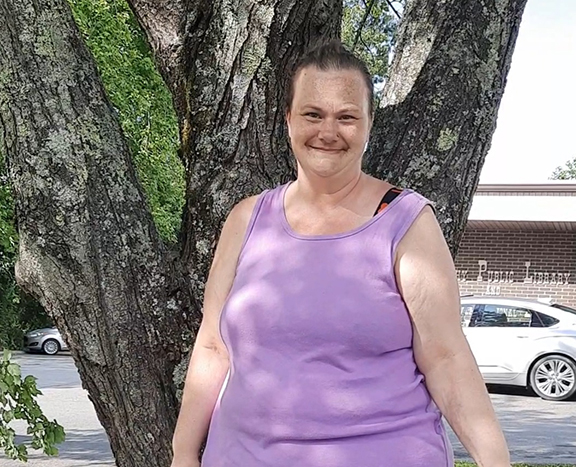
Murphy Meet Vanessa Teeter, a woman who used to have a place of her own to stay in.
"I was in an abusive relationship. His parents owned the house, so it was kind of hard staying there when I was evicted. Without the abusive partner being there, I had to be out on the streets," said Teeter, who is homeless as a result.
"I have to stay at a homeless shelter now, if they'll accept me. They do a background check, and some of us are criminals, not even bad ones. Charges like simple assault or larceny, and they'll turn you away."
 |
At night, Teeter sleeps at the Hurlburt-Johnson Friendship House homeless shelter downtown. However, from 8 a.m. to 5:30 p.m. each day, she and the other residents have to be out.
"It's not a hangout," Teeter said.
During the hours when she's out on the streets, it can be difficult, as many places do not want people loitering.
"If you're not using their business, you can't even go to the bathroom," Teeter said. “That’s why we rely on places like the courthouse and the library.”
Looking for employment with children adds to the burden of homelessness. Finding affordable day care in order to work is often impossible.
"We can't work because we have kids, but we can't find people to watch our kids. It's very, very hard. It's a cycle," Teeter said.
"The shelter can help somewhat, but if it's not food stamp day then we gotta go find a church or people who will offer us food. Sometimes we go hungry or thirsty for days.”
‘We’re still humans’
In January, during one of the coldest parts of winter, the number of people considered to be homeless in Cherokee County was 205, according to Dr. Sue Lynn Ledford, executive director of Four Square Community Action based in Andrews. The number is an estimate, as not everyone could be found to be counted.
Of the estimated total:
- 54% were male, and 43% were female.
- 21.5% of that total were under age 18,
- 44% were ages 19-64,
- 2.5% were over age 64, and more than 30% were age unknown.
What Teeter wishes folks knew about those who are homeless is that anyone is just a paycheck or two away from potential homelessness.
"We are humans just like you but we're just having a harder time than you right now. Yes we've made mistakes but we're still humans," Teeter said.
She admits that there are some homeless people who may do harm to others, but many would not.
‘I’d rather work’
Teeter is unable to work due to her bipolar disorder.
"If I could work I'd rather work than take money. I don't want money, I get Social Security, I just want food, clothing and necessities,” she said.
“I can't afford housing because it's so expensive, and that's without the expenses.”
According to the National Coalition for the Homeless, there are several reasons why someone would become homeless. Reasons include severe poverty, lack of employment opportunities, a decline in available assistance, a lack of affordable health care, domestic violence, mental illness and addiction.
Anyone, anywhere can experience changes in life that could potentially cause homelessness. And once homeless, it can be an uphill challenge.
Teeter said she wants people with jobs to recognize “maybe that person needs a sandwich or a bottle of water. Maybe run back into the store and grab a bottled water for us."
What homeless people need from folks are “socks, underwear, deodorant, toiletries, a blanket and even a tent for shelter when camping in the woods," she added.
‘Keep your head up’
In 10 years, she sees herself living happily in her own place with her dogs, and making crafts. She enjoys sewing and doing diamond art. She also designs T-shirts, mugs and plates.
Teeter hopes to be off the streets in the near future.
“Everyday, I pray to the Lord, He’s my Savior,” she said. “I pray the Lord helps me to get through the next day, and push me to go and work my way up from the homeless shelter to a hotel or to a campground, and then to my own trailer, house or apartment."
Teeter's advice to homeless people who may be depressed or lack a vision
for the future is to, “Keep your head up and pray. Go look for the Lord."
She was born in Connecticut in 1984. Her favorite color is pink, and she loves daisies and tulips.
Details: For locations to help those with food insecurities, visit go.ncsu.edu/localfoodguide. Flyers with food location sites can be found at the Friendship House, Cherokee County Department of Social Services in Ranger, Murphy Public Library and Penland Senior Center. The Bridge program at Tri-County Community College in Peachtree can assist those who need to earn a GED.