
Murphy It all starts at Tri-Tech Forensics in Leland, which makes the rape kits that get sent to hospitals and law enforcement officers across the state and nation.
“They are ordered by hospitals when they need them directly from a company called Tri-Tech Forensics Inc., which produces the kits for North Carolina,” said Julie Butler, forensic scientist supervisor for Western Laboratory-Forensic Biology. “There is no cost to the hospitals that I’m aware of, but the company gets paid by the state.”
Nazneem Amed, press secretary for the N.C. Department of Justice, confirmed that there is no cost to hospitals for the kits.
Tri-Tech Forensic staff member Amanda Harper said the kits are sold in packages of 13 at a cost of $242.50 per package. This puts an individual kit at just over $18.
In Cherokee County, the kits are stored at Erlanger Western Carolina Hospital in Peachtree. That’s the easy part.
SANE in the ER
When a sexual assault victim enters Erlanger’s emergency room, the hospital provides a specially trained sexual assault nurse examiner, called a SANE nurse, to perform the procedure. This can take up to two hours and requires adherence to strict legal requirements.
For example, the SANE nurse cannot leave the room once the exam starts. At its core, the examination is a collection of evidence starting at the top of the head and ending at the bottom of the feet. It involves, among other things, hair plucking, pictures, buccal, vaginal and anal swabs.
For a victim of sexual assault, the exam can feel a bit like an extension of the initial trauma. Cherokee County mitigates this strain by providing either a trained victim’s advocate from the sheriff’s office or a trained member from Reach of Cherokee County Inc.
Stephanie Swanson is the Cherokee County sheriff’s victim advocate. She trained at the N.C. Victim’s Assistance Network for domestic violence and sexual assault assistance preparation.
“My job is to assist the victim in anything from explaining the court process to working as a liaison between the District Attorney’s Office and the victim,” Swanson said.
These advocates will sit in the examination room with the victim and provide moral support as well as pragmatic assistance. The victim’s clothing, for example, is collected
as part of the kit, so Reach provides comfortable clothes for the patient to wear home.
$500 to $1,200
The cost for the administration of the rape kit is where things become more complicated. According to victimsofcrime.org, the average cost for the kit to be administered and processed falls from $500-$1,200. Erlanger comes in at the high end with a charge of $1,200.
The Violence Against Women Act of 1994 requires each state to provide a no-cost rape kit to each victim, but this does not always happen. One Cherokee County resident had a rape kit administered in April 2022 at Erlanger and received a bill of $1,200, which she gave to a representative from Reach.
However, the bill kept coming to her address as unpaid. She visited the billing department at the hospital, where she was told that the state will pay for the kit itself, but the patient is responsible for the cost of the emergency room visit.
Erlanger declined to comment when approached for this article.
Once the hospital administers the kit, they seal it before leaving the exam room. It must then be logged into the North Carolina Sexual Assault Evidence Collection Kit Tracking and Information Management System. Cherokee County evidence technician Cameron Killian explains the procedure.
“Each kit has an individual bar code the SANE’s nurse must log into the portal. Only trained hospital staff and law enforcement have access to the tracking system portal,” Killian said. “The log is a complicated conglomeration of various pieces of information, including the name of the hospital, the administering nurse and, of course, the bar code on the kit.”
Once it’s logged, the hospital contacts law enforcement for a pickup. An authorized agent of law enforcement must perform this task, which falls under the chain of command for evidence collection. Once the officer takes physical possession, the hospital logs the transfer into STIMS.
100 pages in 45 days
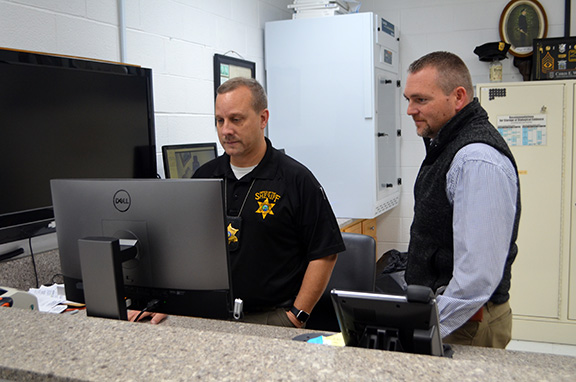
Killian said when the kit arrives at the evidence room inside the sheriff’s office, it goes into a lockbox that requires two keys. The officer must then log the kit into STIMs and fill out an SBI 5 form. The kit cannot be tested at the lab without that form.
The SBI 5 form is a summation of the event, including the case number, and both the victim and suspect’s names. The sheriff’s office creates another bar code to be used for internal tracking. Once the kit has been logged and the SBI 5 form filled out, the kit is ready for transport to the N.C. State Crime Laboratory.
“I always hand-deliver the kits to the Western Crime Lab in Hendersonville,” Killian said. But if the case involves arson, it must be mailed to the Main Campus Lab in Raleigh.
“Then we wait,” Killian said.
The lab results can take up to 45 days to provide results.
“Those reports can be up to 100 pages long,” Killian said.
When the lab has concluded their testing, a law officer must go collect the kit, log it into STIMS and then store it inside the sheriff’s office vault. Killian was trained for his position through an FBI academy course. To Killian’s knowledge, once the kits are stored in the vault, they are never destroyed.
“We keep them even after the case is closed,” he said.