
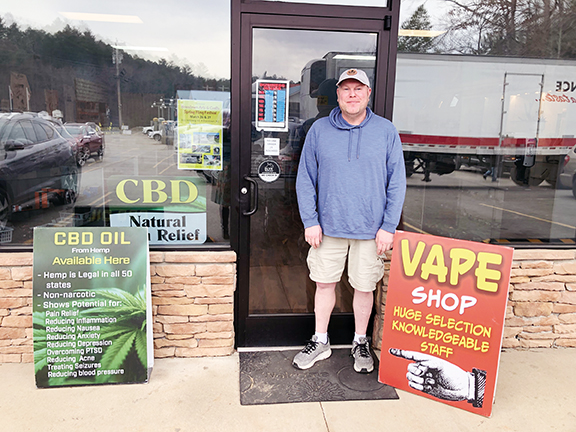
Strawberries and cream, that’s our top seller,” Jason Smith said from behind his tidy counter at Vape.
Smith, who called his title “faithful employee,” said caramel butterscotch is their lowest performer. “Some people think it tastes like coffee,” he added.
Smith knows a good bit about vaping, not just from his position as a professional, but because he also uses the product. Like many who visit the shop in Murphy, Smith was trying to kick a tobacco habit.
“A lot of people get tired of smelling like a cigarette,” he said. Once they start vaping, “food tastes better and they can breath more easily.” It’s also a huge savings.
“If you smoke two packs a day, you’re paying about $196 in two weeks,” Smith said, adding, “Vaping will only cost you $24 in two weeks for the equivalent quantity.”
That’s a significant difference, and one of the reasons teenagers are attracted to vaping over smoking cigarettes. Smith is adamant that his store does not sell to minors, but their only defense is to check identification.
“We card every single customer,” he said, but conceded that “we have no legal obligation to report minors who come in with fake IDs.”
Numbers going up
Some people think stores do not provide enough barriers to keep teens from vaping. Jenni Irwin, a representative of the Coalition for a Safe and Drug-free Cherokee County, said the numbers are rising.
She believes the vape manufacturers, “make it super simple to use. They make the pod component small, and the apparatus itself can be charged using their computers.”
Anne Boring, principal at The Oaks Academy in Marble, said, “Most students vape on the school bus.” She said it’s easy for them to hide it as some of the vaping juices have no scent.
“They just put it in their sleeve,” Boring demonstrated, pulling her wrist to her mouth like a spy using a communication device.
Irwin added that the devices are small enough to remain undetectable and is concerned that the numbers continue to increase. Cherokee County Schools participate in Pride Data, a national school survey that generates data based on student’s anonymous self-reporting. Their most recent results come from the 2018-2019 school year because of the COVID interruption.
Irwin said she feels certain that the numbers will be higher this year, but even the results from two years ago are alarming. Then, 4.1 percent of the seventh grade students reported vaping, with that statistic almost doubling by ninth grade to 8.5 percent. By 11th grade, 9.2 percent of the class is vaping.
Dr. Jeana Conley, superintendent Cherokee County Schools, believes the numbers are so high among teens because “students get a quick ‘high’ due to the double nicotine.” She added that Cherokee County schools do not use wands to find hidden vapes.
“Most students are actually pretty honest because the parents are buying the vape pens, so they do not see anything wrong with having them at school,” Conley said. She does not believe students recognize the addictive qualities in vaping. “Students do not understand nor do their parents. Students think they are invincible.”
‘50 flavors’ attract
Boring said The Oaks Academy created new policies to combat vaping among students, including an automatic three-day suspension and required enrollment in a cessation program within a week of their first offense. The second offense doubles down with an automatic five-day suspension.
“The parents and guardians are supportive of the new policies because they don’t want their kids vaping,” she said, but again, the manufacturers make abstaining more difficult.
“Companies like Juul have specifically marketed and targeted teens,” Conley said. “The candy-colored devices are not indicative of the true dangers of vape pens to students.”
Smith said that his store doesn’t sell Juul.
“Those are disposable, and we want our customers to come back,” he said.
He added, “We sell at least 50 flavors here,” which seems to substantiate Conley’s argument that vaping has been mis-marketed. She said parents “have been misled to believe vaping is a positive alternative to cigarettes, but it isn’t.”
Lance Bristol, principal of Andrews High School, agrees.
“Vaping is a far larger problem than cigarettes,” he said. “There are greater dangers associated with vaping as well.”
Beyond the manufacturing responsibility, Bristol feels the government has not provided enough oversight to keep students save from vaping.
“The FDA regulations of electronic cigarettes is far less stringent than tobacco,” he said.
Parents can help
Like Conley, Bristol wants parents to understand the dangers.
“We want the parents to know the dangers of vaping and have even held an informational presentation at the high school in December,” he said.
All four educators expressed fears beyond the highly addictive nature of vaping, with Bristol saying, “The ability to alter these products is alarming as well.”
Conley explained. “It is far easier to hide illegal drugs and marijuana based products in vaping devices.”
She said it is illegal for a minor to possess vaping paraphernalia. However, Daniel McNabb, principal of Hiwassee Dam High School, said students are in daily possession of vaping pens.
“Parents should be more involved in figuring out where students are obtaining the vaping materials,” he added.
The problem will be around for some time, based on opensecrets.com projections that 2.2 million devices were sold in 2016 – and just one year later, that number jettisoned to 16.2 million. With that kind of trajectory, Smith will see his business boom even as teen addictions rise in tandem.