
Editor’s note: Scott Lindsay’s trial is expected to last up to three weeks. The prosecution expects to call its last witnesses this week, followed by closing arguments before the jury deliberates.
This article summaries some of what has happened as of Friday, the end of the first week of trial, but specific witness testimony is hard to understand outside the context of closing arguments and the judge’s jury instructions, including his interpretation of the law relative to this case. A comprehensive summary of testimony will be reported following the jury’s verdict.
Franklin – The first week in the jury trial of former Cherokee County Department of Social Services and county attorney Ronald Scott Lindsay was completed Friday with several components you don’t often see in criminal trials.
From a change of venue to a judge taking the stand as a witness, the trial State vs. Ronald Scott Lindsay may well be the most interesting show in town that no one is watching.
Lindsay faces 20 felony obstruction of justice charges for his role in separating children from their families through the use of custody and visitation agreements, shortened to CVAs. Those agreements were privately negotiated between DSS, foster families and parents or guardians of the children being removed from their homes, sidestepping legally required judicial oversight.
But did it really sidestep judicial oversight? Or was the use of CVAs simply a different approach to the problem of providing safe housing for children from distressed homes?
That seems to be the distinction being made by Lindsay’s attorney, Jerry Townson of Murphy. At worst, Townson seems to say, the CVA process diverged from DSS policies, but it was not a crime – especially not one that could put Lindsay behind bars for the rest of his life.
Townson is also arguing that Townson may have been the lawyer, but it was others who made the decisions, and they have already been held responsible by juries.
Representing the state is the N.C. Attorney General’s Office, with prosecutors Benjamin “Boz” Zellinger as lead with Arneatha James in the second chair. Presiding is Special Superior Court Judge Steve Warren.
Testimony supporting the prosecution has come from parents affected by the CVA system, who said they either weren’t aware or felt they had no choice when they signed away their rights as parents until their child or children turned age 18 or became emancipated minors. N.C. Department of Health & Human Services witnesses said the CVA system was unique to Cherokee County and violated policy, which in turn was dictated by state law.
Lots of lawyers
The case is a lawyer represented by a lawyer, prosecuted by two lawyers, presided over by a judge – who is a lawyer. If that isn’t enough lawyers to begin with, a Superior Court judge – Tessa Sellers – took the witness stand Thursday for her role in exposing the use of CVA forms when she was a District Court judge. That’s six lawyers, one or two in every role – judge, prosecution and defense, who are normally lawyers, plus the defendant and a witness.
The lead-up to Lindsay’s trial had its own unusual elements. Once the use of CVAs became the target of a criminal investigation, the state took over management of Cherokee County DSS, only the third time that’s ever happened in North Carolina. Two DSS officials were convicted of crimes for their roles in the cases, and the county had to deal with nearly two dozen civil lawsuits – losing one, settling others and costing Cherokee County taxpayers tens of millions of dollars.
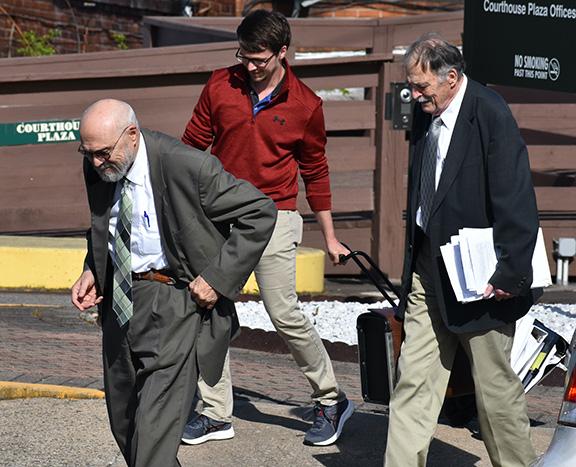
In what seems to be the finale of Cherokee County’s DSS saga, the defendant is represented by a storied Murphy lawyer and former prosecutor – two hunched-over, balding, silver-haired lawyers in the twilights of their careers, who never expected to find themselves in such a situation.
Townson is playing up the role of small-town lawyer before a small-town jury. Dressed in khaki trousers and a navy blue sport coat one or two sizes too large, he is seldom seen using a computer in court, has folders upon folders of paper documents that he flips through constantly and carries a 19th-century legal book that he keeps in a Ziplock bag and says he will show is key to the case. Lindsay, the defendant, has been more nattily attired and spends much of his time in court going over files and, unlike Townson, uses a laptop.
They face two attorney general prosecutors who seem out of place in a mountain courtroom in far-western North Carolina. Zellinger has been wearing tailored suits and natural-grain dress shoes, while James has also been smartly dressed.
Their witness list has more than 100 names, although it appears that only a fraction will be called to testify.
For his part, Townson does not have a witness list. He has no witnesses to call other than Lindsay, who he doesn’t expect will testify. He’s been putting all his eggs into two baskets – casting seeds of doubt on witness testimony during cross examination, as well as whatever he plans to say in his closing argument.
Meanwhile, in Franklin
The trial was moved from Murphy to Franklin after what is called a “change of venue” motion was granted because of the extensive pre-trial publicity the Cherokee County DSS cases have generated, along with ill will from property owners who saw their tax bills rise by hundreds of dollars per year. Changes of venue in court cases are occasionally sought, but rarely granted.
The change of venue presents challenges, including getting witnesses to court who lack personal transportation. A State Bureau of Investigation agent drove several witnesses from Murphy to Franklin so they could testify in court Friday.
If what lawyers sought in the change of venue was a jury pool that never heard of the Cherokee County DSS cases, that’s what they got – and more.
During jury selection, about 20 people were called to the jury box to fill 12 juror seats and three alternate juror seats. Only two said they read newspapers. The rest get their news from social media, television or, proudly, said they ignore news entirely.
Just one prospective juror, who wasn’t selected, said he even heard of the Cherokee County DSS cases. It came up in conversation during a meal at Chevelles Restaurant & Bar in Murphy.
Two days of jury selection spilled over into a third when a primary juror and an alternate, selected the day before, convinced the judge to release them for personal issues. After going through another wave of jury selection and denying a motion to dismiss the charges, Warren empaneled the jury at 9:30 a.m. May 1, followed immediately by opening statements from the prosecution and defense.
The Lindsay case has been attended by one or two of Lindsay’s supporters and the Cherokee Scout.
Witnesses have included a handful of parents affected by the CVAs, a handful of social workers who handled Cherokee County CVA cases, two Department of Health & Human Services officials with oversight over Cherokee County DSS and a judge.