
Hiwassee Dam – President Franklin Roosevelt showed favor toward seven lucky states in the spring of 1933, when he signed the Tennessee Valley Authority Act, which then birthed the Tennessee Valley Authority.
The idea was to provide jobs and affordable electricity for those living along the 652-mile Tennessee River and any of its tributaries. It was an ambitious act, hoping to improve agriculture and commerce through these Appalachian States as well as controlling flooding through reforestation.
Reforestation was an emergent issue, as the Appalachian Mountains had been logged during the turn-of-the-century timber boom, which according to the U.S. Department of Agriculture, left more than 70 percent of the region’s forest cutover. Naturally, the power companies vehemently opposed the TVA encroaching both on their territory and their prices.
Two lawsuits were launched to challenge the constitutionality of the TVA, but early legal victories were overturned by the U.S. Supreme Court, leaving the TVA to continue its mission untethered from the power companies’ attempts to stop it. Despite corporations shouting against the TVA, Cherokee County residents welcomed the government agency because it brought employment and housing during a time when both were in short supply.
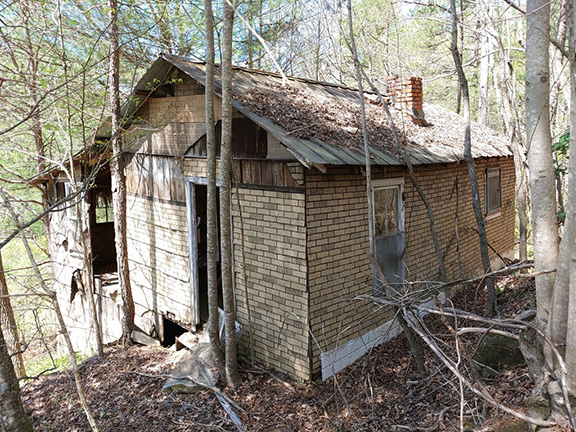
Loy Williamson’s family was among those who championed the TVA’s arrival to the area. Out of the dozen or so houses built by the TVA workers, Williamson’s great grandmother, Mary Emaline Kilpatrick, lived in one along the Kilpatrick Straight off N.C. 294. He remembers that some of the houses, or shacks, were crudely built.
“A lot of them just had two-by-four studs,” he said, “There was no sheet rock. They would cover those two-by-fours with paper. Women were prominent in using snuff and they would grind up the tobacco into a paste.”
Williamson said they would then attach the paper, often actual newspaper, to the boards with the snuff paste. “The snuff would stop the bugs from eating the paper,” he said, then He remembered some of the nicer TVA homes that he believed were inhabited by the foremen.
“They had tongue and groove hardwood floors,” but most of the houses used rough plank boards. Despite the Spartan accommodations, Williamson said the TVA was warmly welcomed in the area.
“All over this country, when the TVA came in here, everywhere you looked people were poor,” he said. “TVA made a big difference; they changed the economy in this whole country.”
Williamson laughed when explaining poverty during that time. He said there was a popular story about a family in Unaka who “saved their seed from year to year so they’d have seed to plant next year. One year after they planted their garden, the rooster dug up their seeds and ate them.”
Williamson said that rooster’s digestive system includes a gizzard, which is a kind of storage place where the food is ground up before entering the intestines. According to the legend, that the Unaka farmer “killed the rooster, got the seed back and replanted it.”
Another one of Emaline Kilpatrick’s great grandsons, Keith Kilpatrick, remembers visiting her TVA shack.
“There were three old houses sitting in the woods,” and Kilpatrick’s was one of them. He remembers hers as having linoleum floors, but agrees with Williamson about the newspaper walls. He couldn’t remember the kitchen or bathroom situation, but did know that they had no heat.
“The heat wasn’t put in until the 1950s,” Kilpatrick said. These hardships were common among those living during the depression.
“The TVA put money in people’s pockets,” Williamson said. “It was a big deal for this country.”
Both his cousin and his “wife’s daddy worked for the TVA. They provided temporary housing all over the place.” He added that the long-deserted houses are too far in disrepair to salvage.
“A lot of the houses have been torn down; they got to a point where they were no longer useful,” Williamson said.
However, Kilpatrick wants that part of his family’s and America’s history preserved somehow. The TVA employed more than 9,000 people from 1933-34. The local workmen built 16 hydroelectric damns in the Tennessee Valley, which helped monetize and modernize the area.
Williamson believes the temporary housing is special because the TVA buildings were not official. There was no official documentation of the houses or who lived in them.
“Many people had to live in them and they are going by the wayside,” he said. “They ought to be documented in some way.”