
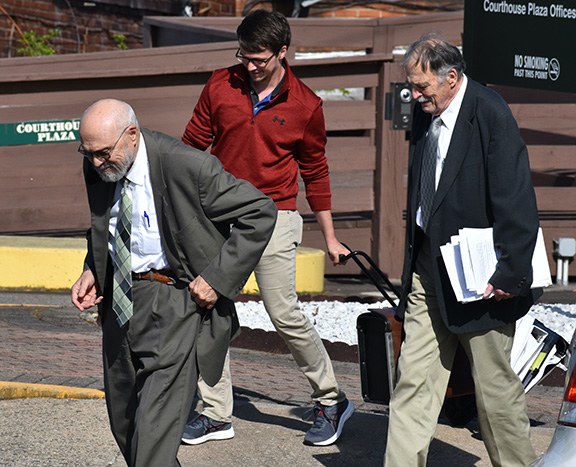
Franklin – Jury selection began in Macon County on Monday in the trial of a former Cherokee County Department of Social Services lawyer facing 20 felony obstruction of justice charges.
Ronald Scott Lindsay of Murphy was charged for his role in separating children from their families – without judicial oversight – through the use of custody and visitation agreements, also known as CVAs. Those agreements were privately negotiated between DSS, foster families and parents or guardians of the children being removed from their homes.
Lindsay was the lawyer advising county DSS at the time. He is represented by Jerry Townson of Murphy. Special Superior Court Judge Steve Warren is presiding, with special prosecutor Benjamin Zellinger prosecuting the case.
More than 100 witnesses could be called to testify at the trial, which is expected to last up to three weeks.
Townson, who is representing Lindsay pro bono – without fee – said Lindsay could spend the rest of his life in prison if he is convicted of all the charges.
Jury selection started at 11:15 a.m. Monday and concluded at 4:44 p.m., with 12 jurors selected from a pool of about 80 people called for jury duty. Two or three alternate jurors were expected to be picked after the Cherokee Scout’s deadline Tuesday. Opening arguments were also expected Tuesday.
The trial is unusual in a number of ways, not the least of which is a lawyer facing felony charges.
The witness list includes 20 sets of parents affected by the custody and visitation agreements as well as investigators, expert witnesses and two judges, including newly appointed Superior Court Judge Tessa Sellers, who was a District Court judge then.
Although the alleged crimes occurred in Cherokee County, a change-of-venue motion was granted in summer 2023 because of the large amount of pre-trial publicity generated by the case, which has cost Cherokee County taxpayers millions of dollars.
During a special meeting on June 29, 2022, the Cherokee County Board of Commissioners unanimously approved a $48.5 million settlement that resolved more than 20 remaining lawsuits stemming from DSS cases. The approval of the settlement added an additional 8 cents added on to the county’s 2022-23 millage rate, setting the new figure at 61 cents per $100 of property value.
The owner of a county property valued at $200,000 pays an additional $160 per year solely because of the lawsuits.
A total of 26 lawsuits were originally filed against Cherokee County and DSS, and the families involved in those cases have won more than $53 million in judgments, settlements and fees. The first of those cases was tried in U.S. District Court in May 2021 and resulted in jury awards and attorney fees of more than $6.5 million for Brian Hogan and his daughter.
As part of the Hogan judgment, the jury determined that Lindsay and former DSS director Cindy Palmer acted in a “grossly negligent manner,” violating the father’s and daughter’s due process rights.
Palmer pleaded guilty in October 2021 to one count of felony obstruction of justice, receiving one year of unsupervised probation. As part of the plea agreement, prosecutors dismissed several other charges, including willful failure to discharge duties, perjury and contributing to the delinquency of a minor. Former DSS supervisor David Alan Hughes also pleaded guilty to two misdemeanors in August 2021.
Zellinger, the special prosecutor with the State of North Carolina, said in 2021 that DSS employees used CVAs on numerous occasions over the course of 10 years, partly because the agency was “greatly understaffed” and “cut a corner” to save time and money. As a result, no services were provided to children following their separation.
Judging from his comments during jury selection, one argument Townson will make in Lindsay’s defense is that there was nothing legally wrong with the DSS agreements made with affected parents. That argument didn’t hold water when it was made in civil court, but prosecutors are required to prove beyond a reasonable doubt that a defendant is guilty, which could give Townson’s argument more traction in criminal court.