
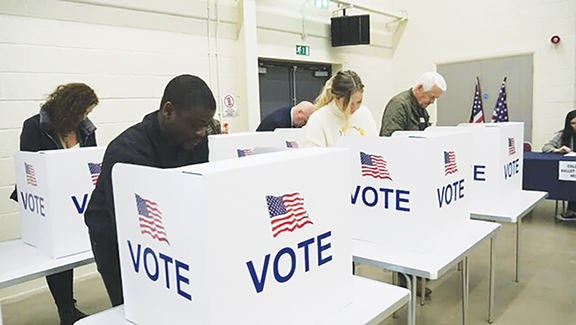
Military, overseas ballots out of luck
Raleigh – The N.C.
Supreme Court issued rulings Friday in the contested results for a seat on that court exempting local voters – but not overseas and military voters – from having to update their voter registration.
The court ruled against candidate Jefferson Griffin’s bid to contest voters with “incomplete” registration, but ruled that two other groups of challenged voters – military members and overseas citizens – will have to take steps to update their records or have their votes tossed out.
Military and overseas voters have 30 calendar days to fix their voter registration or have their votes tossed out in the Supreme Court race – unless other appeals are filed. The League of Women Voters filed an appeal Monday seeking to have military and overseas votes exempted as well.
Republican Appeals Court Judge Jefferson Griffin is challenging more than 60,000 ballots – including 142 in Cherokee County – as part of his attempt to unseat Democratic appointed incumbent Supreme Court Justice Allison Riggs. Riggs had a lead of 734 votes after all the 5.5 million ballots were counted the first time, according to ncnewsline.com.
A machine recount Griffin requested affirmed the 734 lead, so Griffin requested a partial hand recount. The hand recount in Cherokee County involved one voter precinct – Culberson, in which 786 votes were cast, 625 for Griffin and 161 for Riggs.
Griffin wants a large number of votes thrown out because their voter registration forms included a partial Social Security number or driver’s license number.
High court’s ruling
The N.C. Supreme Court issued an order Friday in the election protest brought by Griffin. In a prior decision by the N.C. Court of Appeals, the court would have required challenged voters who had allegedly “incomplete” registrations to take certain actions to have their votes remain in the count in the supreme court contest in the 2024 general election.
Friday’s order from the Supreme Court changes that. Voters allegedly having “incomplete” registrations will no longer have their votes impacted.
However, for certain military and overseas-citizen voters who used absentee ballots, the Supreme Court’s decision would now require them to provide a copy of their photo identification, or complete an affidavit known as a Photo ID Exception Form, to ensure their votes remain in the count for this contest.
The Supreme Court’s order increased the amount of time that an affected voter would have to provide their photo ID documentation to 30 days – from 15 – once they are notified by their county board of elections.
‘Review the effect’
In addition, for certain voters who, while otherwise eligible, have never resided in the United States but have a connection to North Carolina through their parents, the Supreme Court’s order would require those voters’ votes to be removed from the Supreme Court contest.
“The State Board understands there may be further proceedings in federal court before this matter is fully resolved,” the N.C. State board of Elections said in a statement.
“State Board of Elections staff are continuing to review the effect of these decisions and, at the appropriate time, will provide instructions for county boards of elections and affected voters on how to comply with the decisions. This protest does not affect these voters’ selections in any other contest on the ballot.”
Details: Visit tinyurl.com/4evrsypk to see the full list of contested voters.