
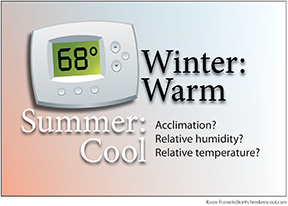
Cherokee County Please tell us we’re not the only ones who have experienced this. When you set your thermostat to 68 degrees in warmer months, your air conditioner will kick in and push out cool air. However, in the cooler months, setting your thermostat to 68 degrees will engage your heater and push out warm air.
Why does 68 degrees feel cool in the summer but warm in the winter?
Before we get to the answer (actually, answers), here’s what Cherokee Scout readers said when asked about it last week.
“Perspective,” Neil Martin Brooks said, as “88 outside to 68 inside feels cool, 48 outside to 68 feels warm! Similarly, winning $100,000 to a poor person is huge and life-changing, while a $100,000 year-end profit for a billion-dollar company that profited $200 million last year is called a loss! All perspective!”
Emily Malin of Andrews said it’s “because we live in the most beautiful place in the world, with all four seasons showing their splendor, which in turn evokes feelings of comfort for each. In spring and summer, we long for those hot days and outdoor activities and turn on the A/C. In fall and winter, we desire cozy warmth of a fire or snuggles indoors and turn on the heat. We humans are a phenomenon wrapped up in good vibrations!”
“You’ve got a 12-year-old son that changes the upstairs thermostat and it effects the whole house,” John Midkiff of Hiwassee Dam suggested.
While perspective plays a role in how we perceive temperature, humidity is also a factor, as pointed out by Ainslee Smith.
“I was just talking to a friend of mine today about how same temperature, but seasons have an affect on how we feel. We looked it up, and humidity is a factor in how the temperatures affect us,” she said.
Then there’s just plain getting used to it, as Joe Kubicek points out.
“I’m no rocket surgeon, but I’d guess acclimation,” he said.
Further research shows that they’re all right. Family members meddle with the thermostat, we grow used to seasonal temperatures and a touch of humidity can help in the cooler months.
Moisture in the air amplifies heat and cold, but with the air being especially dry during cold months, a touch of humidity from a humidifier (or even a pan of water placed on top of your furnace) can make a difference in several ways.
The moisture clings to air temperatures, so 68 degrees of mildly humid air will transmit a feeling of warmth in the winter. Set your thermostat much lower, however, and that touch of humidity can feel downright chilly.
The 68-degree benchmark was part of a national energy conservation push during the administration of President Richard Nixon, when oil-producing nations imposed an embargo.
President Jimmy Carter, facing another oil crisis in late 1976-77, urged the nation to set its thermostats to 65 degrees in the daytime and lower at night.
Setting a thermostat to different temperatures around the house and throughout the day makes sense. Your living room would be more comfortable at 68 degrees, whereas you might sleep better if your bedroom temperature was set a few degrees cooler.
Setting your thermostats a bit lower than your ideal can translate into lower energy bills, which is why Nixon and Carter urged lower thermostat settings during energy crises. If 68 degrees isn’t warm enough for you in the winter, you can always set your thermostat a little higher (if you can afford it), or bundle up with warmer clothes and blankets.
As Kevin Heyboer answered our question, “68 is cold, period. My house never deviates more than from 74 to 76, all year long. Our electricity is cheap and hydroelectric, so no reason to suffer.”