
The three biggest changes for Cherokee County are in its midst.
The Cherokee Scout sat down with government, education, business and other local leaders to get a glimpse of the state of Cherokee County. Here are some key takeaways:
- Broadband internet will open up remote areas of the county to housing. Grant funding has made it feasible for broadband internet providers to connect places like Hanging Dog and Unaka, where lack of connectivity has hamstrung local housing markets.
- Artificial intelligence is the next big thing. Bitcoin mining and electric vehicles were top of mind for Cherokee County economic development officials during recent years, but those two have been supplanted by artificial intelligence. Core Scientific carried out a major expansion and renovation of its property in Marble, which had focused on cryptocurrency but is switching over the AI.
- Workforce development. Industry
scouts scoping out Cherokee County are more concerned about a stable and educated workforce than other considerations, so Tri-County Community College is working to address those needs by enhancing its medical and industrial programs, as well as its law enforcement training. The college recently acquired partial ownership of the former National Guard armory in Murphy to be used for law enforcement training.
Here are some other insights from the Scout’s interviews.
Murphy
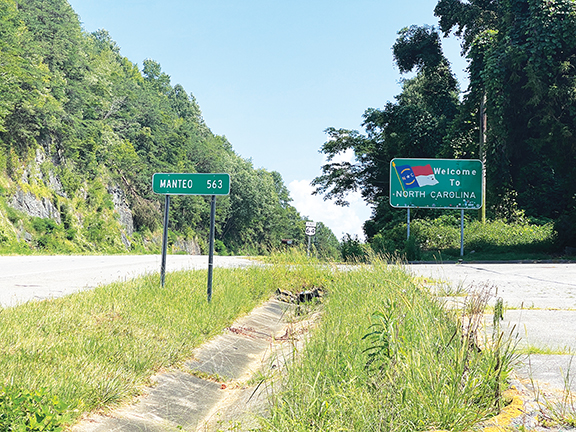
Murphy is the county seat for Cherokee County, the only county in North Carolina that borders both Georgia and Tennessee. The county is served by four-lane highways nearly end to end – the Tennessee state line in the west to Andrews in the east – and from Murphy through Culberson to the Georgia state line.
Still, traffic congestion – the societal pulse that reflects both economic vitality and delayed urban planning – is a thing in Murphy. More than 400,000 vehicles make their way each week past the Cherokee County Chamber of Commerce’s offices off U.S. 64 West, Executive Director Victoria Ivie said.
The N.C. Department of Transportation spent years reconfiguring and reconceptualizing U.S. 64 in Murphy. Nowadays, it’s putting the finishing touches on a roundabout at Murphy’s main downtown intersection of Valley River Avenue and Hiwassee, Peachtree and Tennessee streets.
Once the street project is complete, downtown Murphy will have fresh pavement and stripes, brand new waterlines, two-way traffic and a center turn lane, expanded parking and four pocket parks – including one with a stage.
Meanwhile, numerous downtown businesses are undergoing renovations. By Christmas 2025, Murphy will be changed.
Town leaders aim for steady, sustained growth, supported by infrastructure improvements to keep ahead of that growth. Murphy temporarily lost its Big Lots discount store after the corporate owner filed for bankruptcy protection, but the storefront is expected to reopen in the summer under new ownership.
Andrews
Andrews has been recovering from one gut-punch after another for the last 40 years – mill and factory closures, 9/11, the Great Recession and the COVID-19 pandemic most prominently.
The town also contends with being an incorporated municipality that is not a county seat. Without the justice system and county government feeding the local economy as it does in Murphy and other county seats, Andrews is left to fend for scraps or come up with its own devices.
In many cases, Andrews goes it alone. It has its own chamber of commerce, a large regional park (Heritage Park) with the county’s only public swimming pool and operates the Cherokee County Fair, just to name a few examples.
Andrews neighbors Western Carolina Regional Airport, the westernmost general aviation airport in North Carolina.
Andrews also has the county’s only rest area, one of the state’s lovelier ones but oddly located at a town gateway, intercepting potential customers. Still, it is an attraction that could be useful.
For infrastructure, the town has benefited from around $20 million in state grants to rebuild infrastructure, including sewage treatment and drinking water.
Over recent years Andrews became home to Andrews Valley Rail Tours, Morning Fog restaurant and a DG Market. On the other hand, it lost its McDonald’s, Cups & Cones restaurant, Sage restaurant and, most recently, Walgreens pharmacy.
“Every time we take one step forward, we take two steps back,” Andrews Mayor James Reid said.
Reid said he plans to run for re-election during municipal elections this November so he can oversee the completion of projects he has set in motion.
Following years of turmoil and turnover, Andrews’ police department has stabilized under Chief Caleb Stiles. And fire protection is provided by Valleytown Fire & Rescue under contract with the town.
Reid said he looks forward to a turnaround for Andrews over the next two years, as developers start seeing the town’s potential and the town completes infrastructure projects.
Reid and the Andrews Chamber of Commerce are on the same page.
“We believe Andrews is in a growth stage,” said Shannan Kelly, executive director for the Andrews chamber. “We have a good vibe here. Our food is top notch, and our pubs and breweries have some of the best spirits and brew around.”
Kelly echoes Reid’s challenges.
“We have suffered from the loss of businesses,” she said, “but we are seeking investors, and they are showing up to discover what we have to offer. We have a vision for the future, and that is prosperity for our town. We are working with town administrators every day for to ensure our vision is on the same page. We are actively seeking business owners for the investors coming to our town.
“The chamber will be focusing on small events in and around town at least twice a month to bring in foot traffic,” Kelly added. “We are working with our town on the social district trying to help out our current owners, and bring in more patrons and ultimately sales.”
The town just approved a social district for the downtown area, which would allow adults to stroll about downtown sidewalks with their adult beverages. Final approval is pending with the N.C. Alcoholic Beverage Control Commission.
Housing
Affordable housing is a serious need in Cherokee County. A study in 2022 reported a housing shortage of 1,400 units.
Murphy unveiled a 56-unit Valley River Apartments in the spring aimed at affordable workforce housing, with work in progress to develop senior housing in Murphy. Meanwhile, developers are working with the town for market-rate housing, including a 32-unit subdivision just off downtown.
With nearly 100 units just opened or under development, Cherokee County still has a long way to meeting local housing needs.
Cherokee County
Paul Worley is chief operating officer and vice president of continuing education at Tri-County Community College, which serves Cherokee, Clay and Graham counties. If it involves economic development, particularly in Cherokee County, Worley is probably at the center of it.
Worley and his staff have been playing a wack-a-mole-type game trying to keep pace with, if not get ahead, of economic needs and conditions.
Dr. Dan Eichenbaum, chair of the Cherokee County Board of Commissioners, has two goals for his tenure this year: education and the county’s financial health.
Eichenbaum has a list of areas that could help the county. First is education; more on that later. His other measures include:
- Hiwassee Lake: The Tennessee Valley Authority acquired too much land when it built Hiwassee Dam. Instead of returning the land to its original owners, the land was turned over to the U.S. Forest Service. Eichenbaum wants the Forest Service to sell the land to make way for housing and recreation.
- Forest management: Logging restrictions have hampered logging in Cherokee County, which no longer has an active sawmill. The Forest Service can’t maintain its holdings in the county.
- State park: The Forest Service should turn land over to the state so it can develop a state park in Cherokee County.
- Wilderness designations: Wilderness designations prevent any other uses. All requests for wilderness designation must cease, Eichenbaum said.
Education
Education is a central issue touching all aspects of life in Cherokee County.
Local employers want a workforce that is reliable, healthy and capable of learning the job. Local builders want a population that earns enough to afford housing. Local law enforcement understands that people who have jobs and a place to live are less likely to commit crimes.
Cherokee County Schools had a 92.5% graduation rate in 2024, well above the state average of 87%, according to Murphy Mayor Tim Radford.
Cherokee County Schools staff and faculty are generally proud of what they have accomplished, despite having too many campuses and not enough funds.
Somewhere around 20% of Cherokee County’s school-age children are home-schooled, and enrollment is generally declining outside Murphy schools. It is common for young professionals to move across county and state lines to send their children to better-funded schools.
Given the constraints, Cherokee County Schools stack up well against neighboring North Carolina counties and even some of their neighbors in Tennessee and Georgia. According to U.S. News & World Report, Murphy High and Peachtree Elementary schools lead far-western North Carolina for education outcomes and aren’t far behind Tennessee and Georgia.
Still, no one argues that the school district needs to economize; how to economize is the issue.
Residents in Andrews and Hiwassee Dam see their schools as prime targets for cutting costs by closing campuses – high schools there would have closed under a consolidation plan that nearly succeeded in late 2022.
School board and county board members have been at odds over what to do since then. At least six plans are on the table – five from the school district, one from commissioners. Cherokee County Schools has about two years to solve the problem before funding comes up short.
Superintendent Keevin Woody did not respond to several attempts seeking his input for this report.
Eichenbaum, an eye surgeon, is arguably one of the most educated people in the county. He envisions Peachtree becoming a center of academic excellence in the region, with critical mass provided by Tri-County Community College, the Schools of Innovation and a new Murphy High School.
He sees Cherokee County Schools providing college preparation for some students and skills training for others, so all students graduate with skills they need to succeed.