
If you read social media these days, you might think Cherokee County isn’t doing so well.
Drug addicts and homeless people roam the streets and highways – which, by the way, are some of the worst in the state. The county’s free-fall into crypto mining hell can only mean that nuclear waste dumps are around the corner. Speaking of corners – there won’t be any left after they all get turned into traffic circles.
How about those Floridians? What about those locals? Change is needed because there has been too much change. And good luck finding a home to rent or buy.
People long for the good ol’ days, when everyone worked at textile plants and on assembly lines, getting paid good wages by companies that gave back to their communities.
Those, indeed, were the halcyon days, a narrow period from 1940-90 – 50 years spanning the end of the Great Depression, before and during which Cherokee County struggled, through prosperous World War II and post-war years until the decline of American manufacturing, when struggles returned once again.
Since 1990, Cherokee County has had its challenges, but the ills that it faces are often exaggerated or misinterpreted, if not downright made up. So where is Cherokee County today? Really?
First let’s address the top problem in the county: Homelessness. You don’t agree? OK, how about drug abuse? Or the shortage of affordable housing? Or maybe it’s a lack of natural gas service. Or poorly funded schools. Or issues with broadband internet service. Or roads.
Those are all issues that rose to the surface in a casual survey of a select group of community leaders interviewed by the Cherokee Scout. We talked with people in government, economic development, higher education and K-12 education, tourism, real estate – even a hair-cutter.
We found that Cherokee County does indeed have one singular, near universally acknowledged main problem – housing. Everyone we talked to including affordable housing as a top or near-top issue.
Bowen National Research, a firm out of Pickerington, Ohio, performed an exhaustive, grant-funded study of Cherokee County and submitted its findings in 2023.
Often these kinds of reports get put on a shelf and gather dust. Not this one. But more on that, later.
Bowen National Research did the research and crunched the numbers leading to this conclusion: “Cherokee County has an overall housing gap of 1,440 units for rental and for-sale product at a variety of affordability levels.”
Demand for very low-income rental housing, low-income/workforce rental housing and moderate-income rental housing was described as “significant.” Low-income for-sale homes was also significant.
Demand was described as “high” for moderate-income for-sale homes and high-income upscale for-sale housing. The level of demand for high-income market-rate rental housing and entry-level for-sale homes – the two categories that outperformed the rest in the study – were still described as having moderate demand.
“It is projected that the county has a five-year rental housing gap of 496 units and a for-sale housing gap of 944 units,” according to the Bowen report. “The rental housing gap is distributed relatively evenly among most of the various household income/affordability segments, with the greatest rental housing gaps existing for the most affordable project (rents of $1,308 or less), while the greatest for-sale housing gap appears to be for product priced between $174,401 and $261,000.”
The report also listed numerous steps to address this problem, including goal setting, capacity building, education and outreach and more.
A working document
Remember those reports that get put on a shelf? Not this one.
The 2023 “Cherokee County, North Carolina Housing Needs Assessment” is being put to work by local government and economic development to find solutions, obtain grants, recruit industries and even sell real estate. It put to ink and paper (or pixels and phosphors) what everyone perceived to be true, but just didn’t know how true.
“That housing study paid major dividends,” Paul Worley said.
Worley is a Tri-County Community College economic development director who helps three counties – Cherokee, Graham and Clay. Worley is a behind-the-scenes expert who describes what he does as something akin to a farmer, planting seeds and putting attention to the seeds that sprout.
“We work just as hard for projects that don’t pan out,” said Worley’s colleague, Aaron Patton, director of economic and workforce development at Tri-County.
If a company suddenly opens up a facility or expands an existing plant, Worley and Patton probably had something to do with it.
The way Worley sees it, Cherokee County has a diverse economic base that is resilient and nimble. The past that people long for was during a time when the county lacked those qualities and was vulnerable – much like Canton over in Haywood County, which is facing the closure of its paper mill and biggest employer in town.
Cherokee County has been a one- or two-industry county for most of its existence – it was a trading post, then an Army town, then logging and farming with a touch of minerals. During the 50 years starting with World War II, Cherokee County added industries including apparel manufacturing and electronics assembly. As manufacturing in the United States declined, the county struggled.
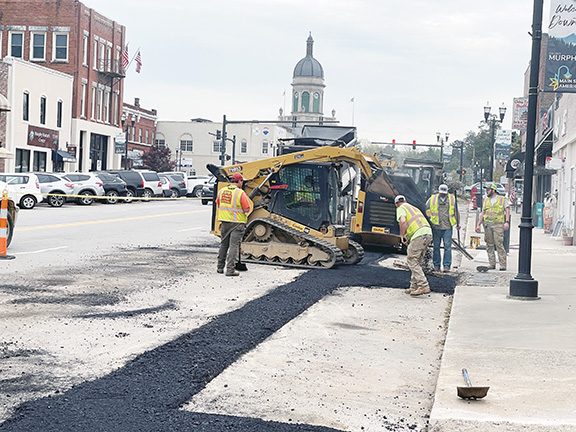
Today, Cherokee County manufactures high-quality tools, machined metal products, and electronic products and components. It raises cattle, grows hay and lots of other agricultural products. Tourists flock here during summer and fall months for countless reasons or while they are on their way to someplace else. There’s a casino, a thriving Murphy downtown with nearly zero vacancy rate. There’s an airport actively working to improve infrastructure.
Worley is paid to be upbeat and optimistic, but he’s also paid to be realistic and practical. He even sees value in data mining – also known as crypto mines – which, if well run, provide huge influxes of property tax dollars to the county, pay for their high demand for electricity, add good-paying jobs and (remember, we said “well run”) have low impact to the environment and their neighbors.
The three things that make Worley’s job hard are the county’s housing shortage, a shortage of affordable child care and the absence of natural gas service.
People generally like to live near where they work. (Telecommuters take that to the extreme.) But as the Bowen report showed, housing is in short supply across all categories. That forces workers to find housing within nearby counties, which takes Cherokee County dollars out of the local economy.
A shortage of affordable child care makes it hard for young families to live and work. And a lack of natural gas service affects Worley’s ability to recruit new industries.
(Side note: Even if natural gas were to suddenly magically be available, existing businesses would continue to rely on existing fuels like kerosene and propane because retrofitting to natural gas would be too expensive.)
Worley’s top three list – housing, child care and natural gas – all point back to his ability to recruit new industry to the area.
As for the state of the economy, Cherokee County is actually doing quite well, he said. Its resilience helped ease it through the Canton mill closure (Cherokee County provided wood chips but has regrouped and found other customers) and workforce reductions over the past year (one plant was able to fulfill its workforce reduction requirement mainly through attrition, while another cut back hours but kept everyone on the payroll.
The towns
Murphy Mayor Tim Radford has a slightly different list that reflects a more broad-based job that includes economic development but goes from there. To Radford, jobs and housing are the top priority.
“We need more good-paying jobs to keep folks around, but finding a place to live here can be tough and expensive. It’s a catch-22,” he said.
Next is workforce. “We have some job openings, but not always the right people to fill them,” he said. “We need to make sure folks have the skills/training they need to land those good jobs.”
Here’s where Radford diverges from Worley. No. 3 is substance abuse. “This is a tough one, but we need to help people who are struggling. It’s better to prevent the problem than deal with the consequences later,” he said.
No. 4 is education. “Good schools keep our young people here and attract new families. We need to make sure our education system is top notch,” he said.
Radford has a list of Murphy-centric issues that in some cases match with county issues, and in some cases are town-specific – including employee retention and sewer system maintenance.
The town’s sewer system is an issue. “Our town is growing, and soon our sewage treatment plant won’t be able to keep up,” Radford said. “We’re asking the state for help to upgrade it.”
Substance abuse is also an issue. “Just like the county, we need to tackle this issue head-on. It affects everyone, and we need to offer support and resources,” he said.
Like the county, housing and homelessness are top issues in Murphy.
“No one deserves to be on the streets,” Radford said. “We’re working with different nonprofit organizations and state/federal leaders to find solutions and get people back on their feet.
“I imagine Murphy in 10 years with plenty of good jobs, affordable places to live, with upgraded infrastructure to support all the folks living here, visiting here and moving here. We want it to be a welcoming place where families can raise their kids and people can enjoy the outdoors and have fun things to do after work.
“It’s a big dream, but we can make it happen if we all work together.”
Andrews faces its own challenges and has still not quite recovered from its pre-1990 days. Still, it too may be on the cusp: downtown Andrews is becoming a foodie destination, an old plant on the town’s west end has been put back into service, a neighborhood of tiny houses was built out, and Andrews continues to be the top choice for family activities thanks to its park system, public pool and baker’s dozen events throughout the year.
Trivia question: Where can you spend the night in a vintage caboose? Answer: Andrews.
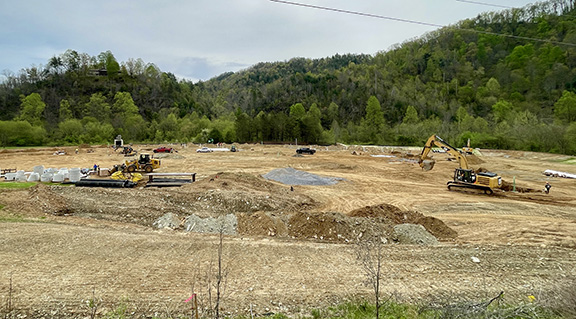
As for housing, Murphy is in the process of building a 56-unit affordable apartment complex to address a workforce housing shortage and is looking at another property off Fort Butler Street as another possible site. Work is in progress to building affordable housing off Old Robbinsville Road near Andrews.
COVID-19 taught that people in many jobs and careers can live wherever they want and work remotely. A developer sees potential there and has bought a long-disused motel – the Mountain Vista Inn in Murphy – and plans on turning it into high-quality efficiency units aimed at people who are still looking for their forever home or who don’t need more than a comfortable bed and an internet connection in a nice setting.
The educators
So economic development and local government see housing as being a big issue. How about higher education?
Donna Tipton-Rogers, president of Tri-County Community College, echos everyone else that housing is a top issue in Cherokee County.
“The scarcity of housing options is a significant challenge, impacting the overall livability and economic growth of the area,” she said.
“The college is actively participating in an initiative, through partnerships with the local towns, county commissioners and the Dogwood Health Trust to develop affordable housing for the county’s workforce in Murphy and Andrews. Through this project, we will be training a new generation of contractors and construction workers, while emphasizing to local developers that there is a strong market for workforce housing.”
Next on Tipton-Rogers’ list is limited child-care services, which she said is “a critical obstacle for working families, affecting both quality of life and workforce participation.”
“In response to the critical shortage of child-care services, the college is collaborating with state, local, and non-profit agencies to identify sustainable solutions,” she said. “However, there are many complexities to the child-care sector, including the issue of under-compensation for childcare workers. Historically, the knowledge and skills of our Early Childhood Education Program graduates have been undervalued.”
Tipton-Rogers also sees leadership development as an important role for the college in the community.
“Education is the great leveler, and degrees from Tri-County Community College offer its graduates new opportunities and open doors,” she said. “In addition to its curriculum degree programs and workforce certifications, the college has worked with local businesses and industries to develop leadership training tailored to their unique needs.
“In 10 years, the vision for the college is one of comprehensive growth and profound community impact. We will continue to adapt our academic portfolio to meet the evolving needs of our community.
“We strive to be a central hub for the region and help foster partnerships that extend beyond the traditional education boundaries into community development, technological advancement and leadership training. Tri-County Community College strives to be a pivotal force in addressing local challenges, enhancing the quality of life and driving economic growth in the region.”