
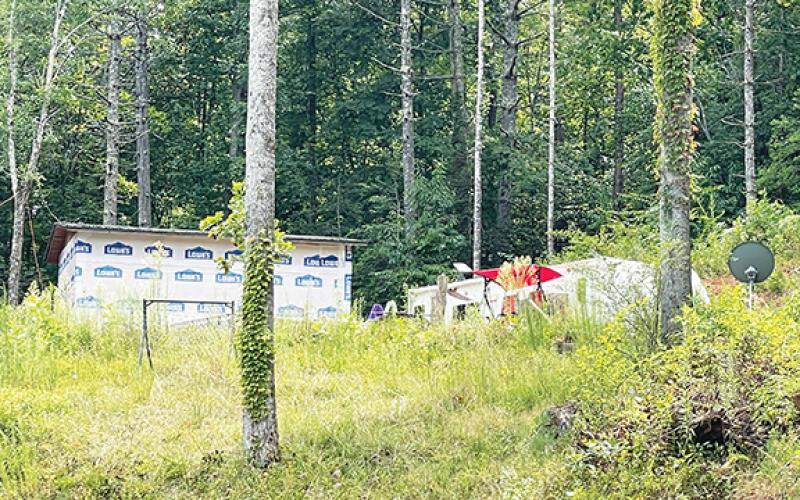
Murphy – J. Harley Kloepfer was right – he was unarmed, complying and shouldn’t have been shot when a Cherokee Tribal Police SWAT team surrounded his travel trailer off Upper Bear Paw Road on Dec. 13, 2022.
However, local law enforcement officials weren’t entirely unjustified in much of their response to Kloepfer’s property leading up to the shooting.
 |
The Cherokee Scout has sifted through hundreds of pages of depositions in the federal lawsuit Kloepfer and Ali Mahler filed against the Cherokee County Sheriff’s Office, Cherokee Tribal Police and others, including nearly 400 pages of transcripts in Kloepfer’s own deposition.
Shortly after his deposition was conducted on Jan. 29, insurance companies for the county and Eastern Band of Cherokee Indians negotiated a $10 million settlement in the case, avoiding a trial. The two entities split the settlement in half, with their respective insurance carriers paying the costs less co-pays, which was $5,000 in Cherokee County’s case.
Kloepfer’s deposition jibes with what law enforcement officials reported about events leading up to the gunfire.
He and his wife were arguing loudly. “So it may sound like I was doing something physical to her or anything like that, but it wasn’t,” Kloepfer said.
He did shoot off about 45 rounds from his handgun – although at a target and not his wife, but neighbors and law enforcement had no way of knowing that.
What happened
Kloepfer did not answer the door when sheriff’s deputies responding to the scene knocked at about 11:15 p.m. He had been drinking earlier that day and fell asleep on his recliner after eating a sandwich.
Something woke him up, perhaps a cigarette in his hand burned to its butt, and he crawled to his bed, where Mahler was asleep. They had been fighting, and he didn’t want to wake her up.
All these details were recorded by surveillance cameras Kloepfer installed on his property. The existence of the video, released a month after the shooting, refuted law enforcement claims that Kloepfer was at fault in the shooting.
The video also showed lights from sheriff’s deputies’ flashlights shining outside the windows and the sound of gentle knocking at the door, neither of which were enough to wake Kloepfer.
What did draw his attention was the sound of his front door opening and closing and the motion of a SWAT team drone rolling about on his floor at about 5 a.m. He pulled out his gun and pointed it at the drone.
When he heard voices coming from outside – “Harley, come out with your hands up, you’re not in trouble, we just want to talk” – he put his pistol aside, picked up the drone and, with a cigarette in his other hand, opened the door.
All SWAT team members knew was the video showed him pointing a gun at the drone. They had no way of telling whether he was still carrying it.
Only some members of the SWAT team opened fire. Kloepfer was shot twice, once in his arm and once in his chest.
From the moment the first trigger was pulled, the incident turned south for local and regional law enforcement officials.
Kloepfer was unarmed and attempting to comply with commands. A release from the Cherokee County Sheriff’s Office laying blame on Kloepfer turned out to be completely false.
Mahler, Kloepfer’s partner who he describes as his wife, the one whose welfare law enforcement was checking on, narrowly escaped being shot and felt a round passing through her hair. She was then detained for hours without being told whether Kloepfer was alive or dead.
District Attorney Ashley Welch refused to prosecute Kloepfer. He survived his wounds, lawyered up and won.
Deposition day
Kloepfer’s deposition took place in Murphy on Jan. 29 and lasted nearly seven hours.
During his deposition, Kloepfer described his personal history, relationships, motivations and even his finances. The lengthy interview was grueling, with Kloepfer’s lawyer constantly admonishing him to only answer the questions asked and not stray off track.
Kloepfer and Mahler were represented by Raleigh-based lawyer Ellis Boyle of the Ward & Smith law firm as well as local lawyers Beverly Cook and Zeyland McKinney.
Three sets of lawyers appeared for the defendants – Asheville-based Adam Peoples and Cameron Nieters for three members of the SWAT team, Jake Stewart for the Eastern Band, and Charlotte-based lawyers Mike Ingersoll and Sean Perrin of Womble Bond Dickinson law firm for the county.
The deposition started at 10:45 a.m. and ended at 6:47 p.m., with several breaks in between.
During the interview, Kloepfer said he tried to become friends with his neighbors after he moved to Upper Bear Paw. He advised them that if he was making too much noise, they could just call him.
From revving motorcycles to loud music, fireworks and target shooting, Kloepfer was no one’s idea of a quiet neighbor. The neighbors never called him about excessive noise; instead, they called the sheriff’s office.
Emily Floyd was one such neighbor. Her contacts with the sheriff’s office led to the initial response in December 2022, when all deputies knew was that there had been loud arguing, gunshots and then silence.
Kloepfer said Floyd didn’t fabricate what she reported to deputies, but said she did exaggerate and dramatize it. He described the argument as “New York-type screaming.”
Kloepfer said he has watched the videos over 1,000 times over the previous two years.
The aftermath
Kloepfer said he is 30% paralyzed from the waist down after he was shot by a gang member in Las Vegas about 10 years ago.
He said living in a travel trailer made it easier for him to get to the bathroom, kitchen and bedroom. He kept his motorcycles and ATVs in a garage beside the travel trailer.
It was perfect, he added.
He was living off disability checks supplemented by an $800,000 trust established from a $1.2 million lawsuit settlement that followed his shooting in Las Vegas.
“We went to the Bible Belt in North Carolina to get away from it all and thought we were going to live a better life and happy life,” he said. “And that’s until they shot me and tried to shoot my wife.”
Since the December 2022 SWAT raid, he hasn’t slept in his home. He has lived with friends and relatives in Florida and New York, burned through his trust fund and run up $200,000 in debt.
His plan for proceeds from this latest lawsuit is to find a new perfect home – but this time he won’t rely just on surveillance cameras for security. He plans to have a security guard.