.
Murphy – Imagine dialing 911 because of a domestic disturbance and having not just a deputy sheriff respond, but a trained social worker as well.
That’s the scenario playing out in a number of communities throughout the nation – including western North Carolina, where the Sylva Police Department has partnered with Western Carolina University to provide social workers for cases that require a more holistic touch.
The Cherokee County Sheriff’s Office is pursuing grants to fund a similar program in Cherokee County, but there are some hurdles. Capt. David Williams is leading the effort to create a local version of Sylva’s Community Care Program.
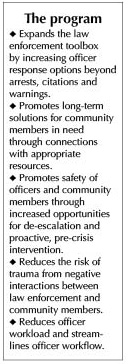
“There is an ongoing national conversation about what modern policing should look like in the future,” according to a summary of Sylva’s Community Care Program at sylvapolice.org. The root causes of homelessness, drug abuse and other issues plaguing rural communities are being addressed head-on.
“While there are a variety of ideas being discussed and even several new models being implemented in some major metropolitan areas; modern policing in rural areas has yet to be defined,” according to Sylva police.
“The Sylva Police Department and Western Carolina University decided to be very intentional about charting the future of policing for rural law enforcement. We have partnered together to create a new model of policing.”
Sylva’s program was launched in 2021. The service consists of placing a senior-level or graduate-level WCU intern from the Department of Social Work within the police department to serve in the role of community care liaison. The primary functions are to follow up with citizens involved in police calls for service and connect victims with community services.
There is no cost to taxpayers for this service.
“When a police officer encounters an individual that they identify as someone who could use additional attention, the officer submits a referral to the community care liaison,” according to Sylva police. “The Sylva Police Department and Western Carolina University are committed to learning ways to improve policing by integrating aspects of social work into a small-town police department. The community care program is already having a positive impact in our community, and we look forward to seeing this program grow.”
Funding
Cherokee County is in the beginning phase of building a program similar to Sylva’s, but faces a couple of challenges from the start.
When officials started looking into the program, they found the process to apply for a federal grant to be more complicated than expected. Williams said his office will have to seek a planning grant to pay for the groundwork necessary just to apply for a funding grant; dollar figures have yet to be worked out.
The other challenge is proximity. Sylva is just down the road from Western, and students in the program have a short commute. For them to work in Cherokee County, they face a much longer drive.
Among details left to be worked out is compensation for the social workers; that and other factors will be ironed out using the planning grant. The completed application will be submitted for the actual funding grant, which will cover any costs to provide a social worker.
Ideal candidates would have a very specific mindset, according to a presentation Williams showed to the Cherokee County Board of Commissioners.
Social workers need an attitude of collaboration, respect for law enforcement, ability to obey commands, assess dangerous situations, appreciate copy mechanisms of first responders, perform well in a crisis, comfortable interacting with anyone, willing to find and address root issues, and be self-motivated and community-minded. The program started as a research project and today is a grant-supported program at Western.
Two faculty members – Cyndy Caravelis, professor of criminal justice, and Katy Allen, professor of social work – began the research project as a response to a growing need in Jackson County for alternative policing models to connect community members to resources in non-criminal situations, according to Western.
“We are beginning our third year of the program and after expanding to the Boone Police Department and having two years of positive results from multiple agencies, we began seeking out grant funding to support the project,” Caravelis said. “We had a series of meetings with Dogwood Health Trust, and one of the reasons they were interested in this project is because it is tackling some of the issues that we are really struggling with, especially in rural counties.”
Those issues include substance abuse, mental health and trying to find alternative policing models for non-criminal police calls.
Adding agencies to the program requires a pre-site visit and conversations with local leadership to make sure that the culture of their police department would be accepting of social work participation, Caravelis said.
Growing
After the pilot year, the program has been growing at a rate of one agency per semester. During the spring 2024 semester, Caravelis hopes to be able to have another intern assist the full-time position at the Sylva Police Department.
“This intern position will support the full-time position because once people know that this service exists, there is no shortage of its use by the community,” Caravelis said. “Sylva is a town of roughly 2,800 people, and the coordinator is very busy. Because a lot of these cases are very complex, it takes a long time to figure out what services they have sought out in the past and what exactly is needed in the present.”
This upcoming school year, Caravelis plans to reach out to the various student organizations on campus to share the programming available through WCU Police as well as working with the Eastern Band of Cherokee Indians for placing students in internships.
“This semester, we are placing a student with the Office of the Tribal Prosecutor which of course requires a lot of victim and offender interaction and caseload management. The goal is to have an entire network of Community Care coordinators across not only this region but also the state,” Caravelis said.
“I often hear people say, ‘What are we going to do about these issues, there are too many to fix?’ and well, through this program, we are able to do something concrete. We are getting to the root of the issues by connecting individuals to resources and while no, you can’t change a community overnight and just make the issues vanish; but person by person, you are laying the foundation for real change.”
The Sylva Police Department was chosen as the 2023 N.C. Law Enforcement Agency of the Year by the N.C. Police Executives Association. The association cited the Community Care partnership as groundbreaking innovation for rural agencies and commended the Sylva Police Department for its innovative approach to alternative responder protocols.
“This program is all about meeting people where they are,” Caravelis said. “We are not making the community member do an extensive intake before they can talk to someone who can help. We are sitting on a curb, talking with them and figuring out their needs and how to best connect them to resources.
“Through this, we are able to give our students real world, non-sterile experience that goes right along with what they will be doing in their careers.”