
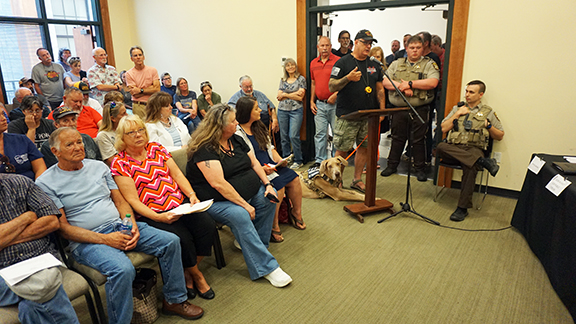
Murphy – Following the Cherokee County Board of Commissioners’ rejection of a proposed animal control ordinance, many people left that July 17 meeting looking to the Cherokee County Sheriff’s Office to enforce state laws against vicious pets.
When asked about it, Sheriff Dustin Smith issued this statement:
“The Office of the Sheriff of Cherokee County is looking forward to working with our community partners; The County Commissioners, The Cherokee County Health Department and The Valley River Humane Society to find legally valid ways to address the myriad of animal control issues facing our communities.”
The statement was brief, but the tip of the iceberg as his staff sifts through state laws to figure out how to move forward.
Commissioner Jan Griggs drafted an animal control ordinance to address vicious dogs, among other things. But she found fleeting support from just one other commissioner, Ben Adams.
Faced with hopeless odds, she sought to withdraw her proposal at the July 17 meeting but was talked over by Commissioner Dan Eichenbaum, who wanted to discuss the proposal. He got support from Commissioners Randy Phillips and Cal Stiles, the board chair. The board voted to discuss Griggs’ ordinance on a 3-2 vote and, to ensure the discussion would take place, rejected her motion to withdraw her proposal, again by a 3-2 vote.
The commissioners agreed with Griggs, who said a local ordinance would simply echo state laws, with Griggs now advising people to contact the county sheriff if they have problems with vicious domesticated animals.
Several people who have been attacked by unleashed dogs have told commissioners they received little or no support from the sheriff’s office. According to sources within the sheriff’s office, it can’t identify a specific dog involved in an attack without photographic or video evidence.
In short, dog-bite victims want justice and compensation for their injuries, but law enforcement want a case they can win in court – and they can’t make that case without hard evidence.
The result is chronically vicious animals remain free to attack again, with few or no repercussions against the dog or the owner.
A few years ago, commissioners authorized one deputy to be trained in animal control. That deputy remains on the force but has been given other assignments. Smith had advised Griggs to call for one or more animal control officers who are not sworn deputies to avoid the temptation to reassign them to other law enforcement tasks.
Paying for one to two new positions was a sticking point in Griggs’ plan, especially since the sheriff already has a deputy certified in animal control, but not the only sticking point. Concerns include issues about mandatory leashes to worries that a dog that growls or nips at strangers could be declared vicious.
There are also concerns that state laws sometimes carry criminal charges, such as N.C. Statute 67-2, which covers dogs in heat: Any dog owner who allows a dog in heat to run at large is guilty of a Class 3 misdemeanor, according to the law.
State law also specifies that many animal control issues, including rabies and vicious animals, should fall under the control of the local health director – not the sheriff.