
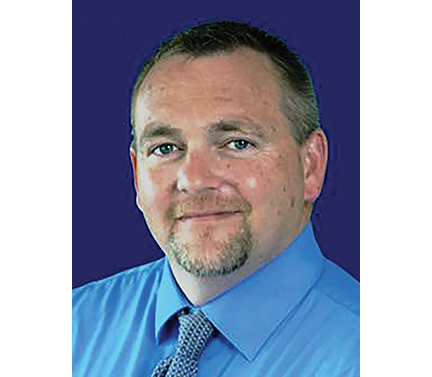
Smith
Murphy – Dustin Smith knows all too well the type of trauma law enforcement officers can sustain in the line of duty.
Smith, who is Murphy’s assistant police chief and unofficially sheriff-elect in Cherokee County, was shot in the line of duty in 2001 following a traffic stop.
The experience forced Smith to face mental health concerns head on, and the cause remains important to him more than two decades later. He and Police Chief Justin Jacobs worked closely with town management earlier this year to implement a mandatory annual mental health session for all Murphy police officers.
Smith said he simply wants to take a proactive approach to law enforcement officers’ mental health.
“We chose to make it mandatory because at the end of the day, if we’re saying we want to help the officers with their physical and mental well-being, we can’t sometimes just rely on them to come to us and say, ‘Hey, I think I need to talk to someone about some things I’ve seen or whatever,’ “ Smith said.
“I want to make sure we’re giving them the opportunity to do that. At the end of the day, it’s their choice – they can sit and play Candy Crush on their phone for that hour, but I want to make sure we’re giving them that opportunity.”
According to the National Alliance on Mental Illness, 35 percent of police officers suffer from post-traumatic stress disorder. Law enforcement personnel are 54 percent more likely to die of suicide than all others with a “usual” occupation, based on the National Library of Medicine.
Smith was part of a recent push to get state legislators to implement mental health evaluations at certain intervals during an officer’s career – such as seven years, 15 years and 25 years. He was disappointed when that effort proved unsuccessful, so Murphy instead decided to implement its own annual mandate.
“North Carolina did a law enforcement reform bill, and we were hoping they would put that in there and mandate it from the state, but unfortunately they didn’t,” Smith said. “They put it in there and just recommended it for law enforcement.
“I just look at all these officers who go through a 30-year career and just deal with a lot of different things. Officers can kind of be people that are prideful and don’t say, ‘Hey, I want to talk to somebody about something.’ ”
Town Manager Chad Simons said the Murphy Police Department’s mandate is a “baby step” in the right direction.
“We don’t have enough resources to deal with this (mental health) issue, and I think for years it’s just been ignored,” Simons said. “It’s come to the forefront now.
“Honestly, people expect our officers to do everything. Not only are they supposed to protect life and property, but they’re supposed to be EMTs, nurses and also mental health counselors when they approach a dangerous situation.”
Smith was in his early 20s in 2001 and was new to patrol as a Cherokee County sheriff’s deputy when he was shot twice with a 12-gauge shotgun following a traffic stop and car chase. Though his bulletproof vest prevented the outcome from being more severe, Smith endured multiple surgeries and will always carry pieces of that encounter with him as a daily reminder of it.
“I still to this day have got 40-something shots in my body,” Smith said. “It’s something I deal with pretty much every day, physically.
“I did seek some counseling for that, but I also realized the importance of that – just any incident you go through in public safety, whether it be a car crash and you’re seeing people dead, children. I just felt like it was very important for us to start dealing with those situations for overall health.”
Smith believes officers have been grateful for the opportunity to speak to a mental health professional and embraced the idea that the department is trying to take care of them. He is expected to be sworn in as sheriff in December, and he would like to implement a similar policy with county law enforcement after he’s in office.
Simons said local officers face additional challenges being in an area where the median income is well below the state and national averages, and access to health care is below neighboring states.
“I’ve had to review some of the calls (officers) have been on, just people needing mental health care that didn’t get it,” he said. “The amount of de-escalation and the skills it takes is immense.
“I don’t know how you quantify that, it’s like not a tangible skill, but it’s a skill nonetheless and a very important one. We have issues every day that nobody knows about because it doesn’t escalate farther, where it might have if they were less of an officer.”