
Andrews – Aging infrastructure, high costs and deferred funding for maintenance are causing headaches with the town’s sewage treatment plant. But hope may be on the horizon.
“This is not the fault of the/any town administration, nor is it the fault of the operators who have been working to put a Band-Aid on the issues to keep the plant running in the best capacity that it is capable of under the circumstances,” said Tim Wood, operator in responsible charge of Andrews’ wastewater treatment plant.
Wood delivered a sobering report to the board of aldermen at its Jan. 11 meeting about the treatment plant, which is off Reagan Avenue on the town’s east side. Andrews’ decades-old wastewater treatment plant is what’s known as a “Grade 3 biological wastewater system.”
It uses two biological trickling filters as the primary treatment of the town’s wastewater, and won’t work efficiently if they do not operate as designed, Wood said. The trickling filters are two large towers filled with a composite material called “media” Wood described as a honeycomb structure.
Untreated water from the pump station enters the filters at the top by rotating arms, which spray the water out evenly across the surface of the filters. The water trickles down the media where bacteria consumes the solids, breaking them down and reducing ammonia-nitrogen and increasing oxygen, which in turn reduces what is known as biochemical oxygen demand (called “BOD”).
The filters eliminate the majority of these two state- and EPA-mandated parameters so that the town can meet the standards required in its permit.
The main influent pump station is responsible for pumping water to the filters. When it works properly, it allows for adequate recirculation and through water pressure, it creates the force needed to rotate filters.
Now for the problem – the rotating arms aren’t rotating.
“We are being fined regularly, and are unable to meet our permitted limits – primarily for BOD and ammonia-nitrogen – because our filters have not, and are not operating properly,” Wood said.
“We spent over $100,000 during the last attempted upgrade – which, by the way, did not get completed due to financing – to replace the media, bearings and seals in both filters.”
That helped for a while, but without the pumps station working property and inadequate flow to the filters on a regular basis, the filters once again began to fail.
Wood said this might have been caused by the sporadic flow of the water to the filters not creating the necessary pressure to keep the filters turning continuously. This allowed corrosion and debris to gather around filter seals and bearings.
It could also have been due to faulty repair during the refurbishing process.
“There’s no way of knowing,” Wood said, “possibly a mixture of both.”
The high cost to again rebuild the filters was weighed against the town’s plans to build a new pump station and treatment plant within the next two years.
Wood’s first inclination was to seek reduced state fines and do his best to comply with requirements as much as possible until the new facility is built. The town has been able to get the fines reduced in the past, whereas the cost to rehabilitate the filters was prohibitively expensive.
“We might save the town money by simply paying the fines vs. spending the type of money it had cost previously to rehabilitate the filters,” he said. “I was looking at it from a cost-analysis standpoint.”
That scheme worked, but Wood said he recently changed his mind.
“I was originally under the impression that our pump station project, and new plant construction would have already begun,” he said. “However, due to the red tape and bureaucracy of dealing with DEQ, EPA, USDA and every other acronym under the sun to finalize a project like this, it has been drawn out much longer than I initially thought.”
The town is getting hit with higher fines as a result, Wood said.
“It was apparent in the last letter from the state assessing us a civil penalty (fine), that they would no longer reduce the amount of our fines as I had been able to get them to do in the past,” he said. “From their perspective, we have no excuse, and the fact that we are working rapidly toward, and have the funding approved for a new facility that will address all these issues is irrelevant.
“It is their position that we should have already addressed the problems with the plant years ago – funding or no funding – therefore they don’t feel the need to offer any leeway.”
In meeting with McGill Associates, the firm the town contracts with for engineering services, he decided that there might be another more cost-effective option that meets limits and eliminates fines over the next year until the new plant goes online.
“We would like to eliminate the need for the filters to turn altogether and replace the current arms with a fixed distribution system that would spread the water out over the surface of the trickling filters,” Wood said. “This would serve the same purpose as the original rotating concept, yet it would be much more cost effective/cheaper, without even needing to do any major repair.”
The fixed distribution system would work via piping across the area of the filter with nozzles that spray the water over the surface.
“In a nutshell, it would essentially be one big plumbing project,” Wood said.
The wastewater plant has $30,000 in unused capital improvement funds. He said $16,800 is enough to get one filter working.
“Since the state does not require us to have an order to construct for this project, we can approve and begin this project at our leisure if we choose, as long as the money is available,” Wood advised the town aldermen.
This repair, along with work on a new pump station that is set to begin early spring, “should go a long way in resolving these issues altogether until we are able to finish the new plant,” he said.
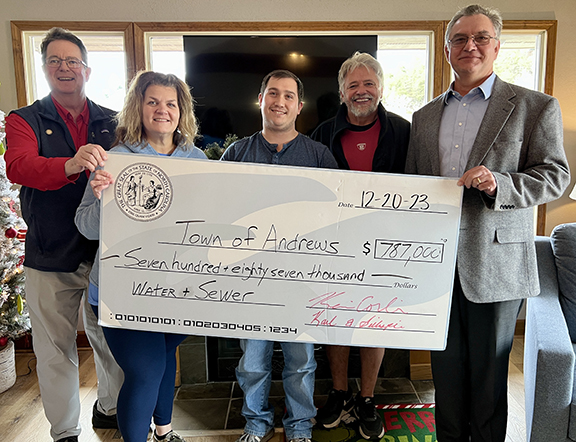
The board approved the first $16,800 to begin the project. Wood expects to come back with a request for the remaining $13,200 in unspent funds in the hope that it will be enough to complete both filters. More than $11 million in state funding is earmarked for the town’s new treatment plant.