
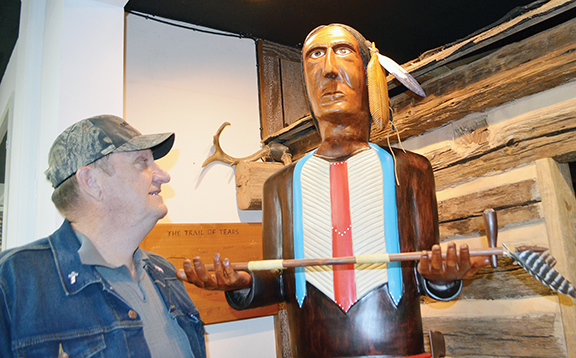
Murphy It took James Bryant just under 100 hours to sculpt his Native American figure from locally sourced southern white pine.
“I used a chainsaw, an angle grinder and a chisel,” he said, adding, “I lost two fingertips during the project.”
The finished piece – a 130-pound, 7-feet, 11-inches tall sculpture – stands in the Cherokee County Museum on Peachtree Street downtown today. Billy Ray Palmer, a museum board member, is thrilled to have the sculpture overseeing the Trail of Tears display at the museum.
“Rhodes Scholar tour busses come through here and just stand in front of it in awe,” Palmer said.
The “awe factor” is easy to see. It’s not just the impressive size of the piece, but Bryant carved the sculpture with a delicacy seen in the Indian’s features.
“I named him Yellow Feather,” Bryant said, “because his feather is made from Osage orange. A friend of mine brought the wood to me from Oklahoma.”
The origin of the feather wood creates a full circle metaphor, as it comes from the final stop on the forced removal of Native Americans from the Appalachian Mountains to Oklahoma on the Trail of Tears under President Andrew Jackson’s Indian Removal Act in 1830. Bryant said he used his own dimensions as a guide to create the sculpture.
“If you look at his palms,” Bryant said, holding his own up for comparison, “you’ll see the lines and grooves match mine.”
Palmer, an old friend of Bryant’s, points out the peace pipe Yellow Feather holds in his open palms.
“He filled that peace pipe with Rabbit weed,” he laughed. “We used to smoke that back when we were school boys.”
Bryant added, “It was real pungent. We’d smoke it in a corn cob pipe, and it burned.”
Both men chuckle at the memory. Bryant was a wood carver from a young age.
“I whittled wood as a young boy,” he said, fishing a whittling knife out of his pocket. “I’ve had this knife for over 40 years,” he added, flipping it open to examine it as if seeing it for the first time.
His first formal training came from Jack Hall, an instructor at John C. Campbell Folk School in Brasstown.
“He told me, ‘All you gotta do is take off the wood that isn’t needed. If you’re carving a dog, just take off what’s not dog,’ ” Bryant said with a laugh.
Yellow Feather isn’t the first contribution Bryant has made to the museum.
“If you look up,” Palmer said, pointing to a row of wooden masks hanging in eyeshot of Yellow Feather, “you’ll see the Seven Clans of Cherokee Masks.”
The masks, each a different shape and color, represent the clans of Long Hair, Wolf, Blue, Wild Potato, Deer, Bird and Paint.
“There is no other collection like them,” Palmer said with reverence. Upstairs, on the main floor of the museum, is another Bryant installation of a five-foot bust of a Native American.
“The humidity cracked the wood,” Palmer explained, pointing out a deep groove running down the side of the sculpture’s nose. “I like it there because it looks like tears.”
Both of Bryant’s sculpted faces appear stoic and grim.
“I’m part Cherokee,” Bryant said, “so, because of my heritage, I choose Cherokee, and you don’t often see them smile,” referring to Trail of Tears art.
Palmer added, “They were marching west, to the place the Native Americans considered the place of death because that’s where the sun set.”
Bryant is most proud of the yellow feather hanging from the sculpture’s hair.
“The hardest to do was the face,” he said, “but overall, I was surprised by the outcome.”
At 75 years old, Bryant has no plans for a future project but remains open.
“If the urge hits me,” he said, “I will.”