
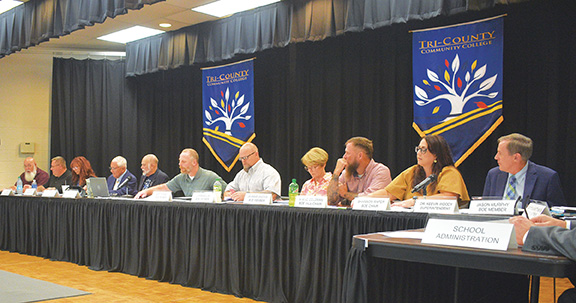
Marble – Cherokee County Board of Education members Shannon Raper and Steve Coleman will be representing the school district in upcoming meetings with county commissioners, Raper announced at the school board’s meeting Thursday.
Raper, chair of the school board, and Coleman, vice chair, will be accompanied by Stephanie Hass, chief finance officer for the school district.
The meeting was requested by county Commissioner Dan Eichenbaum on behalf of the board. County Manager Randy Wiggins said the board will probably appoint its representatives – two county commissioners and chief financial officer Candy Anderson – at its next meeting Monday, Oct. 7.
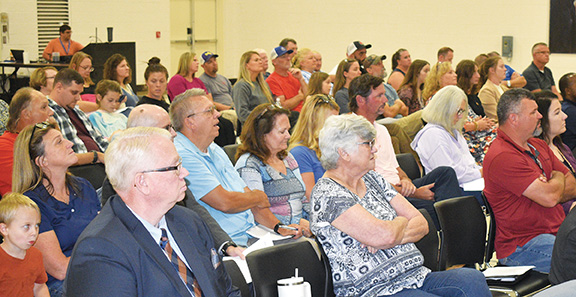
The long-awaited first meeting between Cherokee County commissioners and school board members on Sept. 16 gave the public a chance to say their piece and elected officials to express their feelings face to face. However, the only concrete action that came from it was an agreement to have more, smaller meetings.
The school board has been unable to reach a consensus about how to reduce the high number of campuses in the county. The board’s official plan still calls for consolidating high schools, and the current board, which includes four members who ran against consolidation, has not updated that plan.
Three board members have come up with alternative consolidation schemes that focus on elementary and middle schools.
Meanwhile, the board of commissioners, which has final approval on school district expenditures, has been seeing a steady stream of un-budgeted spending requests for things like a chiller rental and parking lot paving at Hiwassee Dam, roof repairs in Andrews and funds to buy new cars for school resource officers.
The school district submitted a list of questions to the county government leading up to the Sept. 16 meeting. Most of the county’s answers were matter of fact.
One question asked what process commissioners will implement to ensure facility funding over the coming years. The commissioners propose meeting at least every six months.
The school district asked what the county will do with its millage rate increase used to pay a $20 million settlement of lawsuits against the Department of Social Services. They wanted to know whether proceeds from the 8-cent millage increase could be applied to schools once the settlement is paid off.
The county is paying $2.9 million a year toward that settlement, with the last payment due in July 2030. The commissioners passed a resolution stating that “it is the intent” of the commissioners to abolish the millage increase once the settlement is paid off.
The school district asked when was the last time the county increased property taxes to directly fund Cherokee County Schools.
While the county has not dedicated specific property taxes to education, it replied that its general fund appropriation to schools has increased 38% since the 2013-14 fiscal year, compared to the average inflation rate of 24.7% during that time.
The school district asked how the county will provide additional funding to education since it detached Article 64 quarter-cent sales tax proceeds from the schools and applied them to the county general fund. This is where things get a little spicy.
The school district “has not made any requests for capital outlay in the past several years, choosing to put all its eggs in the current expense fund,” board clerk Maria Hass wrote in the response. Un-designating future Article 46 sales tax revenue prevented a county property tax increase.
“The 1/4 cent sales tax has been under-utilized by CCS leading that balance to double in just 2 to 3 years, all while continuing to request additional GENERAL fund appropriations from the county. In the 2023-24 fiscal year, CCS asked for and the CCBOC approved $704,842 from Article 46 sales tax spending. Of that amount, CCS never drew down $561,164 leaving such funds unused. If it was not needed, why was it requested and set aside?”
Schools officials say approved funding requests are set aside essentially until the work is done and bills arrive. They can’t control how long that process takes.
The schools asked what’s the county’s long-term plan to develop and fund future facility needs.
“This is an impossible question to answer without CCBOE telling the county what it needs and how it expects to get there,” Hass replied. “Grants may be available, but CCS must make the applications based on heretofore unknown plans.
“Grants cannot be relied upon to fund 100% of the building project(s) nor the acquisition of property upon which to build. Loans may be available to fund capital needs or to fund grant matches. Money must be allocated to service debts. This may be achievable through sales tax revenues, a property tax increase or a combination of the two. It will depend on the proposed project.”