
Brasstown Hidden within the sun-dappled valley of Cherokee County, a realm of curiosity awaits. Geology meets adventure in the captivating hobby of rockhounding. Rockhounding is the hobby of collecting rocks, minerals and gemstones. It has surged in popularity in the last 100 years.
From the amateur geologist marveling at the glint of mica in a stream bed to a seasoned prospector uncovering a vein of quartz deep within the earth, rockhounding offers a physical connection to the area.
A local rockhounder has made her passion into a lifelong hobby creating jewelry from the rocks that she finds. Local resident Katie Pressley has been fascinated by rocks her entire life.
From a young age, Pressley has had a serendipitous journey in rock hunting. As a first-grader at Martins Creek Elementary School, Pressley’s teacher, Sheila Little, would give students the incentive of either the treasure box filled with small toys, or the “rock box” filled with rocks from her travels.
“Most kids would say, ‘Let me have the treasure box,’ and I would say, ‘Let me see those rocks,’ ” Pressley said with a laugh. “It was full of colorful pieces of petrified wood and other rocks she probably got from her travels out West.”
Creek rocks
She said she would also search for rocks in the creek behind her aunt and uncle’s house as a kid with her twin sister, Corie, and her cousins.
“Part of the creek was dammed up, and we could swim in it,” Pressley said. “We were around 8 years old, and while swimming we’d see who could find the coolest-looking rock or the biggest.”
In 2022, when family came to visit, Pressley said she walked her cousin’s dog to the creek. She noticed an interesting rock and tried to pick it up, but the dog thought it was a toy and tried to take it from her.
“I had never seen this kind of rock before,” she said. “It was two minerals occurring inside this white rock, probably calcite with garnet and hornblende gneiss speckled inside.”
She said through the years, she would always go back to the creek and collect rocks of different shapes and colors. Eventually, she had the curiosity to see what she could do with her collection.
“I first started doing jewelry with beads and wire, I had several people along the way tell me I could cut and polish the stones to make jewelry and put my two hobbies together,” Pressley said.
Expanding eduction
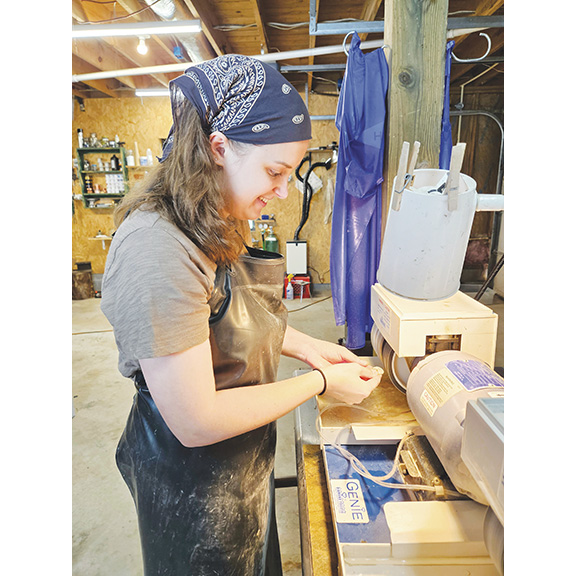
In 2019, Pressley took a class at the William Holland School of Lapidary Arts in Young Harris, Ga. She learned how to cut and polish stones, as well as what type of machines and other gadgets she needed to get started.
In the height of the COVID-19 pandemic, Pressley saved up and bought the equipment she needed to start creating with the rocks she found over the years. In order to understand the art even further, she studied geology texts and materials to learn all she could about the stones.
“My senior exit project in high school was all about the geological formations in this area, and it gave me a practical application of my knowledge,” she said. “Other ways I have had help is from local geologists to better understand the rocks she picks up and how to cut them.”
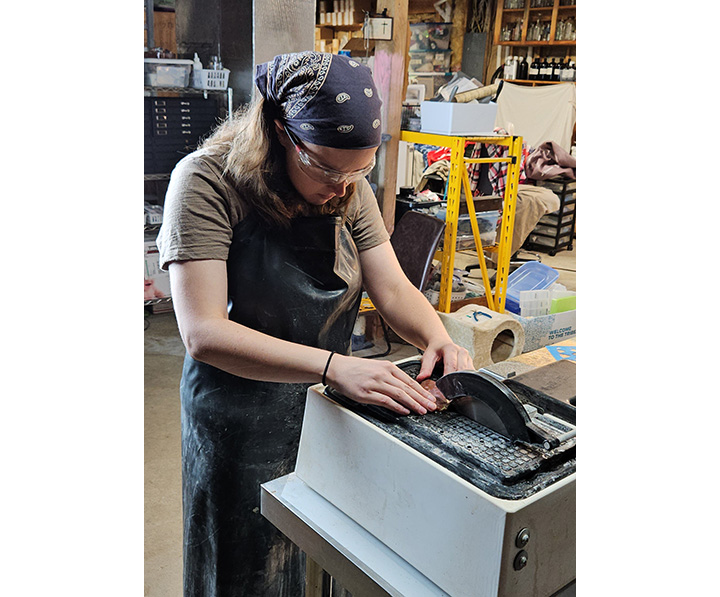
Pressley relayed that while the process of cutting a rock is easy, and the blade is not sharp like a regular saw, some stones are still difficult to cut because it will break apart easily.
“It’s so much fun,” she added, “The mystery of what’s inside some of these cool rocks, like agate, with cool patterns or thunder eggs from farther west that look greenish brown on the outside, but when you cut them there’s beautiful crystal formations on the inside.”
‘Every rock is different’
Once a rock is cut, it moves to the process of shaping and polishing. With nine wheels of varying grit from 80 to 80,000, Pressley smooths and polishes the rock until it shines, with all of the scratches gone.
“Every rock is different, some polish better than others,” she said. “There’s multiple ways to do this and multiple machines to use. I just cut what I think is pretty.”
Every machine to cut and polish rocks uses water or some other lubricant, like mineral oil, to make sure the machine and rock doesn’t not get hot, lubricates the wheel, and keeps dust from getting in the air and into the lungs.
“Usually I wear a respirator especially with rocks that have any kind of metal qualities like pyrite,” Pressley said. “There is a material called Bumble Bee Jasper, which is yellow in color, and there is sulfur inside. Tiger’s eye stones have asbestos in them.”
Once the stone is cut and polished, it is ready for its new home either in a piece of jewelry or sold alone. Pressley, like other rock hounders, enjoys seeing what can be found and how the stories each rock can tell.
The Gem & Lapidary Wholesale is a biannual gathering for rockhounders only one hour away in Franklin, where people travel from far and wide to trade and sell their finds.