
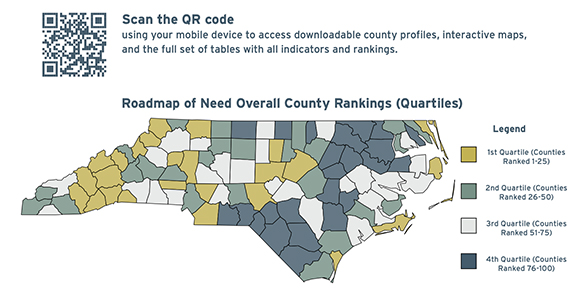
A study of child needs in North Carolina ranked Cherokee County squarely in the middle of the state’s 100 counties, receiving an overall rank of 47.
The study includes such factors as economic development, physical health, mental health and safety, education inputs and education outcomes. Cherokee County ranked 47th overall – 60th in economic development, 84th in physical health, 72nd in mental health and safety, second in education inputs and 49th in education outcomes.
While the county ranked poorly in physical health and mental health and safety, it ranked near the top in education inputs, due in some part to the county’s overabundance of school campuses. Among surrounding counties, Clay ranked 58th overall, Macon 31st and Graham 35th.
Western North Carolina counties were generally in the 1st or 2nd quartiles, compared to eastern North Carolina, where most of the counties were in the 3rd and 4th quartiles. The Roadmap of Need is a whole child needs assessment for state youth, produced biennially by the Public School Forum of North Carolina.
The Roadmap presents county-level data and rankings on 20 indicators of wellness across five domains: economic development, physical health, mental health and safety, education inputs, and education outcomes. “We believe these five domains capture the interconnected conditions and resources that are necessary for a child to succeed, both inside and outside of the classroom,” the report says.
The Roadmap serves as a key resource for policymakers, school leaders, out of school time providers, funders, nonprofits, families, and the public to identify areas in need of targeted investment in order for children to thrive in school and in life.
The findings illustrate “a troubling reality of the inequities in resources, well-being, and opportunities for youth across North Carolina,” according to the report. “The Roadmap points to a number of counties where young people have the greatest need, particularly those in rural eastern North Carolina. It is also important to note that the nature of countywide indicators can mask the significant variation occurring within counties, particularly in our more populous urban areas.”
The study takes into account a wide range of data sources, including median household income, jobless rates, child food insecurity, suicide rates, drug overdose rates, juvenile detention admission rates, student-counselor ratio, teen pregnancy rate, physicians per 100,000 residents, child fatality rates, teacher vacancy rates, federal expenditures per pupil, local expenditures per pupil, school test scores and more.
Cherokee County’s economic development data included median household income of $44,211, a jobless rate at the time of the study at 5.1 percent, a housing cost burden of 24 percent, and a child food insecurity rating of 16.1 percent.
Physical health data for the county included a teenage pregnancy rate per 1,000 of 27.4 percent, physicians per 100,000 population of 17.8, a child fatality rate per 100,000 of 101.3 (among the highest in the state), and an uninsured rate of 15.7 percent.
Several requests for insights into the report made to Cherokee County Schools officials over the last month went unanswered.