
Franklin – Alex Fulford spent his life doing the right things, sometimes at great risk.
He was a career Marine Corps aviator, at one point commanding a helicopter squadron. He earned two bachelor’s degrees and a master’s degree and, after his military service, piloted a medical evacuation helicopter that saved people’s lives.
Fulford was a seasoned pilot with more than 4,700 hours of flight time, including 4,410 hours in helicopters and 1,670 hours as an instructor. However, just before 7 p.m. March 9, he made a mistake that cost him his job – and possibly his career. But it could have been far worse.
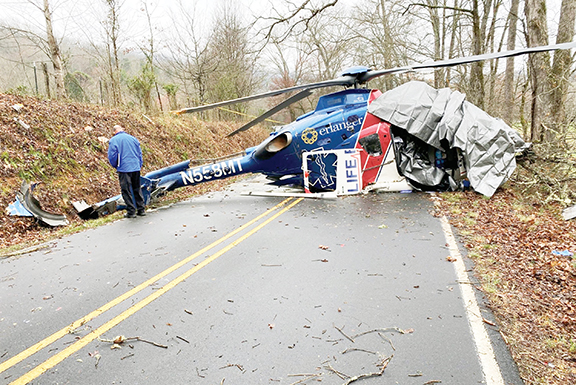
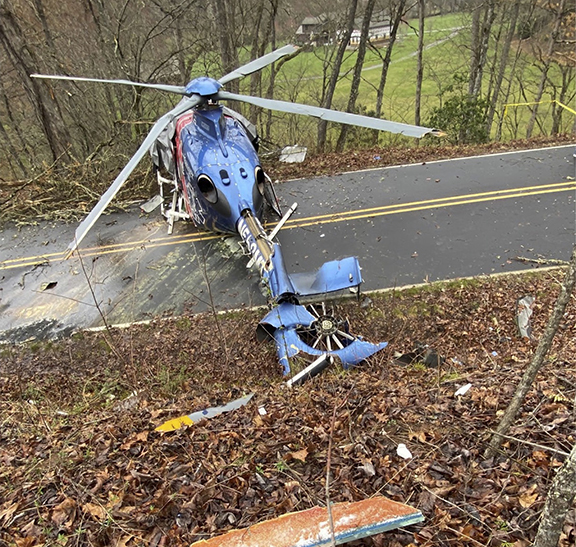
Fulford was the pilot assigned to the LifeForce 6 medical evacuation helicopter based at Western Carolina Regional Airport in Andrews. On March 9, the helicopter he piloted crashed west of Franklin while flying a patient from Erlanger Western Carolina Hospital in Peachtree to Mission Hospital in Asheville.
Injuries from the crash were described as minor, though damage to the aircraft was major.
‘Cut to the chase’
The National Transportation Safety Board investigated the crash and in its final report, issued June 6, almost three months after the crash, blamed it on pilot error. The board said nothing indicated equipment or training as causes of the crash, and “reinforcement of company operating requirements and procedures will be conducted at a minimum.”
The case docket identified the pilot as Fulford, 51, of Hayesville. He holds bachelor’s degrees in alternative and complementary medicine and medical systems, as well as communication and media studies. He holds a master of arts in education.
 |
Fulford issued a statement to the National Transportation Safety Board that left little doubt about what caused the crash. The statement goes into detail, but boiled down, he was checking the maintenance status an engine and, while he was distracted, failed to notice the approaching mountain terrain.
Unable to avoid a collision, the helicopter scraped against treetops and spiraled to the ground, landing hard on a two-lane mountain road. All aboard – Fulford, two medics and a patient – survived.
“Though I am extremely grateful for the outcome, I am also aware that we never should have had to land the aircraft in such conditions and that it was my actions and my inactions, that caused this incident,” Fulford said in his statement. “As a former USMC squadron commanding officer, executive officer, Director of Safety and Standardization, Aviation Safety Officer and mishap investigator, I am very familiar with and aware of causal factors, correlating factors and culpability.
“I have been the member of multiple mishap investigation teams and experienced the aftermath. I respect the investigative process and know each member will be thorough and present their findings as dispassionately as possible.”
Fulford “cut to the chase” and stated unequivocally that he miscalculated the altitude, spent too much time going through maintenance records at the expense of watching where he was going and “did not maintain an adequate scan pattern to keep us clear of all terrain and obstructions.”
“I am aware that all data contained within this narrative may result in the loss of my pilot’s license, though I prayerfully hope that is not the case,” he said. “I do not envy the tasks I have precipitated nor am I at all proud of my actions. It grieves me to know the pain, anxiety and angst I’ve caused families and coworkers.
“I am embarrassed by any perceived sullying of reputations across the board – individuals, my base, the Life Force Program, Med-Trans, GMR and the FAA. The system did not fail me, I failed the system.”
Pilot describes crash
The crash was the result of several situations that distracted the pilot.
Weather conditions resulted in him dialing in a lower altitude than he would normally use on this route. At the same time, he was checking on the maintenance status of one engine, which distracted him from watching the terrain around him.
In his statement, Fulford provided a gripping narrative about the crash.
“Coming back heads up, I saw that we were rapidly approaching the tree covered peak of a mountain,” he wrote. “There was no doubt in my mind that impact was imminent. I hauled back on the cyclic to affect a max rate climb. Nearly simultaneously, the undercarriage of the aircraft and tail boom struck several trees with the sound and force expected when those two objects collide at 132 knots.”
“I think we just ripped off the skids,” he told his crew-mates. The skids were still attached, but the tail-boom was damaged, and the aircraft began to spin.
The thickly forested mountains didn’t offer many options for a crash landing, and Macon County Airport was not going to be a viable run-on site due to distance, Fulford said.
“We saw a valley with a few farmer’s fields (which we now know is Burningtown, N.C.) off the nose and quickly discussed sliding the aircraft on in one of the fields. The flight medic called out that he had a good field to the three o’clock, which we chose to attempt,” he said.
“I bled off too much airspeed during the 180-degree turn, and the aircraft began to spin. Noticing the two-lane hard ball road briefly, I attempted to direct the aircraft there to execute a cut-gun autorotation.
“The aircraft impacted a sizable hardwood along the western side of the road while coming straight down,” he wrote. “The fenestron (an enclosed helicopter tail rotor that operates like a ducted fan) impacted the bank on the east side of the road and the skids spread. That was the first time I realized the skids were still attached. I went from ‘Flight’ to ‘Off’ on both switches to kill the engines, left the battery on for lights since there were no external lights in sight anywhere along the road and hollered out for an update from the crew with the nurse and medic answering immediately.
“Both sliding doors were jammed, but the windows had blown out as had some of the cockpit Plexiglas,” Fulford wrote. “The medic announced he was going for help and climbed out the No. 1 side window frame. He made his way south down Middle Burningtown Road. The nurse communicated he had some tingling in his neck and suspected back trauma. He requested a C-collar and then began inquiring of the patient. The monitor had either come loose and was resting on her sternum or the interior had deformed, which resulted in the monitor’s position to be on her sternum. She indicated she was shaken up but fine.”
Emergency services
The flight medic flagged down a passing car and instructed them to initiate local emergency services.
“I attached the c-collar to the nurse and climbed the east-side slope enough to make contact with flight ops via the handheld radio on ‘LF Net.’ I gave them a quick data dump and asked them to begin informing ‘higher’ and to initiate the downed aircraft protocol (though probably not in those exact words). I then climbed down the slope, noticed jet fuel on the south side of the aircraft spreading across the road and decided to turn off the aircraft battery figuring darkness was better than fire.”
The NTSB reported that there was 132 gallons of fuel aboard the helicopter a the time of the crash.
At about 7:10 p.m., the first responders arrived and began securing the scene. The nurse self-extricated through the No. 2 sliding door window frame and was helped to a back board, after which fire and EMS removed the No. 2 side door to gain access to the patient.
“All three individuals were triaged and tended followed by loading into ambulances,” Fulford wrote. “A local family indicated they had WiFi and asked if I wanted to utilize it. I checked with the Macon County EMS director whether he need further data from me and told him I was relocating 100m to the domicile.
“Once inside, I call my RAM and gave him an update. I called my wife to tell her all four people were alive and then I relocated back to the aircraft.”
The N.C. Highway Patrol arrived by this time and assumed security of the scene. Fulford gave the trooper Point of Contact information of incoming personnel. He also asked the Macon County Emergency Medical Services director to try to locate missing equipment and secure other items such as iPads, Logbook, helmets, blood products, etc.). At that point, he boarded an ambulance to be evaluated.
Life Force Air Medical, which is headquartered in Chattanooga, Tenn., temporarily suspended air operations following the incident.
Key points
Fulford wanted to emphasize several points:
- The aircraft did not malfunction.
- His supervisors encouraged him to operate the aircraft safely and to not “push it.”
- The incident was not the result of lack of training.
- Pilots and crews are highly encouraged to discuss “what if” scenarios.
Pilot’s status
Fulford lists his status on LinkedIn as “actively seeking new opportunities.” His last job was listed as EC-135 HEMS (SPIFR) base aviation manager for Med-Trans Corp. from September 2017 to April of this year.
Med-Trans provides the helicopters, pilots and maintenance of a fleet of six helicopters operating as Life Force by Erlanger Health System, which provides the medical crew on board the helicopters.
“Ended an amazing time with a fabulous company,” he said about his time with the company. “I do not have a single negative thing to say about the phenomenal professionals with whom I worked day in and day out. I will truly miss the people, the mission and the opportunities. Fair winds and following seas.”