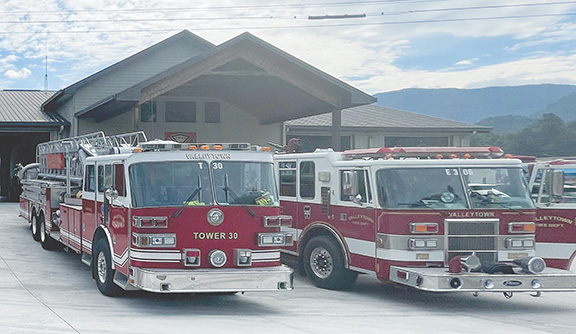
Fire departments in Cherokee County are mapping out near-term plans to improve fire protection and improve insurance rates for property owners in much of the county.
Two volunteer fire departments – Peachtree and Wolf Creek – are seeking tax rate increases to fund expansions that could end up saving taxpayers money. The Murphy Fire Department, meanwhile, has released its five-year strategic plan.
This follows efforts by fire departments throughout the county to improve response time, fire insurance ratings for property owners and safety for the volunteers who are the mainstay of most departments in the county.
Cherokee County agencies have all seen higher costs because of the state of the post-COVID-19 economy.
Peachtree Fire & Rescue saw fuel costs increase by $3,472 over the previous year, $15,000 in equipment maintenance, almost $15,000 for insurance, to name a few examples.
Higher costs, difficulty recruiting and keeping volunteers, and increasing population all play a role in fire department strategic plans and funding.
Murphy
The Murphy Fire Department conducted an analysis of its strengths, weaknesses, opportunities and challenges and came up with several goals:
- Personnel: While its force is well trained, experienced and certified, and with seasoned officers in its chief and assistant chief levels, the Murphy Fire Department is dealing with aging personnel and command staff. It hopes to improve compensation and improve training to help retain staff and recruit new members.
- Facilities and equipment: While its force includes good buildings in strategic locations, some of its fleet is aging and funding is difficult.
- Rating: The Murphy Fire Department boasts a solid ISO rating, which results in competitive property insurance rates and a positive economic impact. The challenge is to maintain that rating and communicate the importance of good ISO ratings to the community. “We are proud of our insurance rating and the fact we can actually profit property owners thus eliminating most of our service financial burden,” according to the Murphy Fire Department Strategic Plan 2024-2029.
- Community outreach: “A few responses on our community outreach/satisfaction survey indicated we needed to be more visible in the public. Fire personnel spend much time in preparing for incident mitigation and regulatory compliance. However, public education/fire prevention is a very important aspect of the fire service,” according to the plan.
- Technology: “With the exception of our subscription Active911 and fire management software program, we currently do a poor job embracing technology,” according to the plan. Technology is available (at a cost) that would make firefighters better informed about incidents as they respond and improve radio communication with agencies responding to Cherokee County from outside the county.
- Grant opportunities: While it has been successful at winning grants in the past, it lacks a dedicated grant writer, which hinders future attempts at seeking grants.
Tax increases
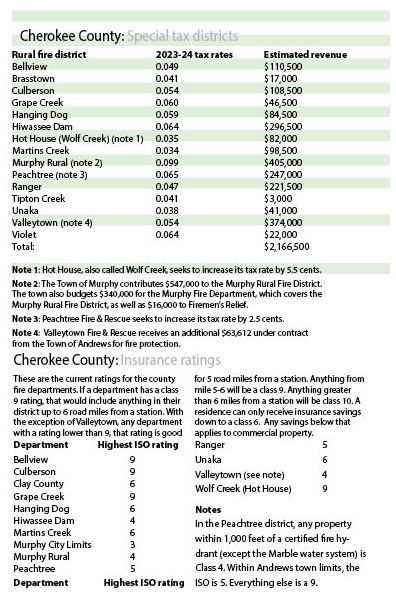
The Cherokee County Board of Commissioners in May gave tentative approval of a 2.5-cent tax increase for Peachtree Fire Department and a 5.5-cent increase for Wolf Creek Fire Department. The board will make a final decision during its annual budget public hearing Monday, June 24.
Both fire departments aim to upgrade equipment, staffing and build substations to serve outlying communities within their service districts. Fire officials believe any tax increases will be more than made up for in reduced property insurance costs.
The tax increase in Wolf Creek is expected to generate $121,759 in annual revenue, while the Peachtree increase would generate up to $94,500 under current property valuations.
Peachtree
Peachtree Fire & Rescue conducted a needs assessment that identified a shortage of daytime staffing necessary to meet increasing population and call volume.
Response times for the department when it is staffed has been four to five minutes depending on location, according to data the department submitted to the county. Response times during unstaffed periods have been in the 12-minute range.
In the event of a structure fire or medical response, those extra minutes can make a big difference.
Peachtree has an on-duty paid firefighter 8 a.m. to 7 p.m. Monday, Wednesday, Friday and Saturday, costing about $25,000. It wants to add an on-duty part-time paid firefighter from 8 a.m. to 8 p.m. seven days a week, doubling the annual personnel cost to $50,000.
The department also determined a need for a fire substation to serve the Daylilly community. A substation will bring the northern part of the Peachtree community – including Daylilly, Old Peachtree and Well Road – to within a 5-mile distance to a fire station and significantly improve insurance ratings there.
The substation would need an acre or two and would include two bays and office space, one fire engine with a 1,000-gallon water tank and one fire pumper with a 1,250-gallon water tank.
Under the increase, a $200,000 home would pay $50 extra on their property tax bill, but Peachtree Chief Jordan Messer told one property owner who was concerned about affording the higher bill that her property insurance bill would be reduced and more than cover the higher property tax bill.
Wolf Creek
Wolf Creek is requesting a tax increase for the fire district of Hot House from 35 cents to 90 cents.
The present rate generates about $82,000 per year in tax revenue. The increase would bring that to just shy of $211,000.
The added funds would pay for, or help finance, $170,000-$180,000 to acquire land off Orton Road and build a new fire substation on that site. It would also purchase a new fire engine and water tanker together costing about $500,000.
It would also help fund day-to-day expenses such as propane, electric and internet, tires, turnout gear, fuel, tools, testing and training, according to a letter to the community from Lt. John “Fred” Koestler of the Wolf Creek Fire Department.
The Wolf Creek Fire Department held two public meetings in its district to talk about a fire rate increase, one of Jan. 9 and the other on March 4. Thirteen people signed the attendance roster for the first meeting, while 22 signed the roster for the second meeting.
Votes at both meetings showed 100 percent in support of the tax increase to move forward, according to records of that event.