

Hayesville – “I graduated valedictorian of my middle school,” Ann Woodford said with a laugh. She’s laughing because she was only graduate of her eighth-grade class.
“I attended Andrews Negro School,” she recalled. This was in 1961, when integrated schools were still not the law of the land.
“My teacher, Ida Mae Logan, lived in a back room of the school building,” said Woodford, who loved Logan. “She sent my artwork off to contests, where I won ribbons and gold keys.”
Logan’s support and belief in her helped carve Woodford’s destiny.
“She taught me that we (African Americans) are somebody,” Woodford said. “She saw me.”
This lesson in the power of being seen guided Woodford many decades later, when she built the nonprofit agency One Dozen Who Care Inc. The organization seeks to empower, educate and encourage women across western North Carolina.
As a young adult, Woodford recognized individuals in the community filling a need or serving a cause. She felt these people were invisible, never recognized.
“I wanted to make the invisible visible,” Woodford said.
The group, serving Cherokee and Clay counties since 1998, started out with 25 local women working together to meet their mission statement to bridge cultures and create community bonds within the region. However, their membership was cut nearly in half when it was time to invest money in order to receive a state matching grant.
“When it was time to pay, there were one dozen of us who stuck,” One Dozen Who Care President Patricia Hall said with a laugh. That’s what inspired their name.
These women began serving their communities, paying particular attention to the youth.
“Our original model was 10/10/10,” board member Mary Sue Casey said. “We wanted to serve 10 youths in 10 months with 10 activities.”
The group held banquets for the youth to help teach social manners, and even went on field trips.
“We took them on a tour of Tuskegee College. When we arrived, they all gasped when they saw two African- American police officers on the school steps,” Casey said. “They had never seen anything like that before.”
The group formed the ODWC Prescott Scholarship, which offers $3,000 to two female African-American applicants each year.
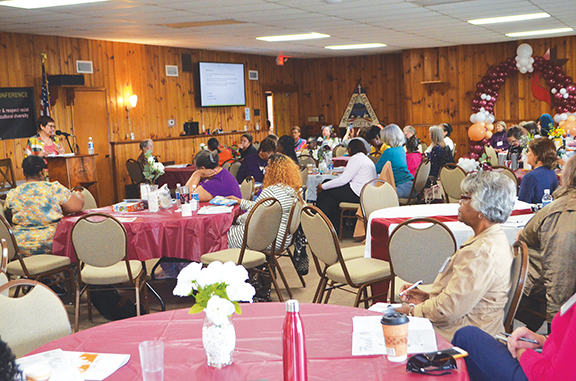
After a year’s worth of service, the group holds its annual Multicultural Women’s Development Conference at the Hinton Center. “We’ve been coming out here for 23 years,” Woodford said.
This year’s conference, titled “Feed My Soul,” featured more than 20 presenters speaking on topics including Your Personal Finances, Slow, Mindful Yoga, Empowerment through Self-Defense and Wise Women’s Stories.
This year saw a record number of attendees spanning wide age differences, religions and races. That’s just how ODWC likes it.
“We tear down the barriers of age and religion. Everybody is welcome here,” Woodford said. “We uplift each other here.”
ODWC hosted two keynote speakers. Lizee Kichung, a U.S. citizen who grew up in South Korea as a fourth-generation Methodist, spoke on “My Story, Impermanence, Resilience and Awakening.” Kathey Avery, a 30-year veteran oncology nurse with Mission Hospital System, spoke on “Bridging WNC for Better Health Together.”
When not in session, the women enjoyed fellowship and a memorable game night, where they could relax and play together. A key to this year’s success rests with One Dozen Who Care’s new executive director, Ronda Birtha, who previously worked with the Cherokee County Chamber of Commerce as well as the Cherokee Scout.
Called their fearless technology magician, Birtha faces challenges of modernizing the way the organization does business. Rather than print out their surveys, for example, she introduced QR codes during this year’s conference.
Birtha has become the progressive face of the organization. She commends the board for their willingness to jump into technology, despite their apprehensions.
“They resist, but they are willing to try,” Birtha said with a laugh. “They are a lively, fun group, and it’s been interesting convincing them to take bold steps in technology.”
Raven Chiong’s poem “Feed My Soul (slow baked, over easy)” focused this year’s conference theme: “Call all sisters to the table. Dish heaping helpings of hugs and hopefulness. Serve with the main ingredient, always and above/all/unceasing/love.”