
Rebecca Cerese readily admits that she stays angry, and the frustration in her voice comes through as clear as her message. The engagement coordinator for the Health Advocacy Project at the N.C. Justice Center in Chapel Hill, Cerese says she just doesn’t get it.
“There is no good reason for the Legislature to continue to dismiss Medicaid expansion,” she said. “We are needlessly causing suffering and deaths.”
The issue is a divisive one that often falls along party lines. North Carolina is one of 12 states that has not yet approved Medicaid expansion, despite support from Democratic Gov. Roy Cooper and state Sen. Kevin Corbin, a Republican who represents Cherokee and surrounding counties.
While Cooper has indicated he will approve a bill that puts Medicaid expansion in the state budget, Corbin co-sponsored a bill when he served in the House of Representatives during the 2019 General Assembly. House Bill 655 would have expanded the state’s Medicaid program to cover working families with a modified adjusted gross income of up to 133 percent of the poverty level.
Although the bill passed the House, the Senate never held a vote. Corbin has said he plans to file another bill this year.
What is it?
The Affordable Care Act signed into law by President Barack Obama in 2010 pushed states to expand or extend Medicaid eligibility to citizens who landed in the gap. They are people who earn too much to qualify for Medicaid, but too little to qualify for subsidized coverage through the government’s health insurance Marketplace. Expanding Medicaid coverage would provide access to affordable health care for an estimated 500,000 North Carolinians.
The cost of expanded coverage for states opting in was initially paid by the federal government. Beginning 2017, states had to pay 5 percent. Last year, that figure went to 10 percent, the maximum a state will have to pay. It’s estimated that if expansion was approved, the cost for North Carolina could be as much as $600 million per year.
However, a federal incentive from President Joe Biden’s administration – 5 percent of the funding North Carolina already pays for existing Medicaid coverage – would pay the entire state’s portion of expanded Medicaid coverage for at least two years, and likely more, Cerese said.
A divisive issue
Those in favor believe every citizen should have access to affordable health care. From a financial standpoint, they say expanding Medicaid benefits would create new jobs and generate revenue for the state. Those who disagree believe it will cost too much, ultimately resulting in higher taxes.
“It’s certainly become a thorny issue,” said David Badger, director of the Cherokee County Health Department.
He believes approval would positively affect medical providers. Conversely, when uninsured patients forgo preventative care and medical treatments, it ends up costing North Carolina money in the long run from emergency room visits, unpaid medical bills that are written off by providers and even disability claims.
Social media is peppered with accounts of people in the health-care coverage gap eager to share their stories. A stream of posts appear on coalition Health Action NC’s Facebook page, for example, including a cancer patient who spoke at a governor’s roundtable before passing away last September. Her family believes she would be alive today if Medicaid expansion were already in place and she had gotten an early diagnosis.
No reservations
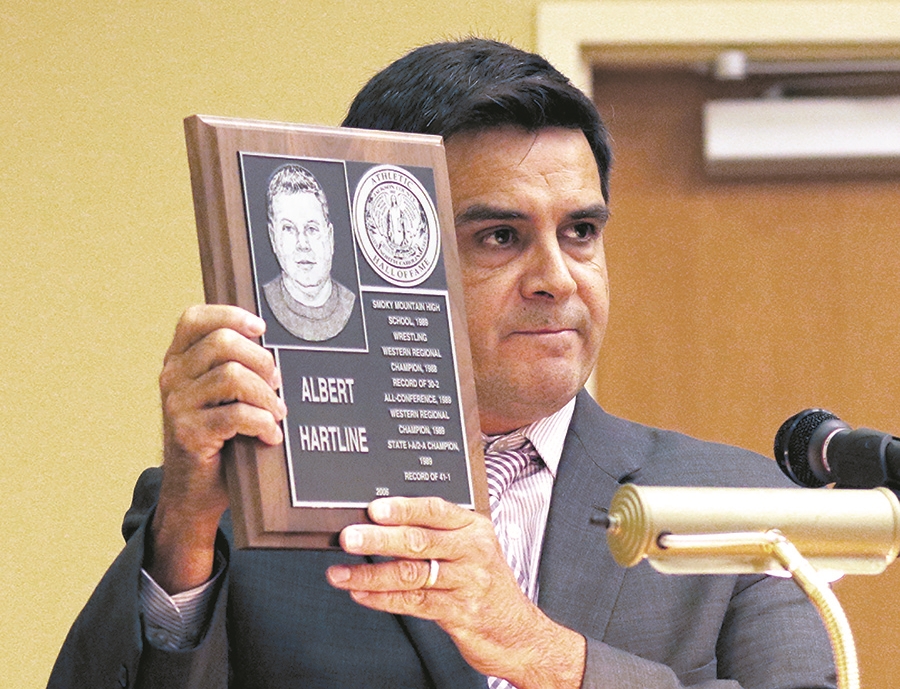
Casey Cooper, chief executive officer of the Cherokee Indian Hospital Authority, is an outspoken advocate for expansion. He recently shared the story of local resident Albert Hartline while asking Cherokee County commissioners for their support on Sept. 7.
Hartline, who was diagnosed with prostate cancer and suffering from severe depression, did not have health insurance. He committed suicide after shooting his neighbor.
"This data is really important because there's a misunderstanding out there, a narrative if you will, that there are able-bodied adults who are simply choosing not to work and if they would go to work they could get health insurance," Cooper told the Clay County Board of Commissioners on Sept. 2.
"That's not true. The majority of the uninsured in North Carolina are already working, they unfortunately are working poor and they're stuck in the coverage gap."
Cooper told Cherokee County commissioners that Graham, Jackson, Macon and Swain counties have passed a resolution in support of expanding Medicaid. Dr. Rob Peck, chairman of the Clay County Commission, said his board would possibly take action on it during the October meeting.
About 1,000 members of the Eastern Band of Cherokee Indians would gain coverage under the expansion, Cooper added. About that same number would receive coverage in Cherokee County along with 782 in Clay County.
The rural factor
Data indicates that western North Carolina has a much higher percentage of uninsured workers than the state’s average. Cherokee, Clay, Graham, Macon and Swain counties all rank above 20 percent percentage of uninsured workers. In contrast, the national average is 11 percent, while the state’s average is 13.8 percent.
The state’s failure to expand Medicaid has created unnecessary hardship for the working poor – a majority who are front-line workers with jobs in retail, hospitality and food service. It has also contributed to a reduction of critical services at many rural hospitals; several hospitals in North Carolina, north Georgia and eastern Tennessee have closed or scaled down operations in the last two decades.
“We’re as far west as we can possibly get,” Cherokee County Commissioner Jan Griggs said. “And it is important to keep our hospitals open.”
She has not seen data to support the claim that that enacting Medicaid expansion would help keep hospitals open. Before weighing in on the matter, Griggs said she wants more factual information as well as opinions from local medical professionals.
As far as the claim that Medicaid expansion will raise taxes, Griggs said it very well could. She plans to explore both sides of the issue.
What comes next?
Every time Democrats have introduced a bill pertaining to Medicaid expansion in North Carolina, Cerese said Republicans in the General Assembly shut it down. Cooper vetoed the last proposed annual budget because it did not include Medicaid expansion. While legislators produced “mini” bills to circumvent the veto, budget planning is still ongoing.
Cerese is hopeful that expansion may pass this year for several reasons. First, since the term “Medicaid expansion” is a hot-button trigger, the vernacular has changed to “close the gap coverage” among coalitions fighting for approval.
Studies demonstrate that Medicaid expansion would benefit the state on many levels. And the fact that a two-year financial incentive would negate the immediate cost to North Carolina could be the push the Legislature needs.
If the House and Senate come together to create a conference report that includes Medicaid expansion, Cerese has no doubt that Cooper will approve it. Should that happen in the near future, expanded coverage could begin as early as January.
Regardless of which way you’re leaning, you can voice your opinion by contacting your senator and congressman. To verify your district representative and obtain contact information, visit www.ncleg.gov.
“Will it pass?” Griggs pondered. “I can’t answer that. You don’t know what our Legislature is going to do from one moment to the next.”
By Tracy Barnes / Staff Correspondent