
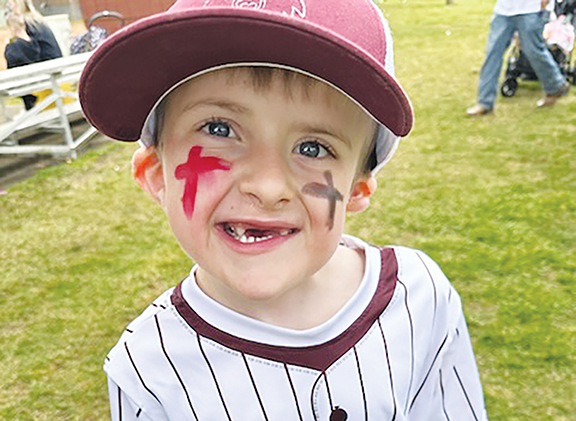
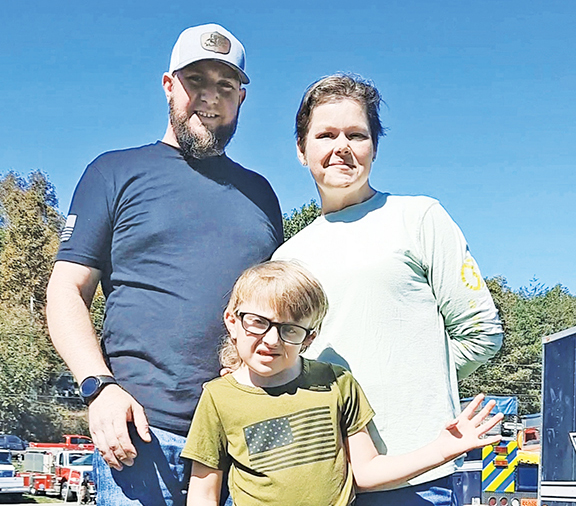
Ranger Caryn and Wesley Beavers were excited to be expecting another baby. As with any mother, prenatal appointments become the norm in order to monitor a baby’s growth and development.
Twenty weeks into her pregnancy, Caryn had an ultrasound, which revealed something didn’t look right. Additional tests were done, and there was indeed a medical problem.
The baby’s organs were reversed. The genetic condition, Situs Inversus, is rare. All of the baby’s internal organs of the chest were opposite of what normal anatomy would display.
There was also some doubt regarding the veins and arteries leading into his heart and whether or not they would flow properly. When lying on his tummy, the front of Kasen’s heart was facing upward.
Beavers carried to full term and delivered Kasen on Jan. 24, 2017, at Erlanger Hospital in Chattanooga, Tenn. Specialists were on standby.
After the birth, doctors held Kasen up and noticed he was also crooked to the left, which they thought may be muscular. He remained in the nursery for about six hours, but was having trouble controlling his breathing.
He was moved to the neonatal intensive care unit, where it was discovered that part of his spine failed to grow properly, causing his left head tilt. Kasen also had several fused vertebra and a hole in his heart.
As a result of the issues with his spine, although his legs will grow normally. However, he will not grow to a normal height from the waist up.
After a week in the hospital neonatal intensive care unit, he was sent home without the need for any medications. For the next year, he would have many different appointments with doctors, specialists and therapists.
A cardiologist told Caryn and Wesley they would wait until the baby was a little older to perform surgery to close the hole in his heart.
In August, the Beavers family went to Vanderbilt Hospital in Nashville, Tenn., prepared to do the surgery. However, Kasen developed a fever and the surgery was reschedule for October. The couple would do a lot of praying to help calm their uneasiness.
The surgery involved a GORE device, which is put through a leg vein into his heart, allowing it to help close the hole.
Doctors officially cleared Kasen for regular activities on Nov. 2, as an echocardiogram performed from the inside of Kasen’s body showed no other abnormalities once the hole in his heart was closed.
The pregnancy made the family feel nervous and unsettled. In 2015, they lost a child who was stillborn.
“It was really very emotional because we had just worked through the grief of loosing a child, and now we have another one and they say, ‘We know that he has something wrong and we don’t have a prognosis.’ It was very scary,” Caryn said.
Kasen’s abnormalities are physical and not mental. He excels in his studies and has no learning disabilities.
His parents push him to be and do as much as possible and include himself with other children. He adapts well, using his body in ways that allow him to do everyday things.
“We never wanted him to feel handicapped,” his mom said. She and dad only treat him differently because he’s the last and youngest child of the family, not because of his medical issues.
His two older brothers – Trent, 17, and Owen, 14 – help encourage Kasen when other kids inquisitively ask about his situation. Kasen’s brothers do not have the condition.
Kasen’s hobbies include playing guitar and singing at church.
To other children struggling with medical issues, he said, “Always trust God and stay prayed up.”