
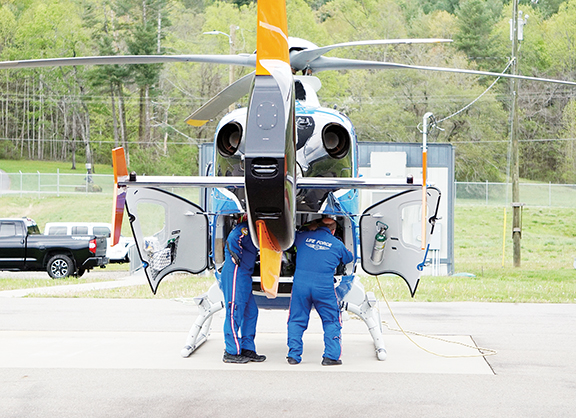
If you are severely sick or injured in mountainous western North Carolina, odds are good that you’re going to need a helicopter ride to a hospital.
In Cherokee and surrounding counties, that helicopter is provided by Life Force, a team effort by Erlanger Health System, which provides the medical personnel, and Med-Trans Corporation, which provides the pilot, helicopter and maintenance crews.
Rescue helicopter medics share some aspects with their ground-based counterparts. They are highly trained professionals who work long hours under all conditions. They contend with horrendous situations often resulting in severe injury and death.
Most significantly, they save lives and help the sick and injured get the treatment they need early enough for that treatment to make a difference.
It’s not pleasant work, but for many who have made it their career, it’s a calling that emerged when they were teenagers.
They undergo continuous training and certification, and between dispatches, they train, inventory and maintain equipment, or sometimes simply relax and catch up on sleep (their shifts are long).
Still, there are significant differences between ground and air medical crews.
A dispatch for a ground-based crew means crews scramble to their ambulances, drive to the incident and take care of business. Sometimes they transport victims to hospitals, sometimes a funeral home is involved – and sometimes they call in Life Force.
Ground-based emergency medical teams typically have an emergency medical technician or two on board, or often a more highly trained and certified paramedic is part of the team.
Life Force teams include a seasoned helicopter pilot provided by Med-Trans Corporation, and a flight nurse and paramedic provided by Erlanger Health System based in Tennessee.
Life Force (or LIFE FORCE, as the organization spells it) is comprised of three divisions:
- Air Medical (Life Force Medical Crew);
- Communications Center (Life Force Dispatch and MedComm);
- Med-Trans Corporation, which provides the helicopters, pilots and mechanics.
As Life Force says in its literature, each group contributes to the mission of providing safe, comprehensive, effective, and compassionate patient care and delivering superior customer service through service excellence and innovation,
Life Force is a regional resource for eastern Tennessee, northern Georgia, northeast Alabama and western North Carolina.
Those who serve
Flight Paramedic Greg Taylor is the clinical base manager for Life Force 6, the rescue helicopter base at Western Carolina Regional Airport. He was in high school when he started attending night school to get his emergency medical technician certification.
Flight Paramedic Steven Tanner has 24 years of experience and decided on that career path when he was 18, inspired by his mother, a nurse. Flight Nurse Justin Panel grew interested in the career when he was in high school and has 17 years under his belt in health care.
There are six Life Force bases in all, each staffed with eight full-time and two part-time professionals. Cherokee County and its neighboring counties are served by Life Force 6 based at Western Carolina Regional Airport in Andrews.
The Andrews facility includes a spacious modular structure on the east side of the airport that includes a full kitchen, bathroom with shower, offices, a lounge with a television and overstuffed chairs, supply rooms for medications and equipment, and sleeping quarters.
Nearby is an Airbus H135 helicopter, a twin-engine helicopter manufactured in Europe and powered by twin Pratt & Whitney turbine engines capable of speeds of more than 160 mph, with a range of better than 300 miles.
By the numbers
Life Force 1 began operations in December 1988 in Cleveland, Tenn., with one aircraft averaging over 700 flights per year. With the expansions of Life Force 2 (based in Sparta, Tenn.) in 1995, Life Force 3 (Calhoun, Ga.) in 2007 and Life Force 4 (Blue Ridge McCaysville, Ga.) in 2010, areas that were not previously served by air medical transportation, improved the odds in the race against time during the “golden hour.”
The “golden hour” is the first 60 minutes in which critically injured patients who receive definitive care are far more likely to survive.
In mountainous western North Carolina, that “golden hour” can be achieved only through the use of air transport.
Life Force later added bases in Winchester, Tenn. (Life Force 5) and Andrews at Western Carolina Regional Airport (Life Force 6).
Tennessee-based Erlanger Health System provides the medical flight crews for the Life Force fleet. Erlanger is an academic medical center affiliated with the University of Tennessee College of Medicine Chattanooga. Erlanger operates several hospitals and clinics in the region, including Erlanger Western Carolina Hospital in Peachtree.
Life Force was the first helicopter program in the nation equipped with Global Positioning System receivers. The GPS space-based radio positioning and navigation system provides safety and speed for Life Force when flying in adverse weather conditions.
GPS provides accuracy and reliability to support precision approaches to landing locations. Life Force also uses night vision goggles using technology developed for military tactical operations.
Capabilities
Life Force serves patients who have suffered any kind of severe trauma or burn, as well as severe medical illnesses. Each aircraft has equipment and the trained staff to care for people in all stages of life, from infants to geriatrics.
Life Force has also been deployed in other situations including search and rescue missions. On-scene and in-flight lifesaving treatment includes:
- Trauma service;
- Four units of blood carried on each flight;
- On-scene surgical procedures and invasive circulatory intervention including surgical airways, chest tubes, central lines, saphenous vein cut-downs;
- In-flight I-stat laboratory analysis and surgical preparations;
- Heart and stroke intervention;
- Aggressive cardiac and stroke protocols including cardiac drugs;
- Pediatric care, protocols, medications;
- Dedicated neonatal transport team;
- Labor and delivery;
- High-risk obstetric care;
- In-flight fetal monitoring system;
- Specilized obstetrics medications.
University of Tennessee Health Science Center College of Medicine in Chattanooga professors and physicians provide ongoing training and advanced in-flight protocols that speed direct admissions to surgery, the cardiac catheterization lab, radiology and other advanced services.
Aviation maintenance
A highly qualified and aggressive maintenance department keeps Life Force flying with very little downtime. Each base has a complete Aviation Maintenance Section and includes FAA qualified Aircraft and Powertrain Technicians staffed around the clock. An extensive inventory of parts, specialized tools and equipment certified by the manufacturer help in preventive maintenance and comprehensive inspections are performed on a continuous basis.
On March 9, Life Force 6 crash landed near Franklin while carrying a patient from Erlanger Western Carolina Hospital in Peachtree to Mission Hospital in Asheville. All aboard survived and the point of this article isn’t the crash, but the insights the crash report provides as to how Life Force bases operate.
The pilot of that flight was Alex Fulford, a career Marine Corps aviator and well-respected member of the Life Force team. Here is part of his report:
At 5:50 p.m. March 9, “We received an inter-facility patient transport request from 5NC4 (Erlanger Western Carolina, Murphy) to NC95 (Mission Hospital, Asheville). If we accepted, it would be our fourth flight during my 12-hr shift which runs from 0630-1830 (6:30 a.m. to 6:30 p.m.). Based on our current location KRHP (Western Carolina Regional Airport) and its proximity to 5NC4 (9 nautical miles), the fact we had enough fuel (132 gal total) to conduct the entire mission and refuel once we returned to base and the logistical history of that particular patient route over the previous five years, we felt confident we could complete the flight within the 14-hr window. Weather was workable: reporting and forecasting VFR along the route. … We filed our Baldwin RA, received acknowledgment and launched.”
At 6:13 p.m., the helicopter arrived at Erlanger Western Carolina Hospital and the patient was placed aboard. “At that time, I noticed the pilot phone had received a call from the Regional Area Manager (RAM). Returning the call while the medcrew worked with the patient, I was instructed to double check maintenance due times to ensure we would not overfly any inspections due to a temporary glitch between RAMCO (company maintenance program) and FlightLog that was being rectified. I computed and recorded the weight & balance information in the flight log for the upcoming leg and attached the NVG battery pack and mount to my helmet in anticipation of donning the (night vision) goggles during the next leg since we would encounter EENT (End of Evening Nautical Twilight) during the upcoming 38 min leg of the flight.”
At 6:45 p.m., the pilot assisted in loading the patient, conducted his final walk around and started/launched. A miscalculation led to the helicopter clipping trees on a mountain peak, with the damaged helicopter landing hard on a paved country road with no loss of life.
Nothing is simple
But his early log entries and the long list of advanced medical services the flight crew provides illustrate the complexities that Life Force crews encounter not just daily, but multiple times a day. This flight was relatively simple – from its airport base to a hospital landing zone to another hospital landing zone.
Weather conditions and terrain can greatly complicate matters. Sometimes Life Force helicopters can’t deploy immediately or at all, depending on weather conditions, and finding a landing zone close by to the patient can present its own complications.
Life Force helicopters have landed on school playgrounds, bridges and even wide spots in a road when necessary, where patients in grave condition are gingerly transferred from the caring arms of ground-based emergency medical services crews to the caring arms of helicopter flight crews.