
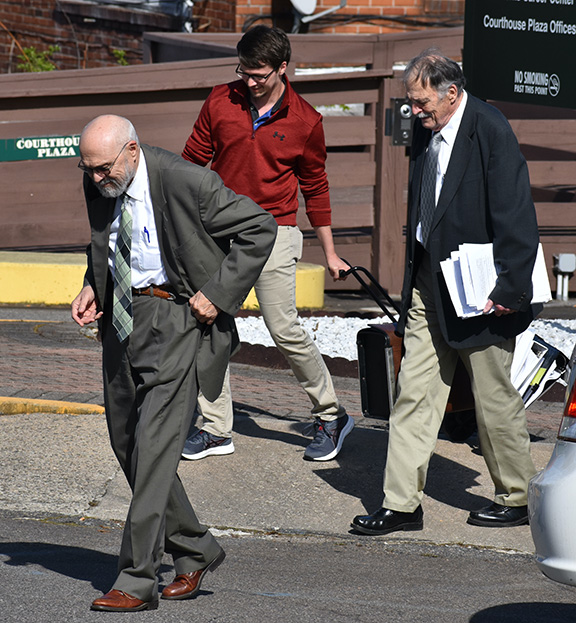
Franklin – Ronnie Scott Lindsay of Murphy was found guilty Monday on 12 felony counts and two misdemeanor counts of obstruction of justice for his role in securing child custody agreements outside the court system when he was a lawyer representing the Cherokee County Department of Social Services.
Special Superior Court Judge Steve Warren consolidated the counts into one for sentencing purposes, sentencing Lindsay to 5-15 months in prison. However, he suspended the sentence for one year, plus court costs, which he gave Lindsay one year to pay.
For sentencing purposes, Lindsay had zero points working against him – he had never been convicted of a crime prior to Monday.
Lindsay was the attorney for the Cherokee County DSS and advised then-DSS Director Cindy Palmer, then-Child Protective Unit supervisor David Hughes and staff to enter into custody and visitation agreements with parents that removed their children from their custody and interfered with parents’ constitutional rights to parent their children.
DSS used these agreements without explaining what they meant to the parents – including that they were signing away rights to their children until they turned 18 or were emancipated. The targeted parents were often struggling with addiction or poverty.
Palmer and Hughes were previously convicted of crimes associated with the use of DSS custody and visitation agreements, called CVAs.
Palmer previously pleaded guilty to obstruction of justice and received a suspended sentence and 12 months of unsupervised probation.
Hughes, who also pleaded guilty as part of an agreement, received a suspended sentence and 12 months of unsupervised probation at a hearing in Macon County on Friday.
Warren said the DSS director had statutory authority over use of CVA documents, but Lindsay was part of the team that led to their use.
“That’s why I’m sentencing him the way he is,” Warren said Monday morning.
Lindsay originally faced 23 counts of felony obstruction of justice. Three counts were dropped before the trial, with another six dropped by the prosecution following evidence in the trial and another two decreased from felonies to misdemeanors.
The trial lasted one day over two weeks, following two days of jury selection. The jury started deliberating Friday and continued for an hour Monday before reaching its verdict.
Murphy lawyer Jerry Townson said he expects Lindsay to appeal the conviction, but asked that another lawyer be assigned to the case. Townson took the case for free.
Lindsay was fired as attorney for both Cherokee County and DSS as a result of his involvement in the cases. Since that time, he has lost his house to foreclosure and found it hard finding clients for his attorney services. Warren declared Lindsay eligible for indigent services because of his financial situation.
‘I seriously apologize’
Following the jury verdicts and before sentencing, Lindsay made a statement to Warren.
The DSS situation has been hard on Lindsay, who is 72 years old. He lost both his job as DSS attorney and county attorney and has had a difficult time finding clients since then. He has been living primarily from Social Security payments and often ends the month with $100-$120 extra, if anything.
He said his life for the last six years has been Walmart, Ingles and church. His sons have been helping with groceries, gas and the occasional dinner out or movie.
Lindsay’s roots in the area date back to the early 1800s. He moved to Murphy in 1978 after passing the N.C. Bar and practiced real estate and criminal law. He also practiced family law, eventually winding up as attorney for DSS.
“As God is my witness, my intent was never to hurt any child,” he said, describing much of his career as trying to help children.
Lindsay is a church deacon who has served on the Cherokee County Board of Elections and Western Carolina University Board of Trustees. He has two sons, who he called the “light of my life.”
“I seriously apologize,” Lindsay told the judge. “I never intended to hurt anyone. I thought – I think – we did help some people.”
According to statements in court, Lindsay received the original document that came to be known as a “custody and visitation agreement” from a colleague at a seminar in the early 2000s. He first used a CVA for two parents who were facing prison but didn’t want their children to go into foster care. That CVA somehow wound up as template in the DSS computer system.
Backlog of cases
An audit by the state Department of Health & Human Services did not detect any previous use of CVAs, but did detect a backlog of cases, which led to ramped-up pressure for Cherokee County DSS to clear more cases. That, in turn, made use of CVAs more widespread. The forms were used more than 20 times in all.
Parents who were party to CVA agreements generally admitted during the trial that much of what the agreements contained were favorable – they awarded custody to the best relative or friend available at the time and placed common-sense restrictions, including requiring use of car seats.
However, CVA forms also took parents’ custody of their children away until they turned age 18 or had a court-ordered emancipation. Many parents who testified said they didn’t or couldn’t read the agreements and were surprised to learn they signed over custody of their children for as long as they remained minors.
Situations leading to using a CVA varied. Some parents were involved with drugs, but one parent had asked his neighbor to watch his child while he spent time in the hospital with his gravely ill wife. Another parent showed up on DSS’s radar because she was working three jobs and wasn’t active enough in her child’s life.
‘Where is the crime?’
The placements sometimes turned out to be detrimental as well. One mother who was addicted to drugs was forced to give up her child to a grandparent who was selling her drugs. Other next-of-kin placements refused to let the parents see their children. In one case, parents lost custody after the drug-addicted mother gave birth and neither parent has seen the child since delivery.
Many parents said they felt pressured and coerced into signing the agreements and didn’t know they could have had a lawyer appointed to represent them if they used the legal route of filing a petition in court or contesting a child petition in court.
The CVA form served several purposes. It sidestepped the courts in which DSS success was not assured. It also facilitated agreements between parents and either relatives or friends for the custody of children.
At the same time, it washed DSS’s hands of cases, saving it time and money. The agreements were signed by parents and custodians and, once signed, DSS closed the cases without expending further resources.
Townson argued that decisions to use CVAs were made by DSS management and not by Lindsay, who merely reviewed the agreements once they were drafted.
Lindsay thought his conduct was legal, Townson said. During the trial, he questioned what law was broken and said courts didn’t have jurisdiction in the cases because petitions had not been filed.
“Where is the crime?” Townson asked in his closing arguments.
State approved
The N.C. State Bureau of Investigation investigated the matter and District Attorney Ashley Welch referred the prosecution of the case to the Department of Justice.
Prosecution Section head and Special Deputy Attorney General Boz Zellinger and Special Deputy Attorney General Arneatha James prosecuted the case.
“Public servants have a responsibility to the people they serve – they have a duty to uphold the law and protect the vulnerable,” Attorney General Josh Stein said in a release.
“Scott Lindsay failed to do that and harmed families in Cherokee County, who suffered for years. I thank the jury in Macon County for their verdict. My heart goes out to these families, and I hope this verdict eases their pain.”
The trial was moved to Macon County due to the substantial media coverage the case received in Cherokee County.