
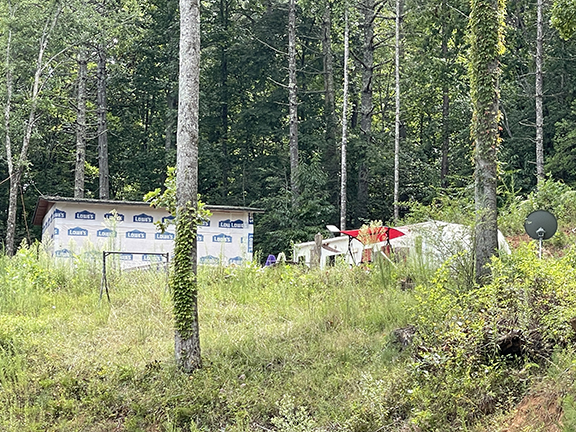
Bear Paw – A federal judge has dismissed most charges against Cherokee County officials filed by a Lower Bear Paw Road couple, whose home was raided by sheriff’s deputies and the Cherokee Tribal Police’s SWAT team on Dec. 13, 2022.
The SWAT raid left Jason Kloepfer critically wounded as he attempted to surrender, unarmed, to law enforcement. His wife, Allison Mahler, was with him at the time but was not injured in the incident.
The couple filed a lawsuit in federal court against the Cherokee County Sheriff’s Office, Sheriff Dustin Smith, numerous deputies and its former lawyer; and the Eastern Band of Cherokee Indians Police, its chief, SWAT team and many members.
U.S. District Judge Max Cogburn Jr. issued his partial ruling on Dec. 4, dismissing charges against Cherokee County’s role in the raid. Although the Cherokee police SWAT team was requested by the Cherokee County Sheriff’s Office, only SWAT team members fired their weapons at the scene, according to court documents.
Claims
The Cherokee County Sheriff’s Office is dismissed as a defendant, the official capacity claims against the individual defendants are dismissed as redundant
and the individually named defendants enjoy public official immunity as to the claims for negligence, negligent infliction of emotional distress, and negligent retention and hiring/supervision, the judge ruled.
As to the official capacity claims against Smith, he is subject to governmental immunity and has not waived immunity through the purchase of liability insurance, the judge ruled.
Kloepfer’s claims against Darryl Brown, who had been the sheriff’s office attorney at the time of the raid, were dismissed as well.
A punitive damage claim against the sheriff’s office in its official capacity was also dismissed.
The court denied the motion to dismiss the remaining claims – including Kloepfer and Mahler’s claims of unlawful detention – so they may proceed to discovery. The parties may re-argue each claim as to each individual defendant on summary judgment, Cogburn ruled.
A special prosecutor is still considering findings from a State Bureau of Investigation investigation to determine whether to seek criminal charges.
On social media, Kloepfer responded.
“So big claims are all still in including illegal detention of Alison Mahler for almost 12 hours, no phone no contact with anyone, not knowing if I’m alive or dead for 10 hours, after claiming she was a hostage and watched her man get shot almost dead,” he wrote.
“Here’s another kicker, EBCI lawyers said, ‘There’s a 9 million dollar policy but their clients (Indian chiefs) don’t feel we are worth anywhere near that.’ Wow, Cherokee Indians calling the kettle black. And sheriffs said they won’t pay a dollar more than the Indians.”
The couple filed the lawsuit in June and seek millions of dollars in damages.
Background
Kloepfer and Mahler filed the lawsuit arising out of a shooting on Dec. 15, 2022, against various defendants, including officers of the Eastern Band of Cherokee Indian Police Department; Cherokee County Sheriff’s Office; Cherokee County Sheriff Dustin Smith and supervisors Chief Deputy Justin Jacobs, Capt. David Williams, Lt. Milton Teasdale, Lt. Mitchell Morgan, Lt. Drew Payne, then-Sgt. Dennis Dore and then-Sgt. Cody Williams; Deputies Nolan Queen, Jessica Stiles, J.T. Gray, Jason Hall, Don Latulipe, Adam Erickson and Paul Fry; and former sheriff’s office attorney Brown.
Defendants were sued in both their individual and official capacities. Kloepfer and Mahler claimed:
- Violation of 42 U.S.C. § 1983 (civil action for deprivation of rights) against all sheriff’s office defendants except the sheriff’s office itself.
- Violation of 42 U.S.C. § 1983 with Monell – 435 U.S. 658 (1978) – liability against the sheriff’s office and sheriff’s office supervisors. This case law allows municipalities to be held liable for certain violations of constitutional rights committed by officers.
- Negligence and negligence per se against sheriff’s office defendants and the sheriff’s office itself.
- Gross negligence against the sheriff’s office and sheriff’s office defendants.
- Abuse of process by the sheriff’s office, its supervisors and Deputy Paul Fry; malicious prosecution by the sheriff’s office, its supervisors and Fry.
- Unlawful detention against sheriff’s office defendants and the sheriff’s office itself.
- Defamation against the sheriff’s office, Smith and Brown.
- Intrusion and invasion of privacy against sheriff’s office defendants and the sheriff’s office.
- Negligent infliction of emotional distress against sheriff’s office defendants and the sheriff’s office itself.
- Intentional infliction of emotional distress against sheriff’s office defendants and the sheriff’s office itself.
- Negligent hiring and supervision/retention by the sheriff’s office and its supervisors.
- Trespass against sheriff’s office defendants and the sheriff’s office itself.
- Civil conspiracy endorsed and ratified after the fact against sheriff’s office defendants and the sheriff’s office itself.
- Assault and battery against the sheriff’s office, its supervisors and Queen.
- Punitive damages against sheriff’s office defendants and the sheriff’s office itself.
- The Cherokee County Sheriff’s Office and sheriff’s office defendants filed a partial motion to dismiss, arguing:
- Defendant sheriff’s office must be dismissed because it is not a suable entity.
- All Section 1983 official capacity claims against the individual defendants must be dismissed as duplicative except for the claim against Smith.
- The claim against Smith is barred because Smith has not waived governmental immunity.
- The negligence-based state tort claims against the individual defendants must be dismissed based on public official immunity.
- Defendants Queen, Stiles, Gray, Hall, Latulipe and Fry must be dismissed because the plaintiffs do not allege that any of these defendants were present when Kloepfer was shot.
- The unlawful detention claim should be dismissed as to all defendants because the plaintiffs do not state a cognizable claim for unlawful detention.
Brown filed a separate motion to dismiss the claims against him for defamation and punitive damages.
Brown asserts that Kloepfer’s claim should be dismissed based on the defense of qualified immunity, the defense of sovereign immunity, the doctrine of public official immunity, absolute privilege, qualified privilege, failure to plead the elements of defamation, failure to support the claim for joint and several liability and failure to state a claim for punitive damages.