
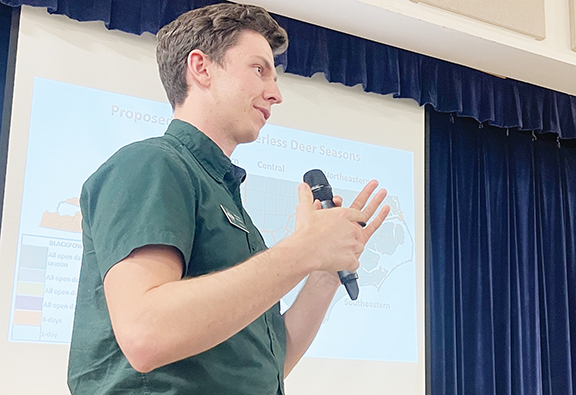
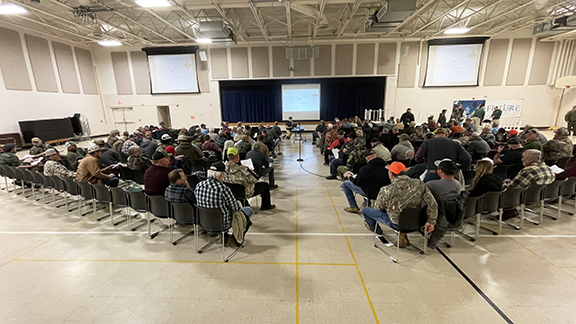
Peachtree – Nearly 150 people attended a public forum about plans for upcoming deer hunting seasons in western North Carolina.
The N.C. Wildlife Resources Commission held the event at Tri-County Community College on March 14 and unveiled recommendations to increase deer hunting season opportunities in the 12-county western region. The recommendations marry demands for hunting with the biological needs of an increasing deer population.
A second forum was held the next day at McDowell Technical Community College in Marion.
State wildlife officials reminded the audience these are recommendations and not proposals. Wildlife activities is big business in North Carolina, with 3.5 million people participating in wildlife-related recreation and a $2.9 billion impact on the state’s economy, according to ncwildlife.org.
Deer populations in the western region of the state are generally more sensitive than in the rest of the state and require a delicate balance between conservation and hunting.
“The last thing we want to do is overshoot the population,” said Moriah Boggess, a deer biologist with the commission.
A survey of the audience showed that 86 percent of the 150 in attendance were deer hunters, taking an average of two deer per year; 72 percent said the deer population is increasing; and 75 percent said they have seen an increased doe harvest. About 82 percent said they hunt for meat.
Because of the changing deer population, 74 percent said the commission needs to make changes to the deer season.
The commission has six objectives officials hope will result in a improved harvest and simplified season:
- Sustained antlered buck harvest of one per square mile;
- Adult doe harvest comprised of 25-35 percent yearling does;
- Total antlered buck harvest comprised of 30 percent or less yearling bucks;
- At least 45 percent of harvest is does;
- At least 50 percent of the harvest prior to rut is does;
- No more than 20 percent of antlered buck harvest before peak rut.
Harvest timing is important because it protects the yearling buck dispersa, maintains a balanced gender ratio during breeding, and synchronizes breeding and fawning.
Rut season varies across the state, with eastern counties having earlier peak rut dates, from October through early November to late November to mid-December in the western half of the state.
As a result, hunting seasons vary widely across the state.
Methods of hunting deer include bow and crossbow, black powder and guns.
In the northeast and southeast, deer hunting starts with three weeks of archery, followed by two weeks of blackpowder and 11 weeks of gun.
In the central region, there is seven weeks of archery, two week of blackpowder and seven weeks of gun.
In the northwest region, there is eight weeks of archery, two weeks of blackpowder and six weeks of gun.
All these regions have similar scenarios, with deer hunting opening off with archery, followed by blackpowder and then gun, with peak rut occurring after the start of gun hunting.
The west, on the other hand, has three separate archery seasons of three, five and three weeks. Two weeks of gunpowder hunting is permitted between the first and second archery periods. A three-week gun season ends at the peak rut and is separated by the second and third archery seasons, with the third archery season being buck only.
The proposed western season simplifies the seasons and makes them more like the rest of the state, with a nine-week archery season, followed by two weeks of blackpowder and then five weeks of gun, with peak rut occurring just before the midway point of the gun season.
The changes would improve the alignment between harvest and breeding season and improve the breeding season sex ratio. It would intensify rut activity and have better dispersal of yearling bucks.
Archery would be shorted by two weeks but gains a week of anterless harvest opportunity.
Blackpowder is moved to a cooler time of the year with more deer activity. It would encompass Thanksgiving, giving blackpowder hunters an opportunity for family outings.
Gun season is increased by two weeks and overlaps the rut. It would encompass Christmas and New Year’s Day.
Deer hunters said they have been forced to hunt in northern Georgia or eastern North Carolina to take their kids hunting during the holidays. This recommendation would address some of that concern.
“If we don’t get these young ones involved we’re going to lose our sport,” one hunter said, adding that spending time hunting in the woods is a better alternative to drug and alcohol abuse.
The deer hunters said they have not seen this many deer since the 1960s. The growing deer population is a problem for motorists who encounter deer crossing highways and gardeners whose gardens are being browsed by deer.
The hunters say they are seeing a deer-to-buck ratio of about 20-to-1.
“We’ve got way too many does,” one hunter said.
Bear hunters attending the meeting said they are happy to let deer hunters have December if they can have eight weeks starting in October.