
Culberson – The county does not have an animal control division, which means the governing body over dangerous or distressed animals falls to the Cherokee County Sheriff’s Office.
The state provides guidance in an ordinance, but it only pertains to prohibition of exotic animals and their transport across the state. So, unless an ostrich is tearing at a fence or a white tiger is bounding through the take-out line at McDonald’s, barking or roaming dogs require a call to the sheriff.
The county does have statutes regarding animals, but even they have limitations. Take general statute 67-4.3, for example: “The owner of a dangerous dog that attacks a person and causes physical injuries requiring medical treatment in excess of one hundred dollars ($100) shall be guilty of a Class 1 misdemeanor.”
That sounds official, but what if the owner disputes the bite? Or the biting dog is a stray?
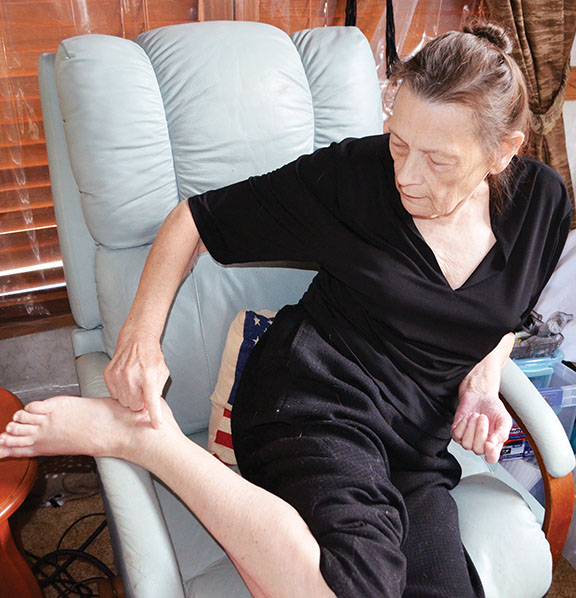
This was the unfortunate situation Brenda Lee-Koch, a disabled veteran living near Culberson Road, found herself in when a stray dog she calls “Blackie” bit her ankle.
“I was at the end of my property when I saw a little brown dog with Blackie,” she said. “Blackie is a big dog. Both of them are strays. I know because I walked up and down Culberson Road, knocking on every door, asking if they knew about either dog.”
Lee-Koch walked toward the brown dog to carefully shoo it off her property. Her landlord had made threats to evict her if she didn’t handle the stray dogs.
He was serious enough in his threat to twice come onto the property with a shotgun. The second time Lee-Koch, who heard shots from inside her living room, stepped onto her porch to investigate.
“He saw me standing there and raised that gun to point at me,” she said. “That man is Satan come up out of the earth.”
Lee-Koch said she when called the sheriff’s office, he took off – as did the dogs. But the officers were unable to assist her when she told them about the strays.
“They told me there was nothing they could do,” she said.
On the day she was bitten, she was attempting to appease her gun-wielding landlord when she approached the two dogs.
“They suddenly got into a fight,” Lee-Koch said. Blackie swung around to nip at the brown dog when its fangs landed swiftly into her ankle.
“It was deep bite, to the bone,” she said.
Lee-Koch called 911. “They didn’t want to come out, but I wanted an officer to see the bite,” she added.
The injury was bad enough to require a trip to the emergency room, where Lee-Koch was sewn up and given the first of four rabies shots. Each shot required a separate trip to the ER.
For the uninsured, those shots can cost up to $1,200 total. But because the dog was a stray, Lee-Koch had no financial recourse. The average cost to have a dog vaccinated against rabies is under $10.
Because the sheriff’s office couldn’t help her, Lee-Koch called the Valley River Humane Society. However, they were also unable to help.
“They told me that even if I could somehow get Blackie over to them, they couldn’t keep him,” she said. “They said me the facility was built for 200 animals. I was told there was 400 animals at that time.”
So, just who is policing the animal treatment and citizen safety in Cherokee County citizens? According to general statute 67-4.2, it is illegal for an owner of a dangerous dog to leave the dog unleashed or unenclosed. It’s only allowed off the owner’s property if it is leashed and muzzled.
But who defines what is dangerous? That’s part of Lt. Sport Teasdale’s job with the sheriff’s office.
“I know that the county commissioners are working with the county attorney to make animal control its own entity,” he said. “But as far as ordinances; we don’t have a whole lot.”
Teasdale said while there is no leash law in Cherokee County, there are procedures once a call comes into his office concerning a dangerous or distressed animal.
“We got a call yesterday about a horse standing out in the rain,” he said. “That’s normal, they stand in the rain. There’s no abuse there.”
When asked what would prompt him to make a site visit, Teasdale said. “If an animal is malnourished, their rib cage is poking out, we’ll investigate.”
He cautioned that many animals that appear abused may be older or suffering from a medical condition.
“We’ll talk to the owners to learn about why the animal is in that condition,” Teasdale said.
The owner must show proof with veterinarian bills and shot records. “We ask a lot of questions,” he added.
If the lieutenant believes an animal is under distress, he provides the owner with a list of requirements. If they aren’t met, the sheriff’s office will secure a search warrant and seizes the animal.
“If we do charge for abuse, the dogs are evidence,” Teasdale said. “We take pictures before and after treatment.”
The owner has 10 days to appeal the charge before it goes to court. In court, the owners can be charged by the housing facility to recoup their costs.
For dogs like Blackie, strays with no owners, the procedures are less straightforward.
“If somebody calls in about an aggressive dog, we go out to try to find the dog to evaluate,” Teasdale said. “If we can’t find an owner, we call the humane society.
“We have a trap pole, but they have several. If they are able to help, they do. But they are understaffed.”
Teasdale said if a dog is vicious, the statute allows them to put it down. Because the office gets so many animal calls, he wants the public to know how to identify a distressed animal before calling.
“The biggest thing people need to understand is what abuse is, if they are neglected, have no access to food or water, if they appear malnourished or are visibly underweight, we will investigate,” he said.
Blackie still roams Lee-Koch’s neighborhood. “He was gone for a while, but now he’s back,” she said.
And there is little she can do about that.