
Murphy – Health officials are vigilant for higher-than-normal flu cases in North Carolina, although the flu rate in Cherokee County is trending normal for this time of the year.
Cherokee is surrounded by counties with high and very high rates of flu-like symptoms, however, so people who are concerned about contracting flu may want to take precautions, such as getting vaccinated, avoiding crowds and wearing masks. If you have flu-like symptoms, stay home if possible.
COVID rates are lower than they were the same period during the previous two years.
Mission Health on Thursday implemented a temporary visitor restrictions at its facilities in the Asheville area because of reported increase in flu-like symptoms in its region.
Emergency department visits in the western part of the state, including Cherokee County, are about normal for this time of the year. Emergency department visits for the far western part of the state were where they were the same time a year ago and have declined over the previous week, according to flu surveillance reports by the N.C. Department of Health & Human Services.
Neighboring Cherokee County, flu-like illness activity in Tennessee, counties bordering Cherokee report high to very high rates of outpatient visits for flu-like symptoms.
Across the border in Georgia, flu-like illness reports are high.
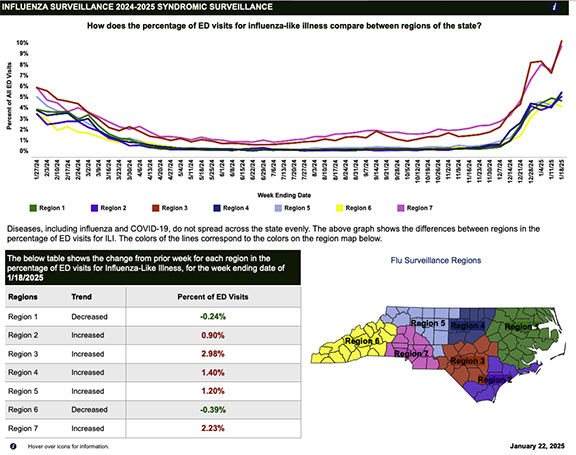
While things are relatively calm here in the far west, flu-like symptoms reported in emergency department visits in and around Charlotte and Fayetteville are four percentage points higher than they were the previous year and increased over the previous week – 2.23% for Charlotte and surrounding counties and 2.98% for a region in and around Fayetteville. The data covers the week ending Jan. 18. Increase rates in and around Raleigh were 1.4%; Wilmington 0.9%, Raleigh 1.4% and the northwest including Boone 1.4%.
The only regions showing declines were the far west, including Cherokee County, at -0.39% and the northeast including Greenville at -0.24%.
Statewide trends
There has been an increase in reported influenza-like illnesses throughout North Carolina. According to the N.C. Public Health Division, the influenza-like illness activity in the state has reached more than 6 percent, and local transmission has increased, Mission Health said in a release.
The numbers compelled Mission Health to initiate visitor restrictions.
“To help reduce the spread of respiratory illness, Mission Health is implementing temporary visitor restrictions, which means that only two visitors per patient may be in the facility and children under age 13 are asked not to visit. Exceptions will be considered as necessary,” Mission Health announced.
This precaution is being implemented at all Mission Health hospitals and affiliates in western North Carolina, including Mission Hospital in Asheville, CarePartners in Asheville, Mission Hospital McDowell in Marion, Transylvania Regional Hospital in Brevard, Blue Ridge Regional Hospital in Spruce Pine, Angel Medical Center in Franklin and Highlands-Cashiers Hospital in Highlands.
“We understand these restrictions may pose a hardship for some, but our utmost concern is for the health and safety of all our patients and our entire community, and we implement restrictions only when absolutely necessary,” Mission Health announced.
“We are also urging community members who become ill with symptoms of the flu to stay home and maintain helpful respiratory etiquette such as covering a cough or sneeze and handwashing. If symptoms worsen, they are advised to contact their primary care provider, seek care at a walk-in clinic such as Mission My Care Now, or call the Mission Health Consult a Nurse at 844-706-8773 for free advice on if and where to seek care.
“It’s important to avoid the emergency room unless there are signs and symptoms of severe illness, as it can expose the patient to other illnesses and expose others to illness as well.”
Visitor restrictions will remain in place until reported flu-like activity decreases.
A call to Vidant Health about the situation at Western Carolina Regional Hospital in Peachtree was not returned.
Flu rates at Cherokee County Schools are not unusually high, according to the school system.
Precautions
Flu vaccinations have been a normal and common preventative against the spread of flu for decades. Vaccinations may have side effects of their own and may not stop someone from contracting flu, but it could likely reduce the severity of flu symptoms.
All flu vaccines for the 2024–25 season are trivalent, meaning they are designed to protect against three flu strains, according to flu.com. These include an influenza A (H1N1) virus, an influenza A (H3N2) virus and an influenza B/Victoria virus.
Type A variants of the flu comprise the majority of test results in hospital tests, according to N.C. Department of Health & Human Services. Of around 3,000 tests, Type A variants comprise more than 95% of positive tests.
These strains were selected based on what researchers anticipated would be the most likely to spread and cause illness during the flu season, according to flu.com.
“During the Southern Hemisphere’s 2024 season, flu vaccines were most effective against A (H3N2) viruses (36.5% effective) and A (H1N1) pdm09 (37.1% effective). Effectiveness against influenza B viruses was not estimated due to low circulation,” according to flu.com.
Flu is a seasonal respiratory illness caused by a virus. It can sometimes have more serious impacts.
Flu outbreaks have forced school closures in Cherokee County in recent years and affected workforce readiness at local businesses and industries.