
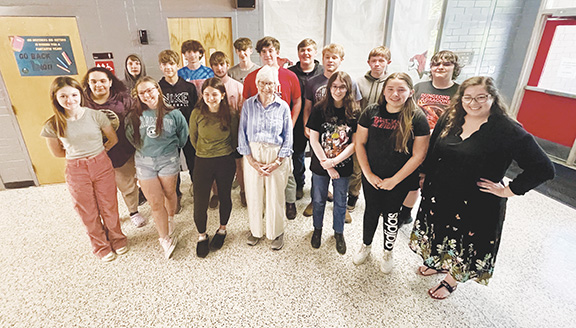
Andrews Imagine hundreds of high-explosive and incendiary bombs from bombers, cruise missiles and rockets – all falling on the Andrews Valley. That’s one message Daphne Irene Minton Sargent shared with sophomores in teacher Nicole Fox’s American history class at Andrews High School on May 22.
Using slides and her own commentary, Sargent gave students a taste of World War II history from someone who witnessed it as a child growing up.
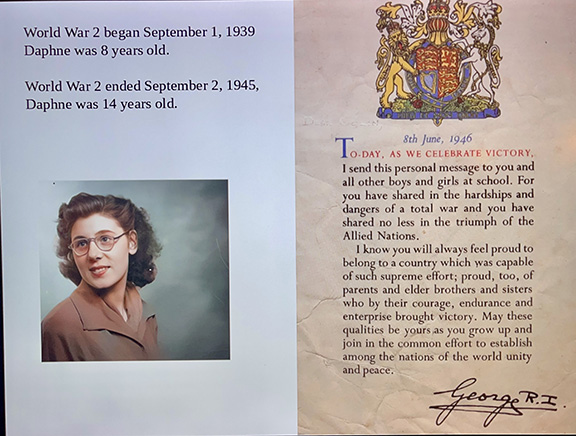
Sargent is in her mid-90s and lives in Andrews today. However, during World War II she was a child growing up in war-torn Bedfont, a town in the London borough of Hounslow, England, not far from Windsor Castle, center of the British Monarchy.
Andrews and Bedfont are both precisely 1.72 square miles in area. Yet, Bedfont today has a population 10 times greater than Andrews Sargent was just 8 years old in September 1939, when the United Kingdom was drawn into WWII. Against warnings triggering war that spanned Europe, North Africa, the Atlantic and Pacific oceans, the Mediterranean Sea, East Asia and Australia.
Along with the rest of the world, the United Kingdom mobilized.
Sargent’s father was a Royal Navy sailor during World War I. He was recalled to active duty along with tens of thousands of other veterans. A draft brought the rest of Britain’s able-bodied men into military and naval service.
At home, school went to half days just three days a week. Bomb shelters were built inside subway tunnels and in trenches covered by corrugated steel and sandbags. Victory gardens were planted wherever seed could take root. Road signs were removed to make it harder for invaders to find their way. Anti-aircraft guns were installed all along the British coastline and around major cities.
And then they waited.
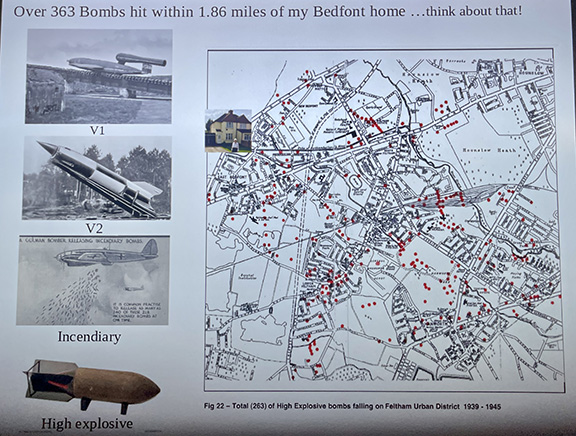
World War II started out slowly in Europe. The first eight months is called “the Phony War,” a period during which there was only one limited military land operation. Within a year, the war’s ferocity grew and the bombs started falling – 363 bombs fell within 2 miles of Sargent’s home in Bedfont.
While her father was away fighting the Battle of the Atlantic, a battle that lasted from 1939 until Germany surrendered in 1945, Sargent was home enduring another famous battle – the Battle of Britain.
The war builds
German forces trapped British and French forces in the French coastal town of Dunkirk. Between May 26 and June 4, 1940, a massive flotilla of civilian and naval vessels evacuated most of the troops, leaving the British Army largely intact and able to continue the fight.
Rather than invade across the English Channel and face the formidable Royal Navy, Germany attacked from the air in an effort to force an armistice between the two countries. Fresh from accepting France’s surrender, Germany hoped to bomb the British into submission, as well.
Between July and October 1940, the Germans used manned bombers and fighter aircraft during the Battle of Britain.
The Battle of Britain is considered Germany’s first loss in World War II, but at great cost. British civilian losses from July to December 1940 were 23,002 dead and 32,138 wounded, with one of the largest single raids occurring on Dec. 19, 1940, when almost 3.000 civilians died.
More terror from the air started in 1944, when Germany developed and deployed the V-1 flying bomb – a pulse-jet cruise missile that delivered a 1,870-pound warhead – and then the V-2 rocket, which delivered a 2,200-pound warhead.
Bombs dropped from airplanes and V-1 bombs could be heard coming and at least prepared the citizens to seek cover.
“We would listen and hope they would go over you,” Sargent said.
British pilots developed strategies against the bombers, fighters and V-1 flying bombs.
The V-2 rocket was a different challenge. It traveled 3,580 mph and could take out whole rows of houses without any advance warning.
No matter how the bombs were delivered, they brought terror wherever they were deployed. During one raid, people sought shelter inside Sargent’s great-aunt’s front porch across the street from St. Paul’s Cathedral in London. They were all killed.
Fit men of all ages were mustered to fight the war, leaving just boys and elderly men along with the female population.
Civilians carried gas masks with them to school and work. Air raid wardens roamed the streets, levying stiff fines on properties where light leaked through poorly sealed windows and doors – whether from an electric bulb or even a dim candle, light could be spotted by bomber pilots searching for targets.
London children were evacuated to the countryside as well as North America, but in September 1940, the cruise ship City of Benares transporting 90 children ages 5-15 from Britain to Canada was sunk by a German submarine. Of 408 aboard, 260 people died, including 77 children.
Public outrage in Britain led then-Prime Minister Winston Churchill to cancel the plan to relocate British children abroad. Still, many children in Bedfont remained, including Sargent.
Nights and sometimes days were spent in bomb shelters, Food was heavily rationed in Great Britain from the start of the war until the mid-1950s. When Princess Elizabeth married Prince Philip in 1947, people from across the nation donated materials for her wedding dress.
In their Victory Gardens, families grew gooseberries, apples, plumbs and rhubarb. With beef and chicken diverted for the war effort, civilians got used to horse, reindeer and whale meat.
One student asked if Sargent ate a lot of horse.
“No,” she replied. “They were kind of expensive, too.”
Milk was available, but only for children and expectant mothers, Sargent said.
She and the other children combed their neighborhoods for scrap paper, metal and bones to contribute to the war effort. Bones? Fat extracted from bone was used to make glue, fertilizer and glycerine, an agent used in high explosives.
Sargent’s father served aboard a destroyer during the Battle of the Atlantic, protecting U.S. and Canadian merchant ships bringing food, weapons, ammunition and other supplies the island nation needed to survive. After the United States joined the war following the Japanese attack on Pearl Harbor on Dec. 7, 1941, ships carried American troops as well.
After the war
When Germany surrendered in April 1945, the Allies celebrated.
“In every street, every town, every city in England, it was one great party,” Sargent said.
During a time of rationing and global war, Saturday night dances were a thing for the young women and soldiers.
It was at one dance where she met her future husband, Roy Sargent. However, that was during the next war, the Korean War, from 1950-53.
Roy was an American serviceman stationed in Great Britain during the Korean War.
The young couple settled in the United States and founded Hawksdene, a bed and breakfast they built near Andrews that they named after their first home together in Britain. They ran the venue for a decade before selling it.
WW II left Sargent’s primary education disrupted. She earned her GED in the United States while raising four children.
Her son, Robin, is a Realtor in Andrews. One student in the class where Sargent spoke was Daisy Sargent, 14, Daphne’s great-granddaughter.