
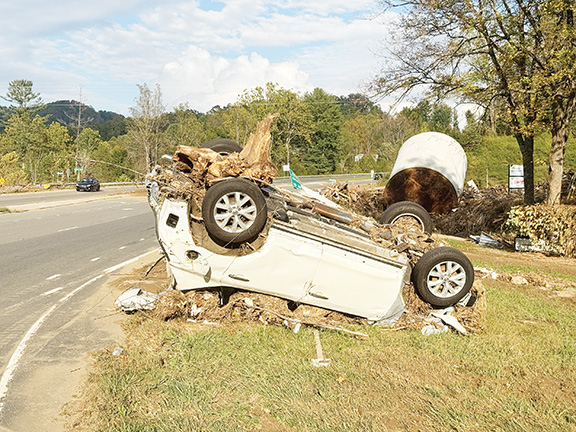
Spruce Pine – This county seat in the scenic mountains northeast of Asheville is experiencing what could have happened in Murphy if the remnants of Hurricane Helene had strayed just a little bit west on Sept. 26-27.
On Sept. 26, Cherokee County residents braced for the worst, but Helene brought just moderate rainfall and disrupted cell phone service. However, in Mitchell County, it was a thousand-year rainfall catastrophe, with hurricane-force winds that took down forests and snapped utility poles with ease.
Flooding undermined highways and railroads, destroyed local bridges and scoured the landscape of homes, churches and businesses. Cars and trucks looked like toys dropped in the mud.
The death toll is still unknown.
Sending for help
The Mitchell News-Journal is the weekly newspaper that covers Spruce Pine and its neighboring communities. It is part of Community Newspapers Inc., a company that includes the Cherokee Scout.
Like all her 14,903 neighbors, News-Journal editor and lone news staffer Mariel Williams had been without electricity, water and cell phone service for more than a week as of Friday.
Across the street from the newspaper office is the railroad and sidings that serve the county’s industries and, beyond the tracks, the North Toe River that swelled and inundated downtown.
The newspaper office was closed as Helene approached, its indispensable computers and unreplaceable archives transported to the regional office in Franklin.
The newspaper office was relatively spared by Helene – just 2 inches of water inside the building. Volunteers helped pull carpet and remove waterlogged baseboards Friday.
The next block down, the elevation dips and restaurants and businesses were inundated. By Friday, lumber, drywall, kitchen equipment, dishes and merchandise were piled 6 feet high in the center of Locust Street.
Construction crews arrived to see about repairing miles of railroad destroyed by flooding. One worker estimated repairs to the railroad would top $500 million and wouldn’t be surprised if part of the line would be abandoned.
On Friday, CNI sent additional staff to help Williams cover this once-in-a-thousand-years disaster. As they traveled Mitchell County to tell its story, it was hard not to see comparisons with Murphy and Cherokee County.
Murphy and Spruce Pine have similar populations, both are centers of government for their counties, both have Walmarts, Walgreens and Ingles as well as myriad small, local businesses – all the things you’d expect in a western North Carolina county seat.
The scene
David Hughes is an assistant volunteer fire chief at Parkway Fire & Rescue. Firefighting runs in the family. His son is the Parkway chief whose day job is fire captain in nearby Marion.
Before Hughes retired, he was a county magistrate and equipment salesman for local industries, including quartz mines and a factory that makes IV bags – two industries that are the largest private employers in the area and which have national and global impacts.
Like everyone else in Mitchell County, Hughes had not showered in more than a week.
The way he described it, highways connecting Mitchell County to its own communities, much less the rest of North Carolina, were blocked for a week before the first big rigs arrived with supplies just the day before.
By Friday, N.C. Army National Guard troops were arriving and N.C. Air National Guard CH-47 Chinook helicopters brought in pallets of drinking water, food and medical supplies. Distribution points were set up at fire houses, churches, key intersections and many seemingly random spots that nevertheless make sense to local people.
The Walmart remained open, operating off generators and selling from on-hand stocks but limiting customers to 15 at a time and accepting cash only. Cash was in limited supply until ATM service was restored at local banks.
As resources arrived, portable showers and clothes washing facilities were installed in the Walmart parking lot.
But the Ingles – one of the large, newer ones with a gas station – was inundated, and its roof collapsed. Hughes wondered whether it would ever reopen. Across the street just off the river banks, above-ground petroleum tanks were knocked over by raging waters of the North Toe River.
The path to neighboring Marion, normally a 15-minute drive via N.C. 226, was a three-hour trek, maybe – and Hughes rattled off a list of local roads only local people would know that might be cleared of fallen trees, with undermined portions given hasty patches of still-warm asphalt.
The specter of death hung everywhere. Hughes said the toll between Mitchell, Avery and Yancey counties had been 147 before updates stopped coming in.
Charlie Hunt is a Spruce Pine lawyer who made his way to Parkway Fire & Rescue outside of Spruce Pine to fill gallon containers with non-potable water to wash and flush his toilets.
He felt lucky – he lost some trees, some of the thousands around the county lost in the storm, but his home escaped damage. He was in good spirits.
Inside the Parkway fire house, N.C. Wildlife Sgt. Dustin Ethridge and Officer Eric Gleason were taking a break after doing welfare checks throughout the county.
Ethridge marveled at how tough people are in Mitchell County. One elderly couple only had bottled water and Vienna sausages, but told him they were fine and urged them to help others.
A volunteer firefighter reported for duty despite having stage 4 cancer and missing chemotherapy treatments.
‘It hurts like hell’
In town at Spruce Pine Fire & Rescue, crews rested and recharged. Two trays of fresh cinnamon rolls were laid out on a table. A hand-washing table outside the main entrance featured warm water – a luxury given the times.
The building had electricity and internet, and state Sen. Ralph Hise Jr., who lives in Spruce Pine, was eating a sandwich from a bagged lunch.
“I’ll bet I’m the only state senator you’ve ever met who hasn’t had a bath or shower in a week,” he said.
Hise was using the fire station as his base of operations, one of the few places where he could be reached by phone. Calling out was another matter, though. Reaching someone local who also had cell service was unlikely, but at least they could call him.
Like Hughes, he was also in the dark about the death toll from Helene.
Spruce Pine Mayor Phillip Hise stopped by. He is Ralph Hise’s uncle. A water plant specialist before he became mayor, Phillip Hise was trying to get water service restored to the town’s water customers, but outflow from the reservoir was a fraction of normal.
“We may need scuba divers to clear a blockage,” he said, adding that the reservoir was covered in a thick layer of fallen trees.
That was the good news. The bad news was that the town’s sewage treatment plant was destroyed.
“It can take four years before we have a new plant operational,” Sen. Hise said.
Firefighters from as far away as New Bern made their way to Mitchell County to relieve local fire crews and free them up to do other work, like clearing fallen trees from the Blue Ridge Parkway. The scenic route was closed with no timeline to reopen, but N.C. 226A, the normal road to Little Switzerland, was impassible and a nearby section of Blue Ridge Parkway was the only alternative.
Also from New Bern was John Wafford, director of disaster relief from the N.C. Assemblies of God Church. He was helping organize a Convoy of Hope delivering a three-to-five-day supply of food and water – 35,000 pounds in all, along with portable generators.
Uphill from the Parkway fire station is a flat piece of property that was being used as a helipad. It was being converted to house 450 relief works and included private, secure sleeping compartments and a general purpose tent.
In Little Switzerland, a community featuring a resort and vacation homes, there was a generator, water and enough goods to provision a small-size Dollar General.
Jennifer Weiss was sitting off to the side with an ice pack on her arm and a fresh EpiPen injection coursing through her veins, with a spare in her pocket.
Over the past year she had become more susceptible to bee stings. Helene had displaced countless nests and one yellow jacket stung her arm, which swelled to twice its normal size.
She owns some AirBnB units nearby and was checking on neighbors’ vacation homes, discarding about 40 pounds of spoiled meat, when she was stung.
“It hurts like hell,” she said. “I’m one of the ones checking on people, not one of the ones who needs help.”