
Murphy – The food truck market grew to $4.11 billion in 2021.
That’s a lot of barbecue sandwiches and curly fries.
The United States alone has more than 30,000 active food trucks operating today. They have always been popular at county fairs and regional events, but when the 2008 recession hit the nation, food trucks began rolling down main streets in larger numbers.
For one thing, the cost of running a bricks-and-mortar restaurant can be financially daunting with having to pay for a lease, utilities, seating and permits. With considerably less overhead, food trucks seem like a reasonable answer for those who love preparing and serving food, but lack a fat wallet.
Food trucks also reflect the tempo and culture of modern life. Humans are at once both independent and social creatures. The traditional values of home-cooked meals around a dinner table shifted as the Industrial Revolution began pulling agrarian family units into urban centers.
Once work separated itself from lifestyle, eating rituals became less about the process of food and more about the product. The late 1950s saw fast-food restaurants invade the nation, making the car seat a new family table. However, it was likely the age of screens that solidified modern eating habits from lingering familial gatherings to quicker, more autonomous service for one.
‘Bring ’em on!’
The cultural landscape today is one of fierce individuality and autonomy. The food truck movement taps into this shift away from a collective conversation by providing single-portion servings, where the customer has minimal contact with other people. Plus, food trucks are fast and specialized, enticing a generation of people entertained by the scroll feature on their screens.
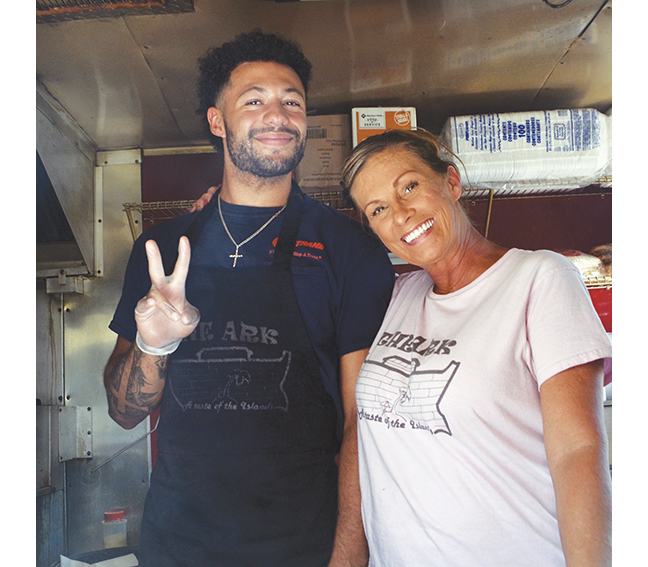
So when food trucks began selling their wares in Cherokee County, they represented a cultural change not everybody was ready to embrace. Lisa McPhee, owner of The Ark, said her food truck started the local movement.
“We were the first ones in the area,” she said proudly during the first Tasty Tuesday food truck event, which was held at the L&N Depot on July 12.
Laura La Chance, downtown development director for Murphy, organized the twice-monthly event. The next one is set from 5-8 p.m. Tuesday, July 26.
“We’ve got three food trucks and two dessert vendors,” she said as residents began lining up for their favorite fares. The tremendous turnout speaks to the interest local consumers have in mobile eateries.
Patrick Keenan, owner and brewer of Buck Bald Brewing, a bricks-and-mortar establishment that celebrated their grand opening with a ribbon-cutting ceremony Friday afternoon, loves the food truck idea.
“Bring ’em on!” he said, pouring beer from a mobile station during Tasty Tuesday. “Little towns like ours don’t tend to have variety. Food trucks bring more people downtown, which means I make more money,” he added with a laugh.
Behind the scenes
Not everybody is convinced that food trucks are such a good idea. The cursory apprehension tends to focus on the myth that food trucks pay no taxes or sewage costs.
Emily David, co-owner of Smokey Mountain BBQ Co., which operates both a food truck and traditional restaurant, explained. “Every food truck is required to attach itself to a commissary kitchen,” she said.
Food trucks use local restaurants to dispose of their gray water. In return, the “overseeing” restaurant receives 10 percent of the food truck’s sales. So in many cases, restaurant owners benefit from having them in town.
In addition, the Cherokee County Health Department, under the jurisdiction of the N.C. Department of Agriculture, requires food trucks adhere to the same standards as brick-and-mortar food establishments.
“Mobile food units (food trucks) are evaluated as a restaurant on wheels,” Sara Smith with the health department said.
That means the trucks must accommodate a three-part sink, tempered water, commercial equipment and the like, as well as submit a Plan Review to receive a certificate of operation. There are added costs, including the permitted commissary fee for water disposal and storage of materials.
“Food truck operators are required to return to the commissary every day” for water disposal and servicing, Smith said. And, of course, all operators are required to pay sales tax.
Capitalism thrives on competition, which is why some restaurateurs welcome food trucks.
“Competition is a good thing,” David said. “It keeps things fresh and moving.”
Briann Beigel, founder of Sweet Pigs Hot Dogs & Catering, said, “They think we’ll ruin their business, but the more food and the more diversity, the more people. There are so many cool shops downtown, and food trucks could help their businesses.”