
Murphy – Cherokee County agencies, churches and citizens are scrambling to put together food relief for thousands of local residents whose SNAP – Supplemental Nutrition Assistance Program – benefits will be disrupted starting Saturday, Nov. 1.
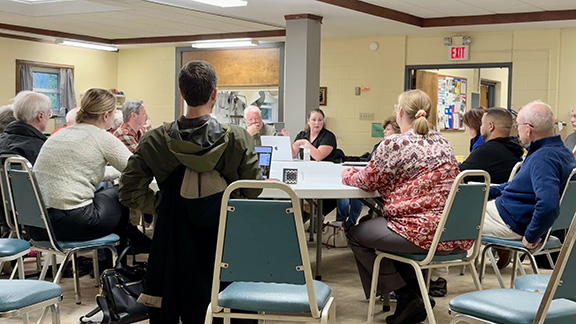
N.C. Cooperative Extension, Cherokee County Department of Social Services, Cherokee County Transit and local churches, nonprofit agencies and individuals have met twice over the last week to create a relief program seemingly out of thin air. The plan, which is still being developed, is to seek and obtain food and monetary donations from the community and use eight existing food banks to distribute food to families affected by the SNAP disruption, which is expected to last until Congress comes up with a budget bill.
The Rev. Wil Posey of Murphy First United Methodist Church, which hosted the meetings, said, “If the federal government shutdown continues, 2,300-plus families will lose food and nutrition benefits starting Nov. 1. That’s a loss of $720,000 in food benefits, and it is also money that goes into our local economy.”
“It’s super scary,” said Amanda McGee, Cherokee County DSS director. “It’s a crisis, it certainly is a crisis.”
On the other hand, McGee said the “community coming together in this crisis is overwhelming. … I felt in awe.”
Marlana Baker, food coordinator for the N.C. Cooperative Extension, Cherokee County Center, said, “The need in our community is urgent. Many of our neighbors – individuals and families right here in Cherokee County – are facing a significant struggle to put food on the table this November.”
Feeding the hungry
SNAP provides monthly benefits to help eligible households buy groceries to maintain proper nutrition and health. Benefits are loaded onto an Electronic Benefits Transfer (EBT) card, which can be used to purchase food at authorized retail stores.
The program is administered by the U.S. Department of Agriculture’s Food & Nutrition Service (FNS) in collaboration with state agencies.
Congress failed to fund the government before the fiscal year ended on Sept. 30, triggering the first government shutdown since 2019. The House of Representatives has approved a continuing resolution that would fund the government through Nov. 21. In the Senate, it takes 60 votes to approve a temporary spending bill – Republicans hold 53 seats – and Democrats say they won’t support such a bill unless Republicans agree, among other things, to extend expiring subsidies for Affordable Care Act premiums.
SNAP is a U.S. Department of Agriculture program. The USDA, on its website, posted:
“Senate Democrats have voted 12 times to not fund the food stamp program, also known as the Supplemental Nutrition Assistance Program. Bottom line, the well has run dry. At this time, there will be no benefits issued Nov. 1. We are approaching an inflection point for Senate Democrats. They can continue to hold out for health care for illegal aliens and gender mutilation procedures or reopen the government so mothers, babies and the most vulnerable among us can receive critical nutrition assistance.”
The USDA’s message isn’t exactly true, or at least omits significant information. The health-care funding it mentions does not benefit illegal aliens, for example, but does benefit many of the same people whose SNAP benefits are set to be interrupted.
The USDA instructed states to delay sending the files needed to load November benefits onto EBT cards. The department also stated it would not use $6 billion in emergency contingency funds to cover the benefits for November. Some states have warned residents that payments may be delayed or halted beginning Nov. 1.
Bills have been introduced, including the “Keep SNAP Funded Act of 2025,” to ensure continued funding, but a broader agreement is needed to end the shutdown.
Other federal changes: The “One Big Beautiful Bill Act of 2025” passed earlier in the year included changes to SNAP eligibility and work requirements, which went into effect on Oct. 1.
The N.C. Department of Health & Human Services said 1.4 million state residents rely on SNAP.
The USDA explained that the federal government would not reimburse any state funds used to cover SNAP benefits. SNAP benefits in North Carolina represent about $230 million to $250 million each month.
“We know how vital these benefits are for children, seniors, and hardworking families in every corner of our state,” Health & Human Services Secretary Dev Sangvai said. “Our priority is to be transparent and provide clear, factual information so families can prepare for a potential delay in benefits. We will continue to process applications and stand ready to issue benefits as quickly as possible once we receive authorization and funding from our federal partners.”
Additionally, NCDHHS does not have funding to maintain benefits past early November for the more than 262,000 people who depend on the Special Supplemental Nutrition Program for Women, Infants & Children. This program provides healthy food, infant formula, nutrition education and breastfeeding support for pregnant women, new mothers and young children. While it is possible the federal government may allocate additional funding, there is no certainty that funding will be received.
NCDHHS is exploring options to maintain these benefits if the state does not receive federal funding for WIC.
What to do
NCDHHS is providing the following guidance for people who depend on food and nutrition benefits:
- Continue to apply and renew: All residents should continue to apply for SNAP benefits and submit renewal paperwork on time. County DSS offices remain open and are processing all applications to prevent a backlog when funding is restored.
- Check your balance: Any benefits on your EBT card are still available to use. Check your balance on the ebtEDGE app, at ebtEDGE.com or by calling the number on the back of your card (1-888-622-7328).
- For help: If you or your family is in immediate need for food resources, please call 2-1-1 to be connected with local resources. You can also visit the NCDHHS website dedicated to food access to find a food pantry closest to you.
Want to help?
- Host a food drive: Rally your business or organization to collect essential items. Find the sign-up form at tinyurl.com/drivefoodcommunity.
- Donate funds: Your tax-deductible gift goes directly to local Cherokee County Food Pantries. Donate at tinyurl.com/givefoodcommunity.
- Volunteer time: Lend a hand at a local food pantry. Sign up at tinyurl.com/volunteerfoodcommunity.
- Food Resource Guide: Visit tinyurl.com/CherokeeCountyresourceguide.